AI Fundamentals
Introduction to Artificial Intelligence
What Is Artificial Intelligence?
Artificial intelligence, or AI, is the science of making machines that can think or act like humans. The core idea is to build systems that can perform tasks that normally require our intelligence, like learning, reasoning, problem-solving, and understanding language.
Think of it this way: instead of programming a computer with a specific set of instructions for every possible scenario, AI aims to give the computer the ability to figure things out on its own.
This could mean anything from an AI that can beat a world champion at chess to one that can diagnose diseases from medical scans or drive a car safely through city streets. The ultimate goal is to create tools that can augment our own abilities and solve complex problems.
A Brief History
The dream of creating intelligent machines has been around for centuries, but the modern field of AI officially began in the summer of 1956. A group of researchers gathered at Dartmouth College for a workshop where they coined the term "artificial intelligence" and laid out the field's ambitious goals.
The early years were filled with excitement and bold predictions. Scientists developed programs that could solve algebra problems and prove logical theorems. But progress was slower than expected. The complexity of creating true intelligence led to periods known as "AI winters," when funding and interest dwindled.
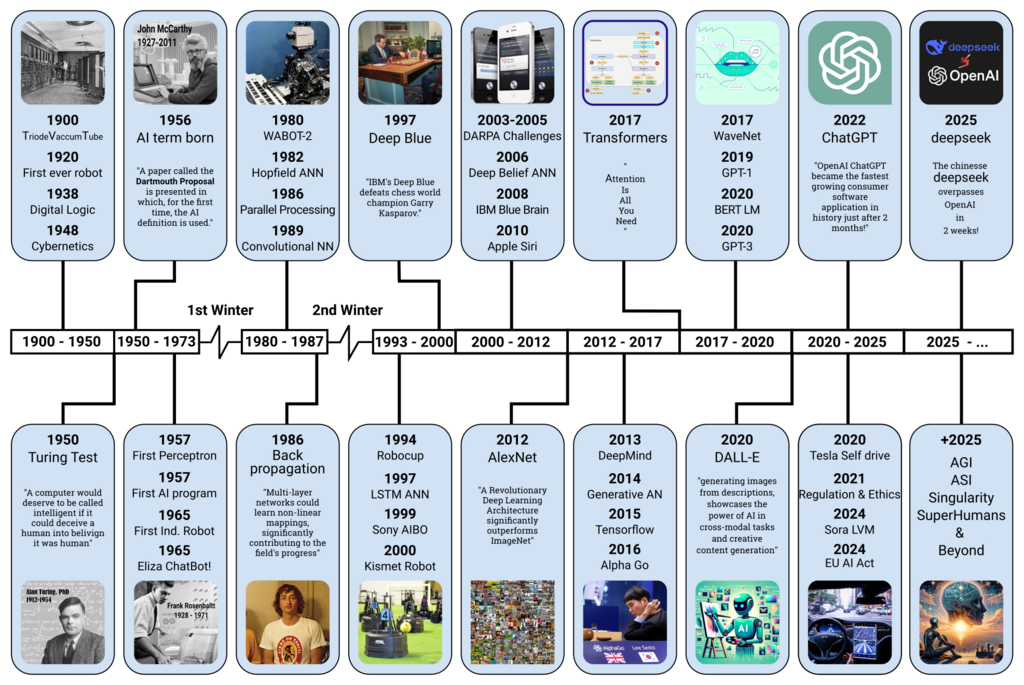
In recent decades, AI has experienced a massive resurgence. This boom is fueled by two key factors: the availability of vast amounts of data from the internet and the development of powerful computers that can process it all. This has allowed AI to move from academic labs into our everyday lives.
The Branches of AI
AI isn't a single technology. It's a broad field with many specialized branches, each focused on a different aspect of intelligence. Let's look at some of the most important subfields.
Machine Learning
noun
A subfield of AI where algorithms are trained on data to find patterns and make predictions without being explicitly programmed for the task.
Machine Learning (ML) is one of the most common forms of AI today. Instead of writing code to tell a program how to recognize a cat, you show a machine learning model thousands of cat photos. The model learns the patterns—pointy ears, whiskers, feline eyes—and can then identify cats in new images it has never seen before. This is the technology behind your Netflix recommendations and your bank's fraud detection alerts.
A powerful subset of ML is Deep Learning. It uses complex structures called neural networks, which are loosely inspired by the connections in the human brain. Deep learning is particularly good at handling very complex patterns, making it the driving force behind technologies like facial recognition and self-driving cars.
Natural Language Processing
noun
The branch of AI focused on enabling computers to understand, interpret, and generate human language, both text and speech.
Natural Language Processing (NLP) aims to bridge the communication gap between humans and computers. Every time you talk to a virtual assistant, use a translation app, or see a chatbot pop up on a website, you're interacting with NLP. It's the technology that allows machines to work with our messy, nuanced, and often ambiguous languages.
Robotics
noun
A field that involves the design, construction, operation, and use of robots. It integrates AI to give robots the ability to perceive and respond to the physical world.
When AI is given a physical body, you get robotics. This branch of AI focuses on creating machines that can move and interact with the world. While simple robots might just repeat a single task on an assembly line, AI-powered robots can perceive their environment using sensors, make decisions, and adapt their actions. This is crucial for applications like warehouse automation, surgical assistance, and planetary exploration.
What is the primary goal of Artificial Intelligence?
The term "artificial intelligence" was first coined at a workshop held at which institution?
These subfields often overlap, working together to create the sophisticated AI applications we see today. Understanding these core concepts is the first step to grasping the power and potential of artificial intelligence.