AI Fundamentals for Newcomers
Introduction to Artificial Intelligence
What Is Artificial Intelligence?
Artificial intelligence is the science of making machines that can think and act like humans. At its core, AI is about creating systems that can perform tasks that typically require human intelligence. This includes things like learning from experience, understanding language, recognizing objects, solving problems, and making decisions.
Artificial Intelligence
noun
A field of computer science dedicated to creating systems capable of performing tasks that normally require human intelligence, such as visual perception, speech recognition, decision-making, and translation between languages.
Think of it this way: when you teach a dog to fetch, you're using principles of learning. AI researchers do something similar, but with computer programs. They design algorithms that allow machines to process vast amounts of data, identify patterns, and make predictions or recommendations. The goal isn't just to mimic human actions, but to understand the underlying intelligence that drives them.
A Quick Trip Through Time
The idea of intelligent machines has been around for centuries, but the formal field of AI research began in the summer of 1956 at a workshop at Dartmouth College. There, a group of scientists coined the term "artificial intelligence" and set out on a journey to build machines that could think.
The path wasn't always smooth. The early excitement was followed by periods known as "AI winters," when funding dried up and progress slowed. But breakthroughs in computing power and the explosion of digital data in recent decades have led to a massive resurgence. Today, AI is one of the fastest-growing fields in technology.

The Three Types of AI
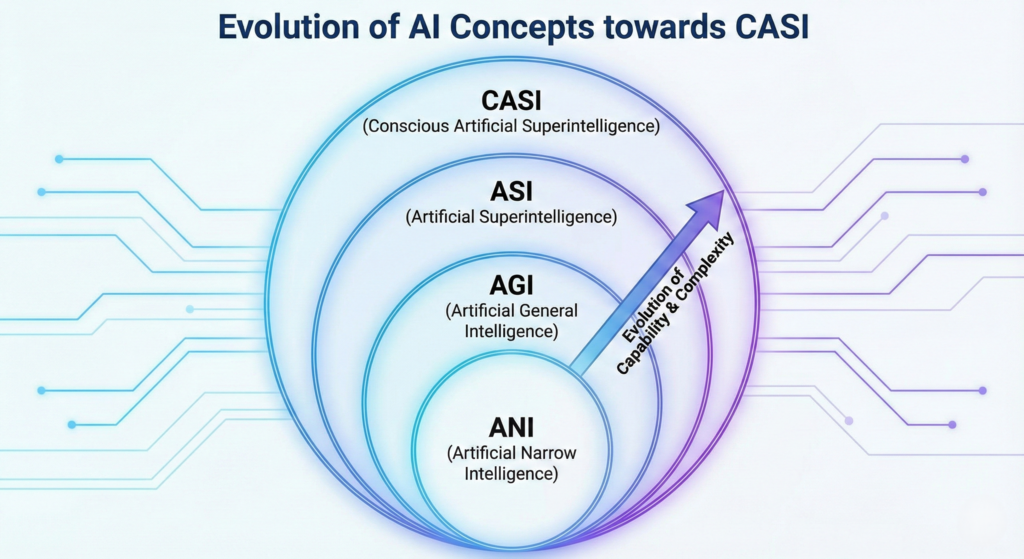
When we talk about AI, it's helpful to break it down into three categories based on its capabilities. These categories help us understand where the technology is today and where it might be headed.
Artificial Narrow Intelligence (ANI): This is the only type of AI that exists today. ANI is designed to perform a single, specific task very well. It operates within a limited context and can't perform tasks beyond its programming. Your spam filter, a chess-playing computer, and the recommendation engine on a streaming service are all examples of Narrow AI.
Artificial General Intelligence (AGI): This is the next step, and it's still purely theoretical. AGI refers to a machine with the ability to understand, learn, and apply its intelligence to solve any problem, much like a human being. An AGI could switch from writing a poem to navigating an unfamiliar city without needing to be retrained.
Artificial Superintelligence (ASI): The final, and most speculative, stage is ASI. This is an intellect that is much smarter than the best human brains in virtually every field, including scientific creativity, general wisdom, and social skills. The concept of ASI raises profound questions about the future of humanity and technology.
AI vs. Human Brains
So how does artificial intelligence stack up against our own? While both can process information and learn, they do so in fundamentally different ways.
Human intelligence is broad, adaptable, and deeply intertwined with consciousness and emotions. We can handle novel situations, understand social cues, and draw on a lifetime of experiences to make judgments. Our thinking is flexible and often intuitive.
AI, on the other hand, excels at tasks that involve processing massive datasets with speed and accuracy. It can spot patterns invisible to the human eye and perform complex calculations in an instant. However, current AI lacks common sense, emotional understanding, and true creativity. It operates based on logic and data, not feelings or intuition.
| Feature | Human Intelligence | Artificial Intelligence (Current) |
|---|---|---|
| Speed | Slower processing | Extremely fast data processing |
| Consistency | Variable, prone to fatigue | Highly consistent and reliable |
| Adaptability | High, can handle new situations | Low, limited to programmed tasks |
| Learning | Requires experience, can be slow | Learns from massive datasets quickly |
| Multitasking | Limited, sequential focus | Excellent at parallel processing |
| Creativity | Genuine, based on experience | Can generate novel outputs but lacks true understanding |
| Emotion | Integral part of thinking | Lacks genuine emotion and consciousness |
AI is a powerful tool designed by humans to augment our own abilities. It's less like a rival and more like a specialized calculator that can handle data on an incredible scale.
AI in the Real World
You probably interact with AI every day without even realizing it. It's already woven into the fabric of modern life across countless industries.
In healthcare, AI helps doctors diagnose diseases earlier and more accurately by analyzing medical images like X-rays and MRIs. It also powers personalized treatment plans based on a patient's genetic makeup.
Finance uses AI to detect fraudulent transactions in real-time and to create automated trading strategies. Banks use AI-powered chatbots to handle customer service inquiries around the clock.
In the entertainment world, streaming services use AI to recommend movies and music tailored to your tastes. Video game developers use AI to create realistic and challenging non-player characters.
Transportation is being transformed by AI, from navigation apps that find the fastest route by analyzing traffic patterns to the development of self-driving cars that can perceive their environment and make driving decisions.
This is just the beginning. As AI technology continues to evolve, its impact on our lives will only grow, creating new opportunities and challenges along the way.