AI Fundamentals for Infrastructure Professionals
Introduction to Artificial Intelligence
What Is Artificial Intelligence?
Artificial Intelligence, or AI, is the field of computer science dedicated to creating machines that can perform tasks that typically require human intelligence. This includes abilities like learning from experience, solving problems, understanding language, and recognizing patterns in the world around us.
The idea isn't new, but the term itself was coined in 1956 at a workshop at Dartmouth College. Early AI research focused on creating systems that followed explicit, hand-coded rules. Over the decades, the field has transformed, moving from rigid logic to systems that can learn and adapt on their own.
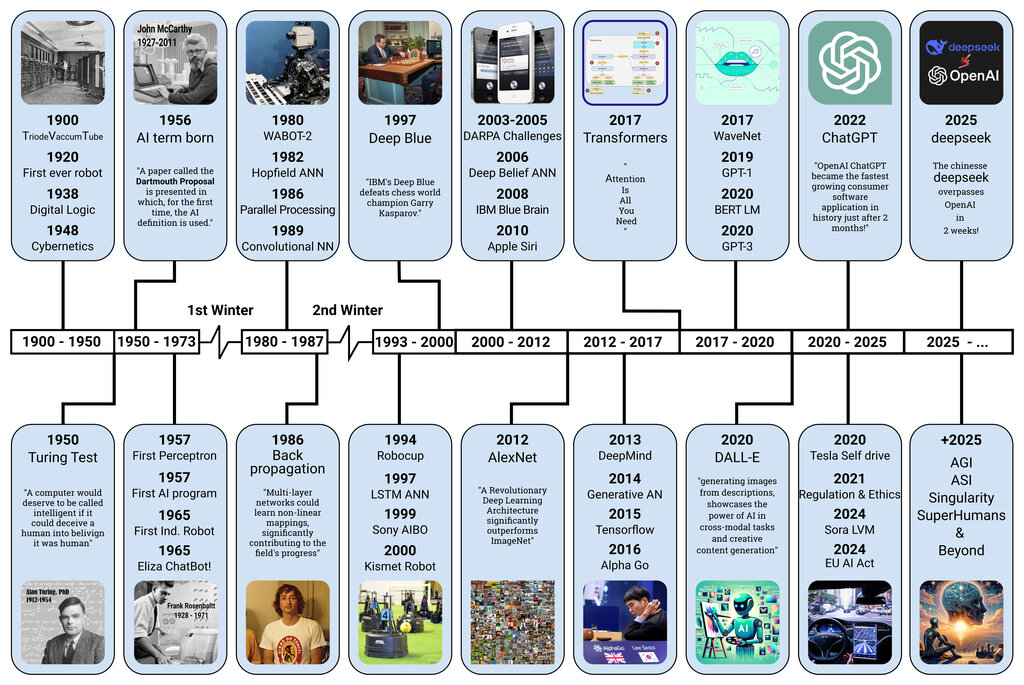
This evolution didn't happen overnight. It was driven by new ideas and, just as importantly, new technology that could bring those ideas to life.
From Rules to Learning
The first wave of AI was all about rules. Programmers would write detailed instructions to guide a machine's behavior. Think of a simple chess program: you tell it the rules of each piece and some basic strategies. This approach, known as symbolic AI, could solve well-defined problems but struggled with the messiness of the real world.
A major shift came with Machine Learning (ML). Instead of feeding a computer rules, developers started feeding it data. An ML model sifts through thousands of examples, finds patterns, and learns to make predictions. You don't tell it what a cat looks like; you show it ten thousand cat photos, and it figures out the features that define "catness."
Deep Learning (DL) is a powerful type of machine learning that takes this a step further. It uses complex structures called neural networks, loosely inspired by the human brain, to find intricate patterns in massive datasets. Deep learning is behind many of today's most impressive AI feats, from voice assistants to medical image analysis.
Most recently, Generative AI has emerged as a branch of deep learning. These models don't just recognize patterns; they use what they've learned to create entirely new content, like images, text, or music.
The Hardware Revolution
The ideas behind deep learning have been around for a long time, but for decades we lacked the computational power to make them practical. The breakthrough came from an unexpected place: video games.
Graphics Processing Units (GPUs) were designed to render complex 3D graphics, a task that involves performing many simple calculations at the same time. Researchers discovered that this parallel processing architecture was also perfect for training deep learning models, which involve similar math. GPUs could train models in hours or days, a process that would have taken weeks or months on traditional CPUs (Central Processing Units).
This hardware acceleration unlocked the potential of deep learning and kicked off the modern AI boom. Without the massive parallel computing power of GPUs, today's advanced AI systems simply wouldn't exist.
GPUs do many simple things at once (parallelism), while CPUs do a few complex things very quickly (serial processing). AI training requires the GPU's approach.
Software and Deployment
Powerful hardware is only one part of the equation. A complete software stack is needed to connect AI algorithms to the underlying hardware efficiently. This stack includes everything from low-level drivers that communicate with the GPU to high-level programming frameworks like TensorFlow and PyTorch, which give developers the tools to build and train models.
An optimized software stack ensures that every piece of hardware is used to its full potential, minimizing wasted resources and speeding up development. It's the essential bridge that makes AI development accessible and performant.
Once a model is built and trained, it needs to be deployed somewhere to run. There are two primary environments for this:
- Data Centers: These are private, on-premises facilities owned and operated by a single organization. They offer maximum control over security and hardware but require significant investment and maintenance.
- The Cloud: This involves renting computing resources from a provider like Amazon Web Services (AWS), Google Cloud, or Microsoft Azure. The cloud offers flexibility, scalability, and access to the latest hardware without the upfront cost of building a data center.
| Feature | Data Center | Cloud |
|---|---|---|
| Control | High | Low |
| Upfront Cost | High | Low |
| Scalability | Limited | High |
| Maintenance | Managed internally | Managed by provider |
The choice between a data center and the cloud depends on an organization's specific needs regarding cost, security, and scalability.
Now, let's test your understanding of these foundational ideas.
Which statement accurately describes the shift from early AI to modern Machine Learning (ML)?
The development of Graphics Processing Units (GPUs) was the key hardware innovation that accelerated the modern deep learning boom.
Understanding these core concepts, from the historical evolution to the hardware and software that power it, provides a solid foundation for exploring the world of AI.