AI Fundamentals for Business Innovators
Introduction to Artificial Intelligence
What Is AI Anyway?
Artificial intelligence is about making machines smart. It's a field of computer science focused on creating systems that can perform tasks that typically require human intelligence. This includes things like learning, reasoning, problem-solving, understanding language, and perceiving the world around them.
Artificial Intelligence
noun
The theory and development of computer systems able to perform tasks that normally require human intelligence, such as visual perception, speech recognition, decision-making, and translation between languages.
At its core, AI is about building machines that don't just follow instructions but can also learn from experience. Instead of a programmer writing explicit, step-by-step rules for every possible situation, an AI system learns its own rules by analyzing huge amounts of data. This ability to learn is what makes AI so powerful and versatile.
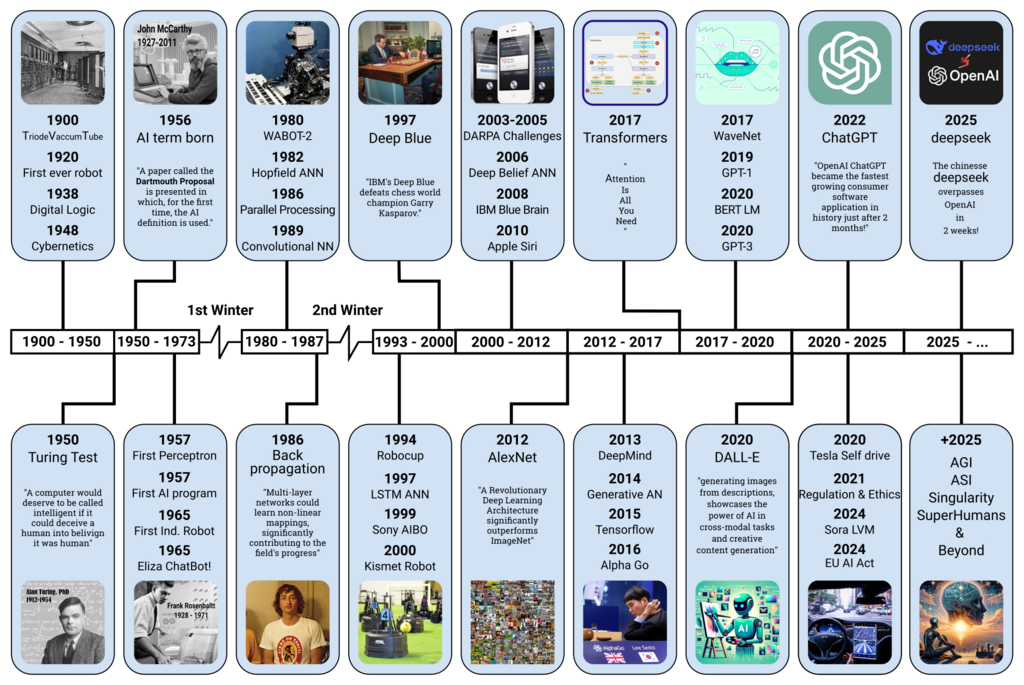
The idea isn't new. The term "artificial intelligence" was coined back in 1956 at a conference at Dartmouth College. Early researchers were optimistic, believing that a machine as intelligent as a human was just a few decades away. The journey turned out to be much harder, with periods of slow progress known as "AI winters." But thanks to massive increases in computing power and the availability of vast datasets, AI has boomed in recent years.
Two Flavors of AI
When people talk about AI, they are usually referring to one of two types: Narrow AI or General AI.
All the AI we use today is Narrow AI. It's designed to perform a single task and is incredibly good at it.
Think of the virtual assistant on your phone, the algorithm that recommends shows on streaming services, or the software that recognizes faces in photos. These systems are highly specialized. A recommendation engine can suggest movies with uncanny accuracy, but it can't drive a car or diagnose a medical condition. It operates within a limited, pre-defined range.
The other type is Artificial General Intelligence (AGI), or Strong AI. This is the kind of AI you see in science fiction movies—a machine with the ability to understand, learn, and apply its intelligence to solve any problem, just like a human. AGI would be able to switch contexts, reason abstractly, and demonstrate common sense.
It's important to remember that AGI is still a theoretical concept. We haven't created it yet, and researchers are still debating how we might get there. For now, every AI application in the world is a form of Narrow AI.
How AI Works
So, how does a machine learn to perform these specialized tasks? It relies on a few core principles, starting with data.
Data is the lifeblood of modern AI. An AI system learns by being fed vast quantities of information.
This is called data-driven learning. To teach an AI to recognize cats, you show it thousands of pictures labeled "cat." Over time, the system begins to identify the common features—whiskers, pointy ears, furry tails—that define a cat. This process of sifting through data to find underlying features is known as pattern recognition.
AI systems don't just find patterns; they use them to make predictions or decisions. Once it knows what a cat looks like, it can identify a cat in a new, unlabeled photo.
Finally, these systems are designed for optimization. They constantly adjust their internal parameters to get better at their task. For an AI that plays a game, optimization means finding the moves that are most likely to lead to a win. For a navigation app, it means finding the fastest route from point A to point B. This process of continuous improvement is what makes AI systems so effective.
These three principles—learning from data, recognizing patterns, and optimizing for a goal—are the foundation of almost every modern AI application. From recommending your next purchase to translating languages in real-time, it all comes back to these fundamental ideas.
What is the primary focus of the field of artificial intelligence?
The type of AI that can recommend a movie but cannot drive a car is known as:
AI is no longer just a concept from science fiction. It's a powerful tool that's already reshaping our world in countless ways.