AI Fundamentals Explained
AI History
From Symbols to Statistics
The earliest attempts at artificial intelligence were rooted in a simple, elegant idea: if human thinking is based on logic and rules, then we can recreate intelligence by programming those rules into a machine. This approach, known as symbolic AI or "Good Old-Fashioned AI" (GOFAI), treated intelligence as a matter of symbol manipulation. Researchers believed they could codify human knowledge into a vast set of explicit if-then rules.
The peak of this philosophy was the expert system. These programs were designed to mimic the decision-making of a human expert in a specific, narrow field. For example, a geologist might consult an expert system to help identify mineral deposits, or a doctor could use one to diagnose an infection. They worked by chaining together logical rules fed to them by domain experts. However, they were brittle. If a situation arose that wasn't covered by the rules, the system would simply fail. They also struggled with uncertainty and couldn't learn from new data, making them difficult and expensive to maintain.
The Cold and Quiet Years
The grand promises of symbolic AI eventually collided with reality. Progress stalled, and the immense practical difficulties of building truly intelligent systems became clear. This led to periods known as "AI winters," where disillusioned funding agencies cut their support and public interest waned. The hype bubble had burst.
During the AI winters, the field contracted significantly. Researchers learned a hard lesson: creating intelligence was far more complex than just writing down rules.
The first major winter occurred in the mid-1970s, followed by another in the late 1980s and early 1990s. The limitations of expert systems and the failure to achieve ambitious goals like real-time language translation led to a widespread perception that AI was a dead end. Yet, it was in the quiet of these winters that the seeds of the next revolution were sown.
The Statistical Revolution
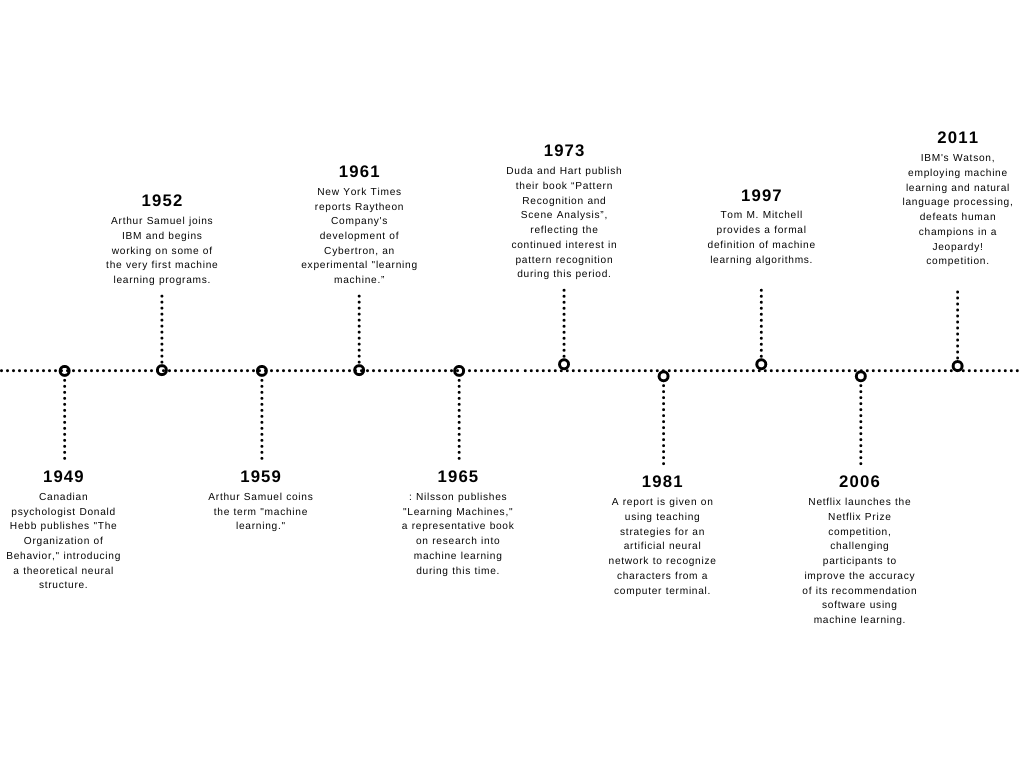
As the symbolic approach faded, a new paradigm emerged: statistical machine learning. Instead of trying to hand-craft intelligence with rules, researchers began building systems that could learn patterns directly from data. This was a fundamental shift. The focus moved from logic to probability. Algorithms like decision trees, support vector machines, and Bayesian networks became central to the field.
This data-driven approach proved far more robust and flexible. A system designed to identify spam email wasn't programmed with explicit rules about what spam looks like. Instead, it was trained on thousands of examples of spam and legitimate emails, learning to associate certain words, phrases, and patterns with a high probability of being junk. This method could handle ambiguity and adapt as new data became available.
The Rise of Deep Learning
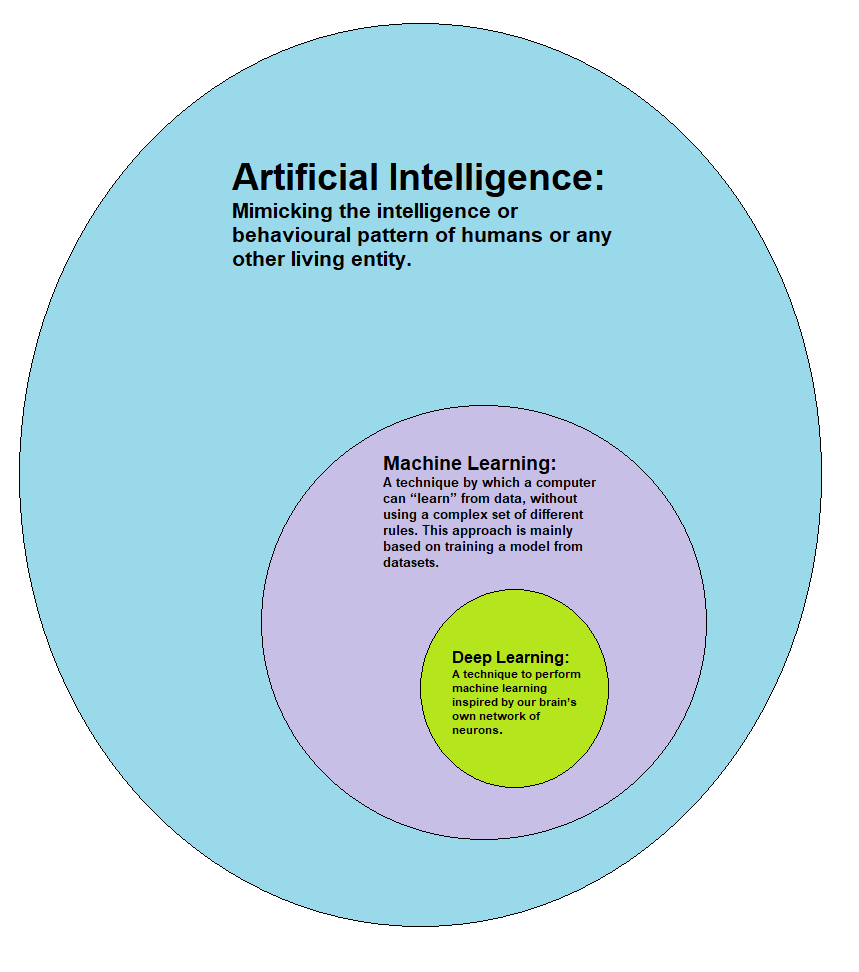
The current era of AI is defined by deep learning, a subfield of machine learning that took the statistical approach to another level. Deep learning is based on artificial neural networks with many layers—hence the term "deep." These networks are loosely inspired by the structure of the human brain.
While the basic concepts of neural networks had existed for decades, three key factors converged in the early 2010s to unlock their potential:
- Big Data: The internet created vast datasets perfect for training complex models.
- Hardware: The development of powerful GPUs (Graphics Processing Units), originally for gaming, provided the massive parallel computing power needed to train deep networks.
- Algorithmic Advances: Researchers developed better techniques to train very deep networks without them failing.
This convergence led to dramatic breakthroughs, particularly in computer vision and natural language processing. In 2012, a deep learning model called AlexNet shattered records in the ImageNet image recognition competition. This moment is often cited as the "big bang" of the deep learning era, proving that these models could outperform all previous methods by a wide margin. From there, the technology quickly advanced, leading to the sophisticated generative models and large language models in use today.
Ready to test your knowledge of AI's journey?
What was the fundamental principle behind the earliest approach to artificial intelligence, known as Symbolic AI or "Good Old-Fashioned AI"?
An expert system designed in the 1980s to diagnose plant diseases is given a plant with a completely new, undocumented virus. What would be the most likely outcome?
The history of AI is not a straight line but a series of cycles—from logic-driven systems to data-driven learning, each phase building on the successes and failures of the last.