AI Fundamentals Explained
Introduction to AI
What Is AI?
At its core, Artificial Intelligence is about creating machines that can think, learn, and act like humans. It's a broad field of computer science focused on building smart systems capable of performing tasks that typically require human intelligence. This includes things like understanding language, recognizing patterns, solving problems, and making decisions.
Artificial Intelligence
noun
A field of computer science dedicated to creating systems that can perform tasks that normally require human intelligence.
Think about how you recognize a friend in a photo or choose the best route to work. These tasks feel simple to us, but they involve complex processing. AI aims to replicate these abilities in machines, allowing them to interpret data, learn from it, and use that knowledge to achieve specific goals.
A Brief History of AI
The dream of intelligent machines has been around for centuries, but the formal journey of AI began in the mid-20th century. A pivotal moment was the Dartmouth Conference in 1956. This summer workshop is widely considered the birth of AI as a field of study.
It was at the 1956 Dartmouth Conference that the term “Artificial Intelligence” was first coined by computer scientist John McCarthy, setting the stage for decades of research to come.
Early research was filled with excitement and optimism. One of the first fascinating creations was ELIZA, a computer program developed in 1966. ELIZA could simulate a conversation with a psychotherapist by recognizing keywords in a user's typed sentences and reflecting them back as questions. While simple by today's standards, it was a groundbreaking demonstration of a machine interacting with a human in natural language.
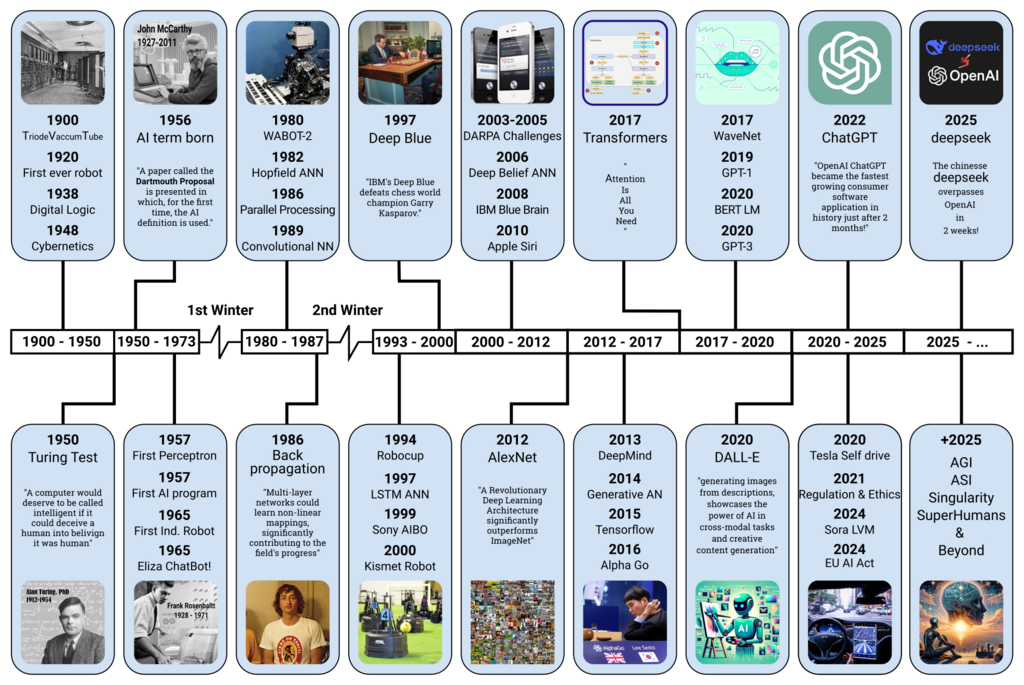
The path of AI wasn't always smooth. It has seen periods of rapid progress followed by "AI winters," where funding and interest waned due to overly ambitious promises. However, advancements in computing power and the availability of massive amounts of data have fueled the incredible progress we see today.
The Flavors of AI
AI isn't just one thing; it's a collection of specialized subfields, each tackling different aspects of intelligence. Understanding these branches helps clarify what AI can do.
| Subfield | Goal |
|---|---|
| Machine Learning | Enabling systems to learn and improve from experience without being explicitly programmed. |
| Natural Language Processing (NLP) | Helping computers understand, interpret, and generate human language. |
| Robotics | Designing and building robots that can perform tasks in the physical world. |
| Computer Vision | Allowing machines to see and interpret visual information from the world, like images and videos. |
These fields often overlap. For example, a self-driving car uses computer vision to "see" the road, machine learning to make driving decisions, and robotics to control the car's physical movements. Together, these branches are pushing the boundaries of what's possible.
What is the primary goal of Artificial Intelligence?
Which event is widely considered the birth of AI as a formal field of study?
From its conceptual beginnings to its modern applications, AI has evolved into a powerful and transformative technology.