AI Fundamentals Explained
Introduction to Artificial Intelligence
What Is Artificial Intelligence?
Artificial Intelligence, or AI, is a broad field of computer science focused on creating machines that can perform tasks that typically require human intelligence. This includes abilities like learning, reasoning, problem-solving, understanding language, and perceiving the world around them.
Think of it less as building a robot that looks human and more as programming a computer to think or act rationally. The goal can be to mimic human thought processes or, more practically, to create systems that make optimal decisions to achieve a specific goal, whether that's recommending your next favorite movie or navigating a car through traffic.
AI isn't a single technology. It's an umbrella term for a wide range of methods and tools that enable machines to simulate intelligent behavior.
AI systems can be simple, like an app that recognizes your face to unlock your phone, or incredibly complex, like a program that can compose music or help scientists discover new medicines. The scope is vast and constantly expanding as technology advances.
A Brief History of AI
The dream of creating intelligent machines has been around for centuries, but the formal field of AI research began in the mid-20th century. A pivotal moment was the Dartmouth Workshop in 1956, where the term "Artificial Intelligence" was officially coined.
Early research was filled with optimism. Pioneers developed programs that could solve algebra problems and prove logical theorems. But the complexity of creating true intelligence was far greater than anticipated. This led to periods of reduced funding and interest known as "AI winters," when progress seemed to stall.
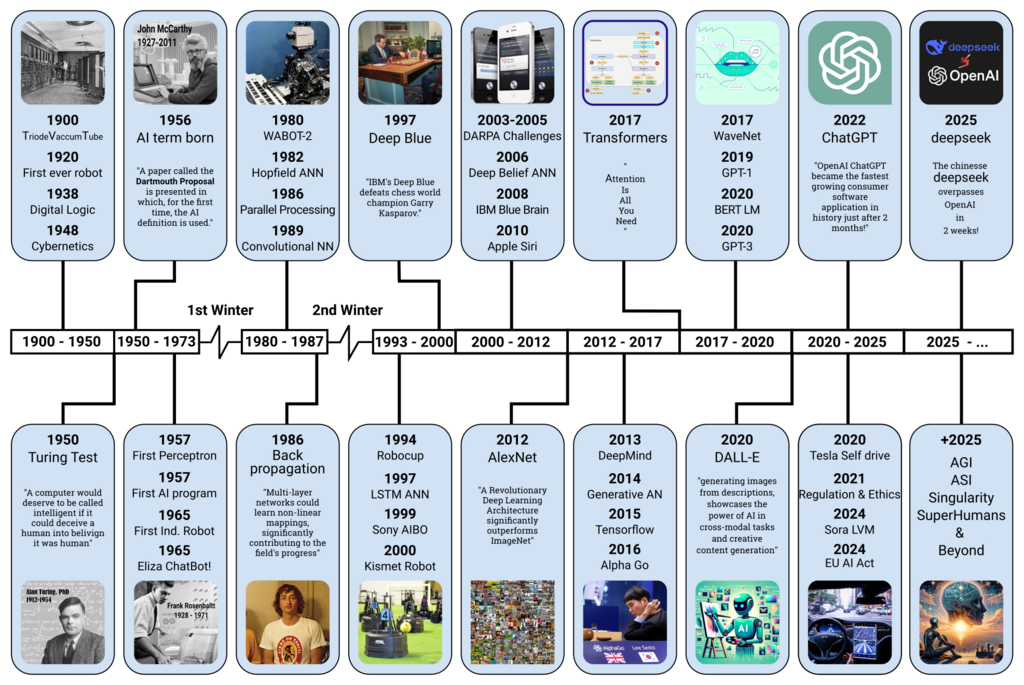
Things began to change in the 1980s and 90s with the rise of a new approach called machine learning. Instead of trying to write explicit rules for every possible situation, researchers focused on creating algorithms that could learn patterns directly from data.
This shift, combined with the explosion of the internet, massive datasets, and vastly more powerful computers, fueled the AI revolution we see today. Landmark events like IBM's Deep Blue defeating chess champion Garry Kasparov in 1997 and the recent rise of generative AI like ChatGPT showed the world what AI was becoming capable of.
AI, ML, and Deep Learning
The terms Artificial Intelligence, Machine Learning (ML), and Deep Learning (DL) are often used interchangeably, but they represent distinct concepts with a clear hierarchy.
Artificial Intelligence (AI) is the entire universe of creating intelligent systems. It's the big idea that encompasses everything else.
Machine Learning (ML) is a subset of AI. It's a specific approach to achieving AI by training a system on data. Instead of programming a computer with hard-coded rules, you let it learn the rules itself. For example, to build a spam filter with ML, you'd feed it thousands of emails already labeled as "spam" or "not spam," and the algorithm would learn to identify the patterns associated with junk mail.
Deep Learning (DL) is a subfield of machine learning. It uses complex, multi-layered structures called neural networks, which are loosely inspired by the human brain. Deep learning is particularly powerful for finding subtle patterns in very large and complex datasets, like images or audio. It's the technology behind self-driving cars recognizing pedestrians and voice assistants understanding your commands.
AI in the Real World
Artificial intelligence isn't just a concept from science fiction; it's already integrated into many aspects of our daily lives. From simple conveniences to complex industrial processes, AI is working behind the scenes across numerous industries.
| Industry | Application of AI |
|---|---|
| Healthcare | Analyzing medical images like X-rays to detect diseases earlier, predicting patient outcomes, and discovering new drugs. |
| Finance | Detecting fraudulent transactions, automating stock trading, and providing personalized financial advice. |
| Retail | Recommending products you might like, managing inventory, and personalizing the shopping experience. |
| Transportation | Powering self-driving cars, optimizing traffic flow in cities, and planning the most efficient delivery routes. |
| Entertainment | Curating playlists on music streaming services and recommending shows on platforms like Netflix. |
| Manufacturing | Using robots for assembly line tasks and predicting when machinery will need maintenance to prevent breakdowns. |
This foundational knowledge sets the stage for understanding how these powerful tools are built and applied. By grasping the core concepts and their distinctions, you can better appreciate the specific models and techniques that drive the world of AI.