AI Fundamentals Explained
Introduction to Artificial Intelligence
What Is Artificial Intelligence?
Artificial intelligence is the science of making machines that can think or act intelligently. It's a broad field with a simple goal: to create systems that can perform tasks that normally require human intelligence. This includes things like learning from experience, understanding language, recognizing objects and people, and solving complex problems.
Think of it less as creating a single thinking machine and more as developing a set of tools and techniques. These tools allow computers to find patterns in data, make predictions, and adapt their behavior without being explicitly programmed for every single step.
Artificial Intelligence
noun
A field of computer science dedicated to creating systems capable of performing tasks that typically require human intelligence, such as visual perception, speech recognition, decision-making, and translation between languages.
At its core, AI is about building systems that can learn and reason. Instead of a programmer writing rigid, step-by-step instructions, an AI model learns its own rules by analyzing vast amounts of information.
The Journey of AI
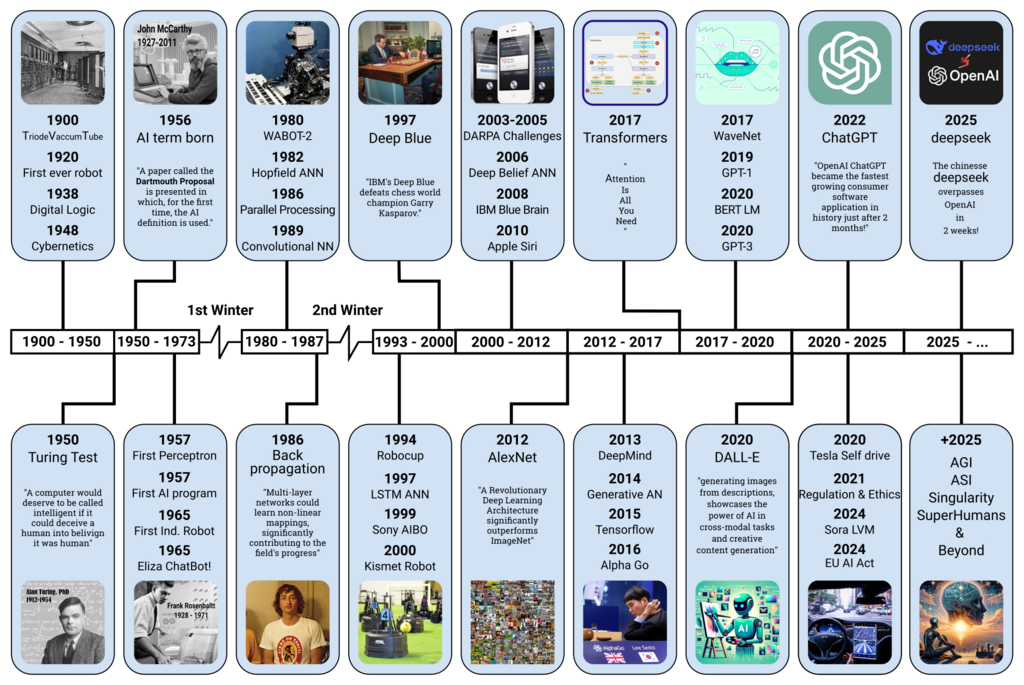
The dream of intelligent machines is ancient, but the scientific journey began in the mid-20th century. The field was officially born in 1956 at a workshop at Dartmouth College, where the term "Artificial Intelligence" was first used. Early researchers were incredibly optimistic, believing that a machine with human-like intelligence was just a few decades away.
However, progress was slower than expected. The complexity of creating intelligence was far greater than anticipated, and computing power was limited. This led to periods known as "AI winters," when funding dried up and interest waned. Researchers realized that building general intelligence was a monumental task, so they began focusing on solving more specific, or "narrow," problems.
This shift from creating a single "thinking machine" to solving specific tasks with intelligent systems was a major turning point in the history of AI.
The 1990s brought a resurgence. A new approach called machine learning gained traction. Instead of trying to write rules for intelligence, engineers created algorithms that could learn from data. A landmark moment came in 1997 when IBM's Deep Blue, a chess-playing computer, defeated the world champion Garry Kasparov.
The real explosion in AI capabilities began in the 2010s, fueled by two key ingredients: the availability of massive datasets (thanks to the internet) and the development of much more powerful computers. This combination powered the rise of deep learning, a subfield of machine learning that uses complex neural networks to achieve remarkable results in everything from recognizing images to understanding human speech.
Why AI Matters Now
AI is no longer just a concept in a research lab; it's a technology that is actively shaping our world. Its significance lies in its ability to automate complex tasks and provide insights from data at a scale humans cannot match.
From the recommendation engines that suggest what to watch next, to the navigation apps that find the fastest route, AI is working behind the scenes in many of the tools we use every day. It's helping doctors diagnose diseases earlier, scientists model climate change, and artists create new forms of expression.
The power of modern AI is its ability to learn and adapt, making it a general-purpose technology that can be applied to nearly any field.
Understanding the basics of AI is becoming essential for navigating contemporary society. It's a tool that amplifies human capability, changing how we work, communicate, and solve problems. As the technology continues to evolve, its impact on our lives will only grow.
What is the fundamental goal of Artificial Intelligence?
The term 'Artificial Intelligence' was first formally introduced at a workshop in 1956. Where did this event take place?