AI Fundamentals Explained
Introduction to AI
What is Artificial Intelligence?
Artificial intelligence, or AI, is about creating machines and computer programs that can think, learn, and solve problems like a human. It's a broad field in computer science focused on building smart systems that can perform tasks that would normally require human intelligence.
This introduction to this special issue discusses artificial intelligence (AI), commonly defined as “a system’s ability to interpret external data correctly, to learn from such data, and to use those learnings to achieve specific goals and tasks through flexible adaptation.”
Think of it this way: when you learn to ride a bike, you're not given a set of rigid instructions for every possible situation. You learn by trying, falling, and adjusting. You interpret the feel of the bike, learn from your mistakes, and adapt your balance to stay upright. AI systems work in a similar way, but with data instead of physical experience.
Artificial Intelligence
noun
A field of computer science dedicated to creating systems capable of performing tasks that typically require human intelligence, such as learning, reasoning, and problem-solving.
The Goals of AI
The ultimate goal of AI is to create technology that can function intelligently and independently. This broad objective breaks down into several key areas. Researchers are working to build systems that can reason through problems, understand language, perceive the world through senses like vision and hearing, and learn from experience.
At its core, the aim is to replicate different aspects of human intelligence. This includes everything from the logic needed to play a game of chess to the creative spark required to compose music. Some AI is designed for very specific tasks (narrow AI), while the long-term, more ambitious goal is to create a system with generalized human-level intelligence (general AI).
The Basic Principles
So, how does an AI system learn? It all starts with data. Lots and lots of data. AI systems are trained by processing massive datasets to identify patterns and relationships that would be impossible for a human to spot.
This process generally follows three basic steps:
For example, to train an AI to identify pictures of cats, you would feed it millions of labeled images. The system processes this data, recognizes the common patterns in the images labeled 'cat' (pointy ears, whiskers, specific eye shapes), and then uses this knowledge to make a decision when it sees a new, unlabeled picture.
A Brief History
The idea of intelligent machines has been around for centuries, but the modern field of AI officially began in the summer of 1956. A group of researchers gathered for a workshop at Dartmouth College to explore the possibility of creating machines that could think. It was here that the term "artificial intelligence" was first used.
The years that followed were a mix of excitement and disappointment. Early successes in solving simple logic problems led to bold predictions, but the complexity of real-world problems proved much harder to solve. This led to periods known as "AI winters," when funding and interest in the field dried up.
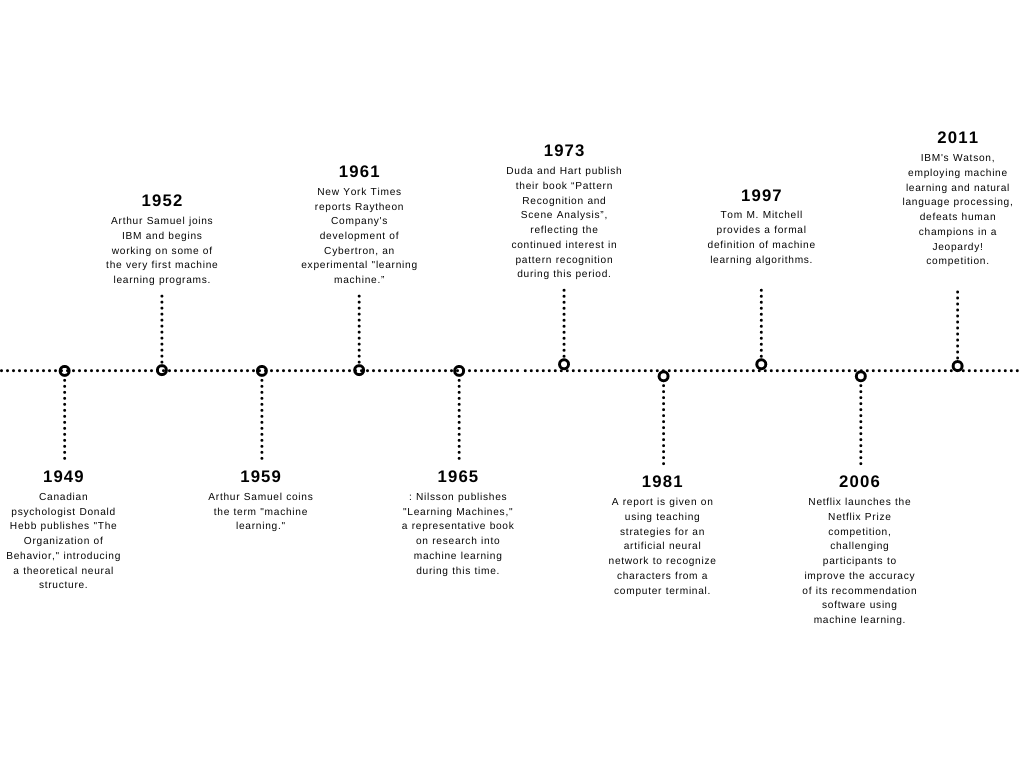
Things began to change in the 1990s and 2000s with two key developments: the availability of massive amounts of data from the internet and significant increases in computing power. These ingredients fueled the rise of machine learning, a subfield of AI that focuses on building systems that learn from data.
A major milestone came in 1997 when IBM's Deep Blue supercomputer defeated world chess champion Garry Kasparov. More recently, breakthroughs in a technique called deep learning have led to the powerful AI we see today, capable of everything from understanding speech to generating realistic images.
What is the primary goal of Artificial Intelligence?
The modern field of AI, and the coining of the term "artificial intelligence", is traced back to a workshop held at which institution in 1956?
AI is no longer a futuristic concept; it's a technology that is actively shaping our world and will continue to do so for the foreseeable future.