AI Fundamentals Explained
Introduction to Artificial Intelligence
What Is Artificial Intelligence?
Artificial intelligence is the science of making machines that can think and learn like humans. It's a broad field in computer science focused on building smart systems capable of performing tasks that typically require human intelligence. This includes things like recognizing speech, making decisions, and translating languages.
Artificial Intelligence
noun
The theory and development of computer systems able to perform tasks that normally require human intelligence, such as visual perception, speech recognition, decision-making, and translation between languages.
The core goal is to create systems that can operate autonomously. Instead of just following explicit instructions, an AI system learns from data, identifies patterns, and adapts its behavior. It can reason through problems, understand complex ideas, and even engage in creative tasks.
A Quick Trip Through Time
The dream of intelligent machines isn't new. Philosophers have long wondered about the nature of thought and whether it could be replicated. But the modern field of AI truly began in the summer of 1956 at a conference at Dartmouth College. It was here that the term "artificial intelligence" was first used, and the field was established as a formal area of research.
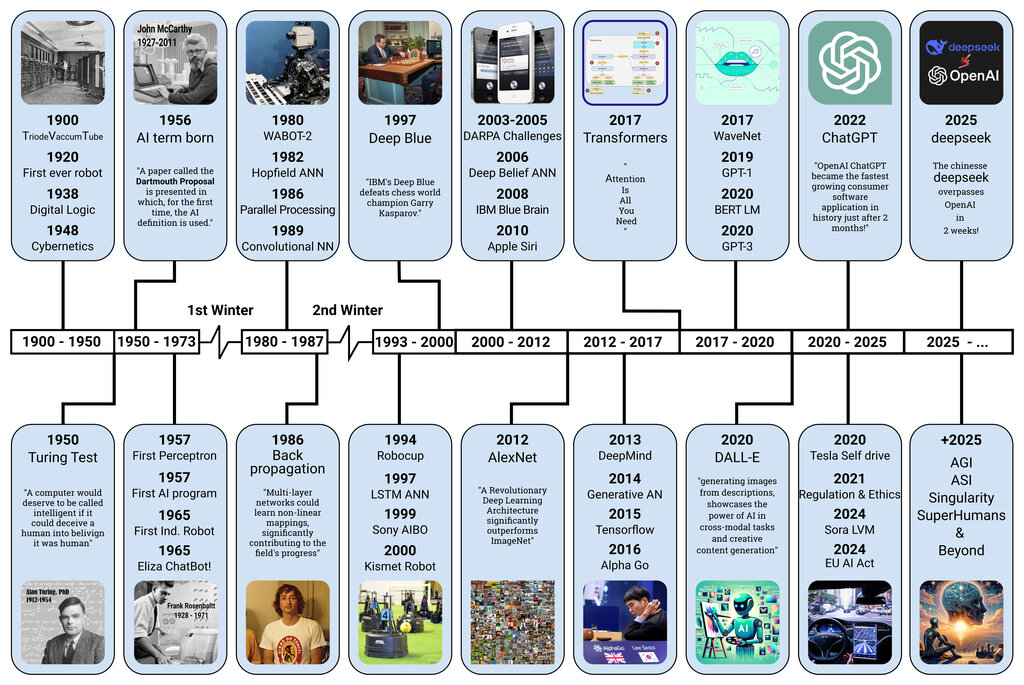
The journey wasn't always smooth. The early years were full of optimism, but progress was slower than expected. This led to periods known as "AI winters," when funding dried up and public interest waned. However, breakthroughs in computing power and the availability of massive amounts of data eventually sparked a resurgence. Today, AI is advancing faster than ever.
The Branches of AI
AI isn't just one technology; it's a collection of specialized subfields, each focused on a different aspect of intelligence. Think of it like medicine, which has branches like cardiology and dermatology. AI has its own specializations.
Some key areas include:
-
Machine Learning (ML): This is the most common type of AI. It's about creating algorithms that allow computers to learn from data without being explicitly programmed. Think of a spam filter that gets better at catching junk mail over time.
-
Natural Language Processing (NLP): This branch focuses on the interaction between computers and human language. It's what allows voice assistants like Siri and Alexa to understand what you're saying.
-
Computer Vision: This field enables machines to interpret and understand visual information from the world, such as images and videos. It powers everything from facial recognition on your phone to self-driving cars navigating the road.
-
Robotics: This area combines AI with engineering to build robots that can perform tasks in the physical world. These can range from robots on an assembly line to robotic surgical assistants.
These subfields often overlap. For example, a robot might use computer vision to see its environment and machine learning to improve how it picks up objects.
This is just a glimpse into the world of artificial intelligence. By understanding these foundational ideas, you're ready to explore how AI is already changing our world and what it might do next.