AI Fundamentals Demystified
Introduction to Artificial Intelligence
What Is Artificial Intelligence?
At its heart, artificial intelligence is about building machines that can think, learn, and solve problems like humans do. It's a broad field of computer science focused on creating systems that can perform tasks that normally require human intelligence. This could be anything from understanding language to recognising objects in a picture.
Artificial Intelligence
noun
A field of computer science dedicated to creating systems capable of performing tasks that typically require human intelligence, such as learning, reasoning, problem-solving, perception, and language understanding.
Think of it this way: we don't just program these systems with a rigid set of rules. Instead, we design them to learn from data, identify patterns, and make decisions on their own. The goal is to create a machine that can adapt to new situations and handle tasks without being explicitly told how to do everything step-by-step.
The core idea of AI is to simulate human intelligence in machines, enabling them to learn, reason, and act.
A Brief History of AI
The dream of intelligent machines has been around for centuries, but the scientific field of AI is relatively new. It officially began in the summer of 1956 at a workshop at Dartmouth College in the US. A group of scientists gathered to explore the idea that "every aspect of learning or any other feature of intelligence can in principle be so precisely described that a machine can be made to simulate it."
The years that followed were filled with excitement and major breakthroughs. Early AI programs could solve algebra problems and prove theorems in logic. However, the initial optimism soon ran into obstacles. The limited computing power of the time and the sheer complexity of human intelligence proved to be bigger challenges than expected. This led to periods known as "AI winters," when funding dried up and progress slowed.
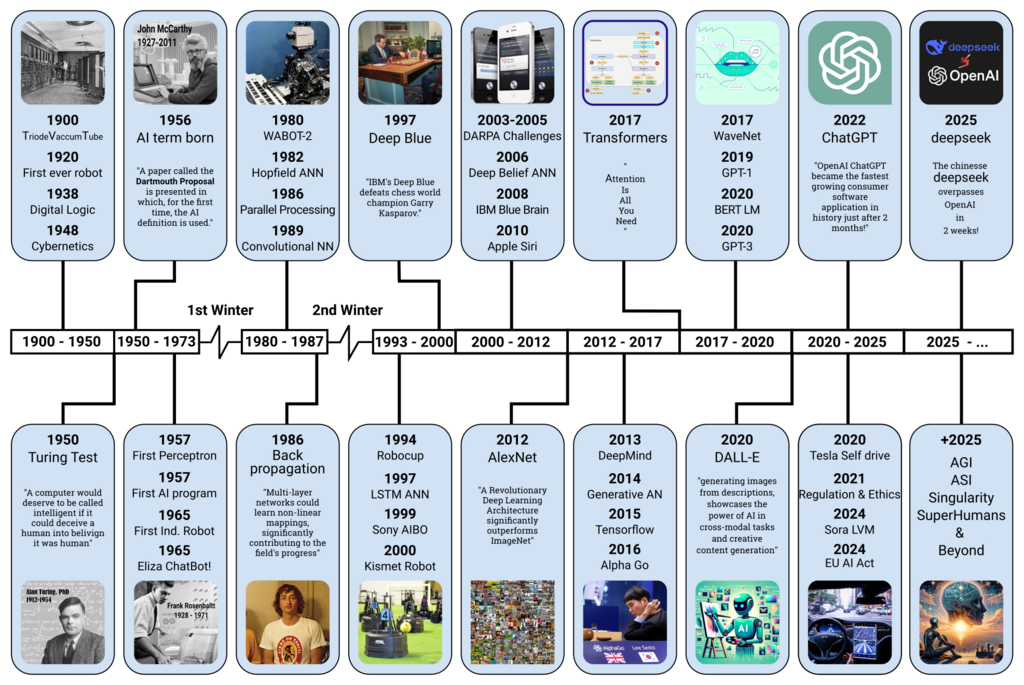
But with the explosion of data and massive increases in computing power in the 21st century, AI came roaring back. Milestones like IBM's Deep Blue defeating chess champion Garry Kasparov in 1997 showed the world what was possible. Today, AI is a driving force in technology, and its evolution is accelerating faster than ever.
The Three Types of AI
Not all AI is created equal. We can categorise AI into three distinct types based on its capabilities. These are Artificial Narrow Intelligence (ANI), Artificial General Intelligence (AGI), and Artificial Superintelligence (ASI).
Artificial Narrow Intelligence (ANI), also known as Weak AI, is the only type of AI we have successfully created so far. ANI is designed and trained for one specific task. Your phone's voice assistant is a form of ANI. It can answer your questions, set timers, and play music, but it can't have a meaningful conversation about philosophy or drive a car.
ANI is all around us, powering many of the services we use every day.
| Application | Task | Example |
|---|---|---|
| Voice Assistants | Understand and respond to voice commands | Siri, Alexa, Google Assistant |
| Recommendation Engines | Predict user preferences | Netflix film suggestions, Amazon product recommendations |
| Spam Filters | Identify and block unwanted emails | Gmail's spam detection |
| Self-Driving Cars | Navigate roads and traffic | Tesla Autopilot, Waymo |
Artificial General Intelligence (AGI), or Strong AI, is the next step. AGI would have the ability to understand, learn, and apply its intelligence to solve any problem, much like a human being. An AGI system could learn to play chess, write a novel, and compose music all on its own, without being specifically programmed for each task. This type of AI is still theoretical and a major goal for many researchers.
Artificial Superintelligence (ASI) is the final, hypothetical stage. An ASI would be an intellect that is much smarter than the best human brains in practically every field, including scientific creativity, general wisdom, and social skills. The concept of ASI raises many profound ethical and philosophical questions about the future of humanity.
Intelligent Agents
So how does an AI system actually work in the world? We can think of AI systems as intelligent agents. An agent is anything that can perceive its environment through sensors and act upon that environment through actuators.
A human is an intelligent agent. Our sensors are our eyes, ears, and other organs. Our actuators are our hands, legs, and mouth. We perceive the world (see a car coming) and act upon it (step back onto the pavement).
A robotic vacuum cleaner is also an intelligent agent. Its sensors might include infrared detectors to see walls and cliff sensors to avoid stairs. Its actuators are its wheels and vacuum motor. It perceives its environment (detects a wall) and acts upon it (changes direction).
This simple loop of perceiving and acting is fundamental to all of artificial intelligence, from the simplest thermostat to the most complex self-driving car.
What is the primary goal of artificial intelligence?
A smartphone's voice assistant, which can answer questions and set alarms but cannot write a novel, is an example of which type of AI?
This covers the basic landscape of artificial intelligence. You now have a foundational understanding of what AI is, where it came from, and how its different forms are categorised.