AI Fundamentals
Introduction to AI
What Is Artificial Intelligence?
At its core, Artificial Intelligence (AI) is about teaching computers to think, learn, and solve problems in ways that mimic human intelligence. It’s not about creating conscious robots from science fiction. Instead, it’s about building systems that can perform tasks that would otherwise require a person's ability to reason, perceive, or understand language.
Think of it this way: when you teach a dog to fetch, you're using repetition and reward. AI often works similarly, but on a massive scale with data. A computer can analyze millions of images to learn what a “cat” looks like, far more than a person could ever see.
The ultimate goal is to create tools that can handle complex tasks efficiently and accurately. From recognizing your face to unlock your phone to helping scientists discover new medicines, AI is a broad field focused on making machines smarter and more capable.
A Quick Trip Through Time
The idea of intelligent machines has been around for centuries, but the actual field of AI officially kicked off in the summer of 1956 at a workshop at Dartmouth College. A small group of researchers gathered to explore the idea that “every aspect of learning or any other feature of intelligence can in principle be so precisely described that a machine can be made to simulate it.”
This event sparked decades of research, filled with both breakthroughs and setbacks. Early optimism was high, but the challenges were immense. Periods known as “AI winters” followed, where funding and interest dried up because progress was slower than promised.
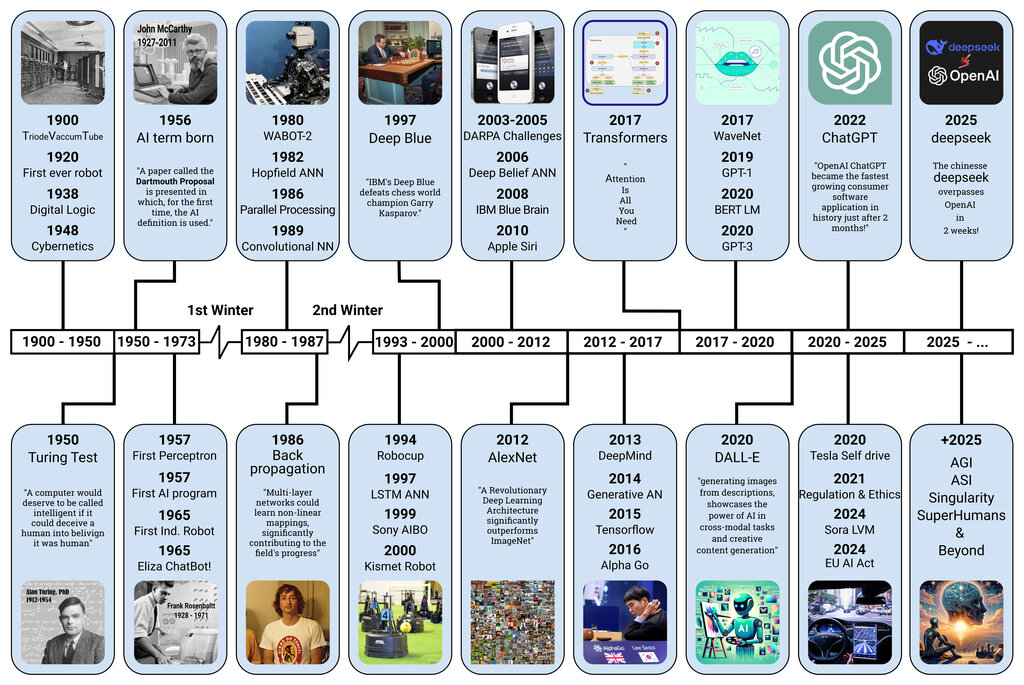
Things began to change with two key ingredients: more powerful computers and vast amounts of data from the internet. In 1997, IBM's Deep Blue computer defeated world chess champion Garry Kasparov, a major milestone. Later, the development of machine learning allowed computers to learn from data without being explicitly programmed for every task.
This shift paved the way for the AI we see today, from the algorithms that recommend your next song to the large language models that can write an email or a poem.
What Is AI Trying to Achieve?
The goals of AI can be broken down into a few key areas, each focused on a different aspect of intelligence.
Reasoning
noun
Using logic to solve problems and make decisions. An AI might use reasoning to find the most efficient route for a delivery service, considering traffic, distance, and number of stops.
Another key goal is learning. This is where systems improve their performance over time by analyzing data. Your email's spam filter is a simple example; it learns to identify junk mail by looking at which messages you mark as spam.
Perception is also critical. This involves making sense of the world through raw data, like images, sound, and text. A self-driving car uses perception to identify pedestrians, traffic lights, and other vehicles on the road.
Finally, there's language interaction. This is the ability to understand and generate human language. Smart assistants like Siri and Alexa rely on this to understand your commands and provide useful responses.
AI in the Wild
You probably use AI every day without even realizing it. It's the engine behind many of the services and products we rely on.
| Industry | Application |
|---|---|
| Healthcare | Analyzing medical images to detect diseases early. |
| Finance | Identifying fraudulent credit card transactions. |
| Entertainment | Recommending movies, shows, and music. |
| Retail | Personalizing online shopping experiences. |
| Transportation | Optimizing routes in navigation apps like Google Maps. |
From helping farmers monitor crop health to enabling customer service chatbots to answer your questions 24/7, AI is being applied in nearly every field to improve efficiency, accuracy, and convenience. As the technology continues to advance, its impact will only grow.
What is the fundamental goal of Artificial Intelligence?
The field of AI is considered to have officially begun at which key event?
This is just the beginning of the journey into understanding AI. By grasping these core ideas, you've built a solid foundation for exploring the more complex and powerful aspects of this transformative technology.