AI Fundamentals
Introduction to Artificial Intelligence
What Is Artificial Intelligence?
Artificial Intelligence, or AI, is the science of making computers smart. It’s about teaching machines to think, learn, and solve problems in ways that mimic human intelligence. Instead of just following a strict set of pre-programmed instructions, an AI system can analyze new information and adapt its behavior.
Think of it like this: you can give a computer a list of rules to play chess, and it will follow them perfectly. But with AI, the computer can play thousands of games, learn from its mistakes, and develop strategies all on its own.
AI isn't a single technology. It's a broad field of computer science with many different branches and approaches. These branches work together to create systems that can see, hear, speak, and even create.
Why AI Matters
AI is no longer just a concept from science fiction. It’s a fundamental part of modern life, working behind the scenes in many of the tools we use every day. When your email app automatically filters out spam, that's AI at work. When a streaming service recommends a movie you might like, it's using AI to understand your preferences.
Beyond these daily conveniences, AI is driving major advancements in critical fields. In healthcare, it helps doctors diagnose diseases earlier and more accurately. In finance, it detects fraudulent transactions to protect consumers. Navigation apps use AI to analyze traffic patterns in real-time, finding you the quickest route. This ability to process vast amounts of data and find patterns is what makes AI so powerful.
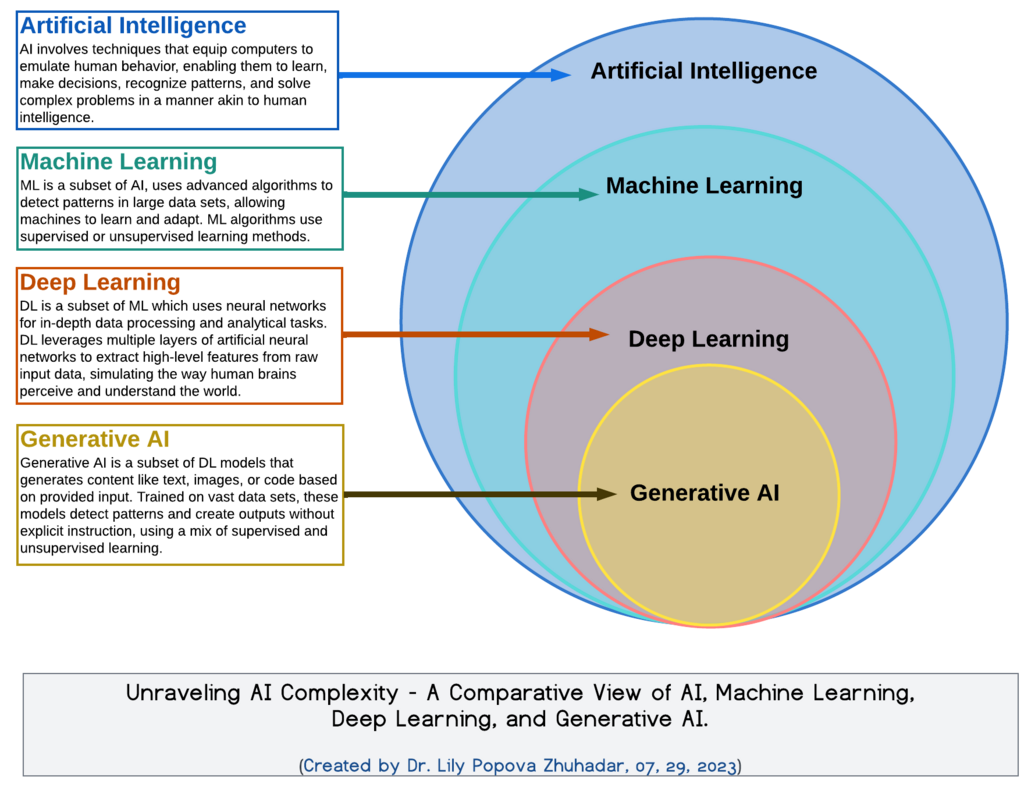
The Building Blocks of AI
To understand AI, it helps to know a few of its core concepts. These are the foundational ideas that power most AI systems.
Machine Learning
noun
A subset of AI where systems learn from data to identify patterns and make decisions without being explicitly programmed for every task.
Machine learning is all about experience. Instead of writing code for every possible scenario, developers feed an algorithm huge amounts of data and let it figure out the patterns on its own. It's the engine behind personalized recommendations and facial recognition.
A key type of machine learning is built on neural networks. Inspired by the human brain, these are complex systems with interconnected layers of 'neurons'. Each layer processes information and passes it to the next, allowing the network to recognize very complex patterns, like identifying a specific person in a crowd or understanding the nuances of a sentence.
Another crucial concept is Natural Language Processing (NLP). This is the branch of AI that gives computers the ability to understand, interpret, and generate human language. Every time you talk to a voice assistant like Siri or use an online translation tool, you're interacting with NLP. It bridges the gap between human communication and computer understanding.
These concepts are the starting point for exploring the world of AI. Let's review what you've learned.
What is the primary goal of Artificial Intelligence?
The branch of AI that allows computers to understand, interpret, and generate human language is known as ______.
Together, these building blocks allow AI to perform a stunning range of tasks, transforming industries and changing how we interact with technology.