AI Foundations Prompts and Agents
Introduction to Artificial Intelligence
What Is Artificial Intelligence?
Artificial Intelligence, or AI, is a field of computer science focused on creating machines that can perform tasks that typically require human intelligence. This includes things like learning from experience, solving problems, understanding language, and recognizing objects in images.
Think of it this way: when you write a traditional computer program, you give it a very specific set of instructions to follow, like a recipe. With AI, you instead create a system that can learn the recipe on its own by looking at examples of finished dishes.
Artificial Intelligence
noun
The theory and development of computer systems able to perform tasks that normally require human intelligence, such as visual perception, speech recognition, decision-making, and translation between languages.
AI refers to the simulation of human intelligence in machines that are programmed to think, learn, and problem-solve like humans.
A Brief History of AI
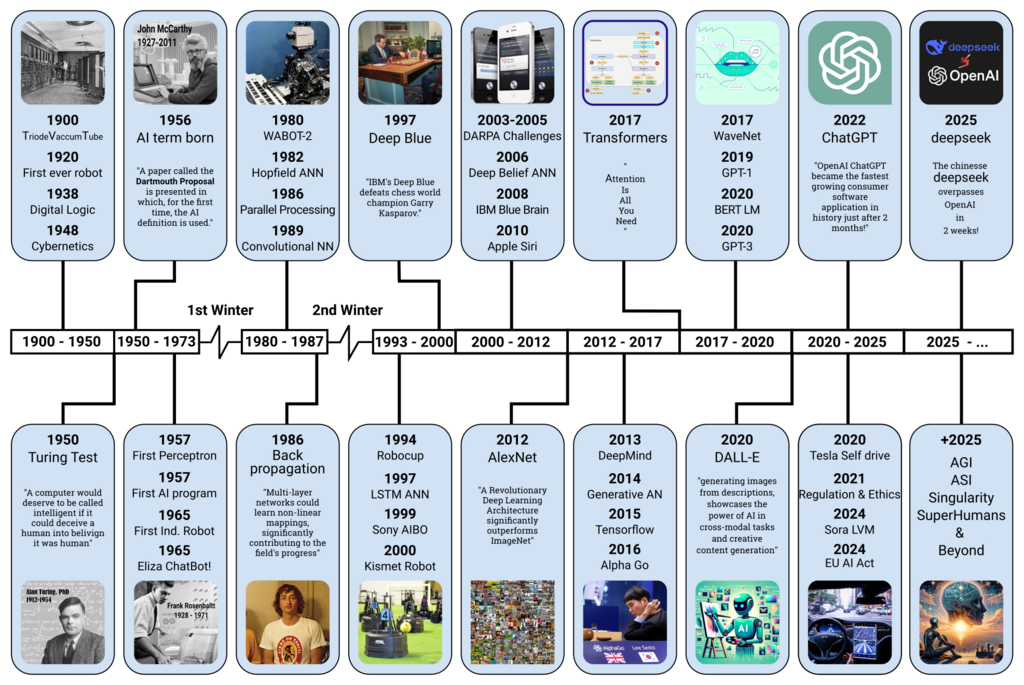
While the idea of intelligent machines has been around for centuries, the modern field of AI has a clear starting point. The term "Artificial Intelligence" was first coined in 1956 at a summer workshop at Dartmouth College. A group of scientists gathered to explore the idea that "every aspect of learning or any other feature of intelligence can in principle be so precisely described that a machine can be made to simulate it."
This event kicked off decades of research. Progress came in waves, with periods of great excitement and investment followed by "AI winters," when funding dried up and public interest faded. However, recent breakthroughs, driven by massive increases in computing power and the availability of huge datasets, have brought AI out of the lab and into our daily lives.
The AI Family
AI is not a single technology but a broad field with many branches. Just as "biology" includes everything from botany to zoology, "AI" is an umbrella term for various subfields and techniques. Understanding these relationships is key to grasping what AI is and what it can do.
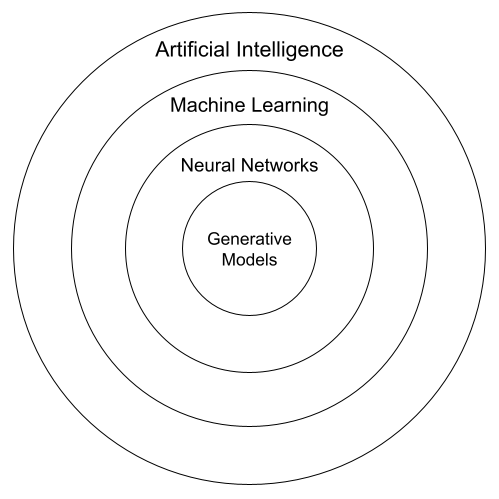
One of the most important subfields is Machine Learning (ML). Instead of being programmed with explicit rules, an ML system learns patterns directly from data. For example, a spam filter learns to identify junk email by analyzing thousands of examples of spam and non-spam messages you've received in the past.
A popular technique within machine learning is the use of Neural Networks. These are computing systems loosely inspired by the structure of the human brain. They consist of interconnected layers of nodes, or "neurons," that process information and pass it along to the next layer. By adjusting the connections between these neurons, the network can learn to recognize complex patterns in data, like identifying a cat in a photo or understanding a spoken command.
Narrow vs General AI
When people talk about AI, they are usually referring to one of two broad categories: Artificial Narrow Intelligence (ANI) or Artificial General Intelligence (AGI).
Artificial Narrow Intelligence (ANI), also known as Weak AI, is designed to perform a single, specific task. This is the only type of AI that exists today. Your virtual assistant, the recommendation engine on a streaming service, and facial recognition software are all examples of ANI. They are incredibly powerful at their one job but cannot operate outside of it. A chess-playing AI can't write an email, for instance.
Artificial General Intelligence (AGI), or Strong AI, is the hypothetical intelligence of a machine that has the capacity to understand or learn any intellectual task that a human being can. An AGI would be able to reason, plan, and think abstractly across many different domains. This kind of AI is still the stuff of science fiction and is not something we have achieved.
| Feature | Artificial Narrow Intelligence (ANI) | Artificial General Intelligence (AGI) |
|---|---|---|
| Scope | Performs a single, specific task | Can perform any intellectual task a human can |
| Capability | Specialized and limited | General and adaptable |
| Current Status | Widely used today | Theoretical / Not yet achieved |
| Example | Spam filters, chess programs, Siri | Fictional robots like Data from Star Trek |
Now that you have a foundational understanding of AI's definition, history, and key concepts, you are ready to explore its applications and more advanced topics.