AI for Workplace Productivity
Introduction to AI in the Workplace
What is AI, Anyway?
Artificial intelligence, or AI, isn't just about robots and science fiction. At its core, AI refers to the simulation of human intelligence in machines. These machines are programmed to think, learn, and problem-solve, mimicking the cognitive functions we associate with the human mind. It's the technology that allows your phone to recognize your face, suggests what to watch next on a streaming service, and helps your bank flag a strange transaction.
Intelligence
noun
The ability to acquire and apply knowledge and skills.
AI isn't one single thing. It's a broad field with different levels of capability. Think of it like a spectrum, from simple task-oriented systems to more complex, human-like intelligence.
Right now, every AI system we use falls into the ANI category. These are the specialized tools that excel at one job, like playing a game or translating languages. The concepts of AGI and ASI are still theoretical, representing future possibilities for AI development.
A Brief Journey Through Time
The idea of artificial beings with intelligence has been around for centuries, but the scientific field of AI is much younger. Its roots go back to the mid-20th century, with landmark developments that laid the groundwork for the technology we have today.
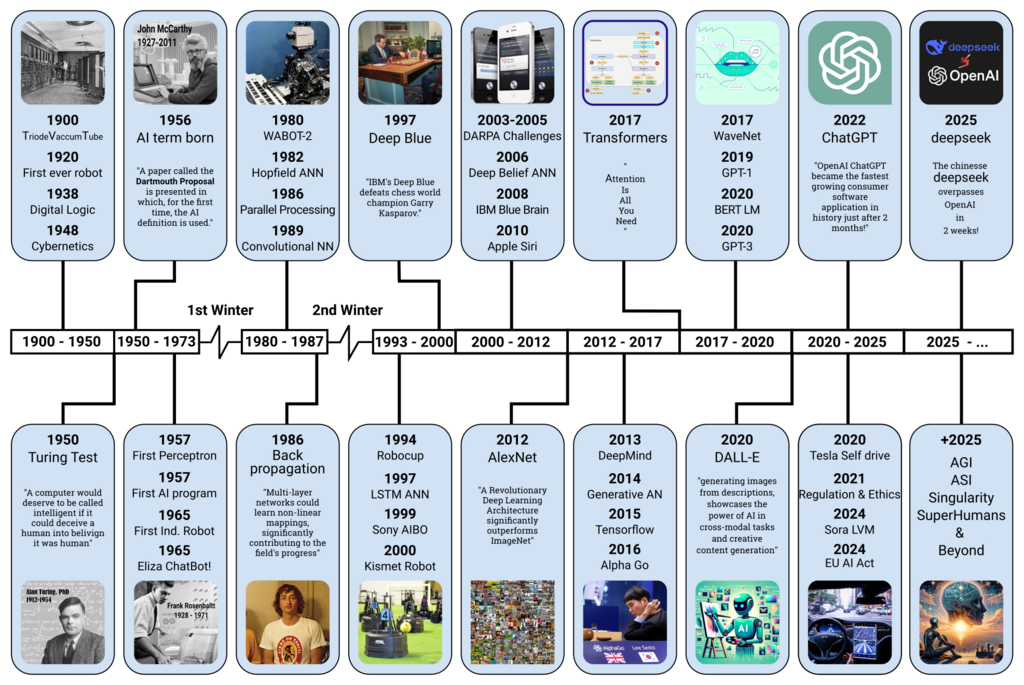
The journey began with theoretical concepts in the 1950s, followed by early successes in logic and game-playing. Progress wasn't always a straight line. The field experienced "AI winters," periods of reduced funding and interest when the technology couldn't live up to its initial hype.
However, a boom in computing power and the availability of massive datasets in the 21st century fueled a resurgence. This led to breakthroughs in machine learning and deep learning, the subfields of AI that power most modern applications. These advancements are what brought AI out of the research lab and into our daily lives and workplaces.
AI's Footprint on Industries
AI is not a niche technology for a handful of companies; it's a transformative force reshaping entire industries. Its ability to analyze data, identify patterns, and automate processes makes it a powerful tool for virtually any sector.
Artificial intelligence (AI) is a wide-ranging tool that enables people to rethink how we integrate information, analyze data, and use the resulting insights to improve decision making—and already it is transforming every walk of life.
Consider a few examples:
- Healthcare: AI helps doctors diagnose diseases earlier by analyzing medical images like X-rays and MRIs with incredible accuracy. It also powers personalized treatment plans based on a patient's genetic makeup and lifestyle.
- Finance: Banks use AI to detect fraudulent transactions in real time, saving customers from financial loss. Algorithmic trading uses AI to make split-second decisions in the stock market.
- Retail: Online stores use AI to recommend products you might like, creating a personalized shopping experience. Behind the scenes, AI optimizes supply chains to ensure products are in stock and delivered efficiently.
- Manufacturing: AI-powered robots work alongside humans on assembly lines, handling repetitive or dangerous tasks. AI also predicts when machinery needs maintenance, preventing costly breakdowns.
The common thread is AI's ability to handle tasks at a scale and speed that humans can't match, freeing up people to focus on more creative and strategic work. By augmenting human capabilities, AI drives efficiency and innovation.
Clearing Up Common Myths
With any powerful new technology, myths and misunderstandings are common. Let's address a few of the most frequent ones about AI.
Myth: AI is going to take all our jobs. Reality: AI is changing jobs, not just eliminating them. While it automates repetitive tasks, it also creates new roles that require human skills like critical thinking, creativity, and emotional intelligence. The focus is shifting from performing routine tasks to supervising and collaborating with AI systems.
Myth: AI is a magical, all-knowing brain. Reality: AI is a tool. It's only as good as the data it's trained on and the algorithms that govern it. It doesn't "understand" concepts in a human way and can be prone to errors and biases present in its training data. Critical human oversight is always necessary.
Myth: You need to be a programmer to use AI. Reality: While building AI systems requires technical expertise, using AI tools is becoming easier every day. Many modern software applications have AI features built-in, accessible through user-friendly interfaces. The key skill is learning how to use these tools effectively in your specific role.
What is the primary goal of Artificial Intelligence?
Every AI system currently in use, such as a face recognition feature on a phone, belongs to which category of AI?
Understanding these foundational concepts is the first step toward effectively harnessing the power of AI in a professional setting. It's about recognizing it as a powerful collaborator that can enhance human potential.