AI for Software Sales Professionals
Introduction to Artificial Intelligence
What Is Artificial Intelligence?
Artificial Intelligence, or AI, is the science of making computers do things that normally require human intelligence. This isn't just about programming a machine to follow a set of rigid instructions. It's about creating systems that can learn, reason, solve problems, and even understand language.
The core idea is to build machines that can perceive their environment and take actions to achieve a specific goal, much like we do.
Think about how you recognize a friend's face in a crowd or understand the meaning of a sentence. These tasks seem simple to us, but they involve complex processing. AI aims to replicate these abilities in machines, allowing them to perform tasks ranging from identifying spam in your email to helping doctors diagnose diseases.
A Brief History
The term "artificial intelligence" was first coined at a conference in 1956. Early researchers were incredibly optimistic, believing that a machine with human-like intelligence was just a few decades away. However, progress was slower than expected.
The field went through several periods of reduced funding and interest, often called "AI winters." The limited computing power and lack of large datasets made it difficult to build systems that could solve complex, real-world problems. But in the last couple of decades, things have changed dramatically. The explosion of the internet created massive amounts of data, and computer processors became exponentially more powerful. This combination of big data and powerful hardware has fueled the AI boom we're experiencing today.
Two Main Types of AI
When people talk about AI, they are usually referring to one of two broad categories: narrow AI and general AI.
Artificial Narrow Intelligence (ANI)
noun
Sometimes called "Weak AI," this is AI that is trained to perform a single, specific task. It operates within a pre-defined range and cannot perform tasks beyond its specialty.
Every AI application you use today is a form of ANI. The algorithm that recommends shows on Netflix, the voice assistant on your phone, and the software that detects fraudulent credit card transactions are all examples of narrow AI. They are incredibly powerful and useful for their specific purpose, but they can't step outside of it. You can't ask your spam filter for a weather forecast.
Artificial General Intelligence (AGI)
noun
Often called "Strong AI," this is the type of AI that can understand, learn, and apply its intelligence to solve any problem, much like a human being. AGI does not currently exist.
AGI is the kind of AI you see in science fiction movies—a machine with consciousness and the ability to think abstractly and creatively. While we have made enormous strides in ANI, creating a machine with the flexible, adaptable intelligence of a human remains a monumental challenge.
The Core Subfields
AI is a broad field, like biology or physics. Within it are several key subfields that power most modern AI applications. Think of these as the essential building blocks.
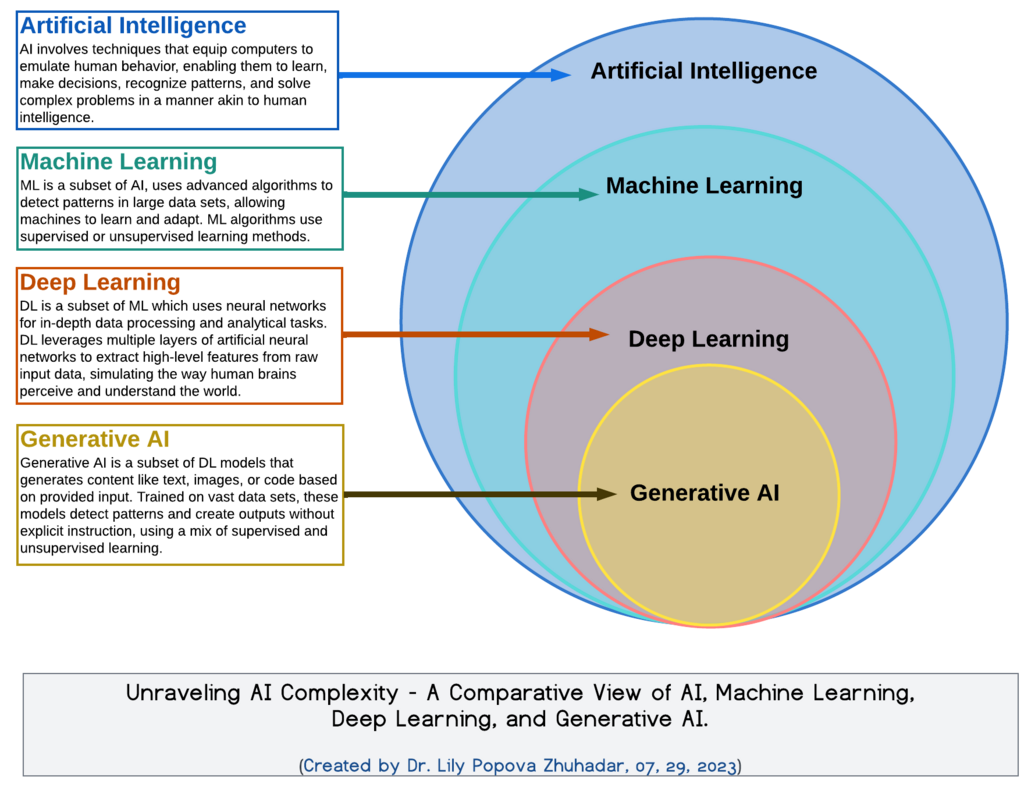
Machine Learning (ML) is a subset of AI focused on building systems that can learn from data. Instead of being explicitly programmed with rules, an ML model is "trained" on a large dataset. It identifies patterns in that data and uses them to make predictions or decisions about new, unseen data.
For example, to build an ML model that identifies cats in photos, you would show it thousands of pictures labeled "cat." The model learns the common features of a cat—pointy ears, whiskers, a tail—on its own. Eventually, it can identify cats in new pictures it's never seen before.
Deep Learning (DL) is a specialized type of machine learning. It uses complex structures called neural networks, which are inspired by the human brain. These networks have many layers of interconnected "neurons," allowing them to learn incredibly subtle and complex patterns from vast amounts of data.
Deep learning is the technology behind many of the most advanced AI applications, such as self-driving cars recognizing pedestrians and traffic signs, and realistic language translation services. Its ability to process complex data like images, sound, and text makes it extremely powerful.
Natural Language Processing (NLP) is a subfield of AI that gives computers the ability to understand, interpret, and generate human language. It's the bridge between human communication and computer understanding.
Every time you use a chatbot, dictate a text message, or use a translation app, you're interacting with NLP. This technology analyzes the structure and meaning of sentences to figure out what you're trying to say and generate a relevant response.
Now let's review these core concepts.
Time to check your understanding.
What is the primary goal of Artificial Intelligence?
A voice assistant on your phone that can answer questions and set alarms is an example of which type of AI?
Understanding these fundamental ideas—what AI is, its different types, and its core components—is the first step to seeing how it's changing the world.