AI for Small Business Success
Introduction to AI
What is AI, Really?
Artificial intelligence isn't just about robots and science fiction. At its core, AI is about creating computer systems that can perform tasks that normally require human intelligence. This could be anything from understanding language and recognizing images to solving problems and making decisions.
Think of it less as creating a synthetic brain and more as building a very specialized, powerful tool. Instead of programming a computer with a rigid set of rules for every possible situation, AI allows a system to learn from data, identify patterns, and adapt.
Artificial Intelligence
noun
The theory and development of computer systems able to perform tasks that normally require human intelligence, such as visual perception, speech recognition, decision-making, and translation between languages.
The Two Main Flavors of AI
AI comes in two main types, and the distinction is important. The AI we use every day is called Artificial Narrow Intelligence (ANI), or Weak AI. It's designed to perform a single, specific task very well. Your GPS finding the fastest route, a streaming service recommending a movie, or a chatbot answering a customer query are all examples of Narrow AI. It's powerful, but it operates within a limited, pre-defined range.
The other type is Artificial General Intelligence (AGI), or Strong AI. This is the AI you see in movies—a machine with the ability to understand, learn, and apply its intelligence to solve any problem, just like a human. AGI is a fascinating concept that researchers are working toward, but it doesn't exist today. For now, all practical business applications involve Narrow AI.
| Feature | Narrow AI (ANI) | General AI (AGI) |
|---|---|---|
| Scope | Performs a single, specific task. | Can understand and perform any intellectual task a human can. |
| Example | Spam filters, voice assistants, recommendation engines. | Fictional characters like Data from Star Trek. |
| Current Status | Widely used today. | Theoretical; does not yet exist. |
How AI Learns
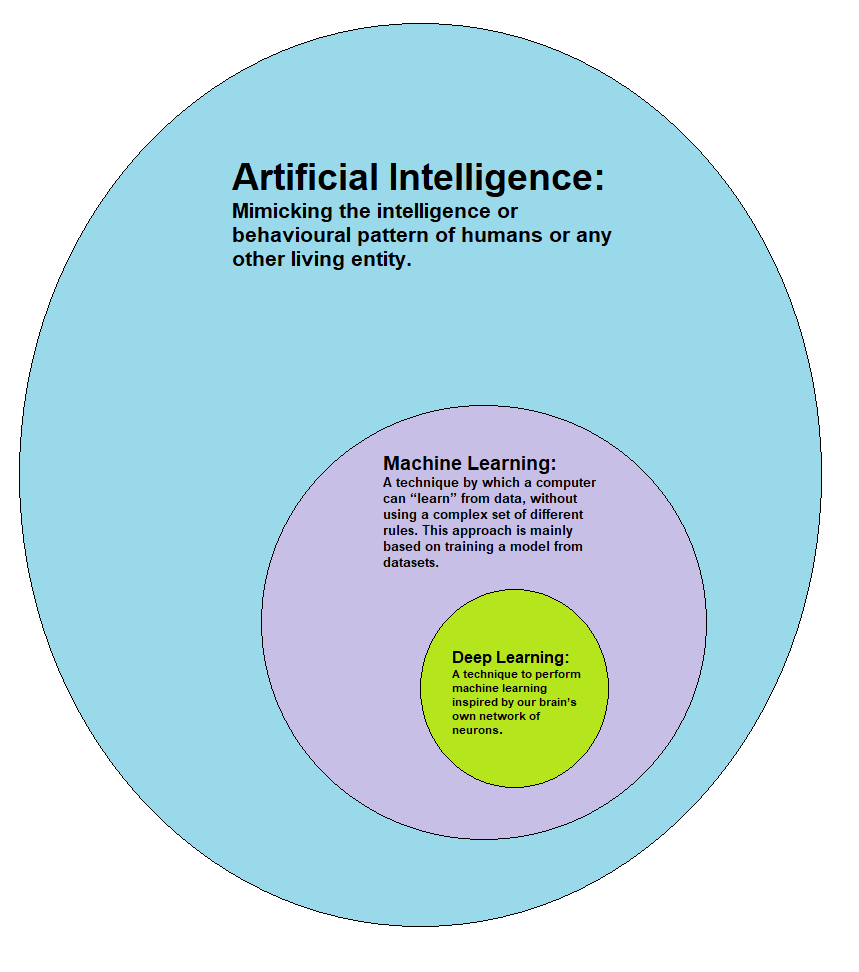
So how does an AI system learn? Usually through a subset of AI called Machine Learning (ML). With machine learning, instead of writing step-by-step instructions, developers feed a system large amounts of data and let it learn the patterns for itself. For example, you can show a machine learning model thousands of customer emails, and it will learn to distinguish between a sales inquiry and a support request on its own.
A more advanced form of machine learning is Deep Learning. It uses complex structures called neural networks, which are loosely inspired by the human brain. Deep learning is particularly good at finding subtle patterns in very large datasets, making it the engine behind things like facial recognition and natural language processing.
AI in Your Business
You don't need a massive budget or a team of data scientists to benefit from AI. Many common business tools already have AI built in, ready to help you work smarter.
For small businesses, AI is a powerful tool to level the playing field against larger competitors.
Here are a few ways AI can be applied:
-
Operations: AI can help you optimize inventory by predicting future demand based on past sales, seasonality, and even weather forecasts. It can automate scheduling and streamline repetitive administrative tasks, freeing up your time.
-
Marketing: AI tools can analyze customer data to help you create highly personalized marketing campaigns. They can automate social media posting, suggest keywords for your website to improve search rankings, and even generate drafts for blog posts or emails.
-
Customer Engagement: AI-powered chatbots can provide 24/7 support on your website, answering common questions instantly. You can also use AI to analyze customer reviews and feedback from social media to understand what people love about your business and where you can improve.
Benefits and Challenges
Adopting AI can bring significant benefits. It can increase your efficiency by automating tasks, lead to better decision-making through data analysis, and help you provide a superior customer experience. Ultimately, these advantages can give you a real competitive edge.
However, there are challenges to consider. Implementing new technology can come with costs and a learning curve. AI systems are only as good as the data they're trained on, so you need to have quality information to get good results. The key is to start small, identify a specific problem that AI can help solve, and build from there.
Which of the following best describes the type of AI commonly used in business applications today, such as a GPS finding the fastest route?
Instead of being programmed with step-by-step instructions, most AI systems learn by being fed large amounts of ____ and identifying patterns on their own.
Understanding these core concepts is the first step. By grasping what AI is, how it works, and where it can be applied, you're in a great position to start thinking about how it can help your business grow.