AI for Senior Product Managers
Introduction to AI and ML
What Is Artificial Intelligence?
Artificial intelligence, or AI, is a broad field of computer science focused on creating machines that can perform tasks that typically require human intelligence. This includes abilities like learning, reasoning, problem-solving, perception, and understanding language.
Think of it this way: a simple calculator can perform complex math, but it only follows the specific instructions it's given. It doesn't learn or adapt. An AI system, on the other hand, is designed to be more flexible. It might learn to recognize your face to unlock your phone or figure out the best route through traffic based on current conditions.
The core idea of AI is to build systems that can think, or at least act, intelligently. This doesn't mean they are conscious, just that they can simulate intelligent behavior.
A Brief History
The concept of AI has been around for centuries in myths and stories, but the formal field of study began in the 1950s. Since then, its journey has been a series of booms and busts, with periods of great optimism followed by "AI winters" when funding and interest dried up.
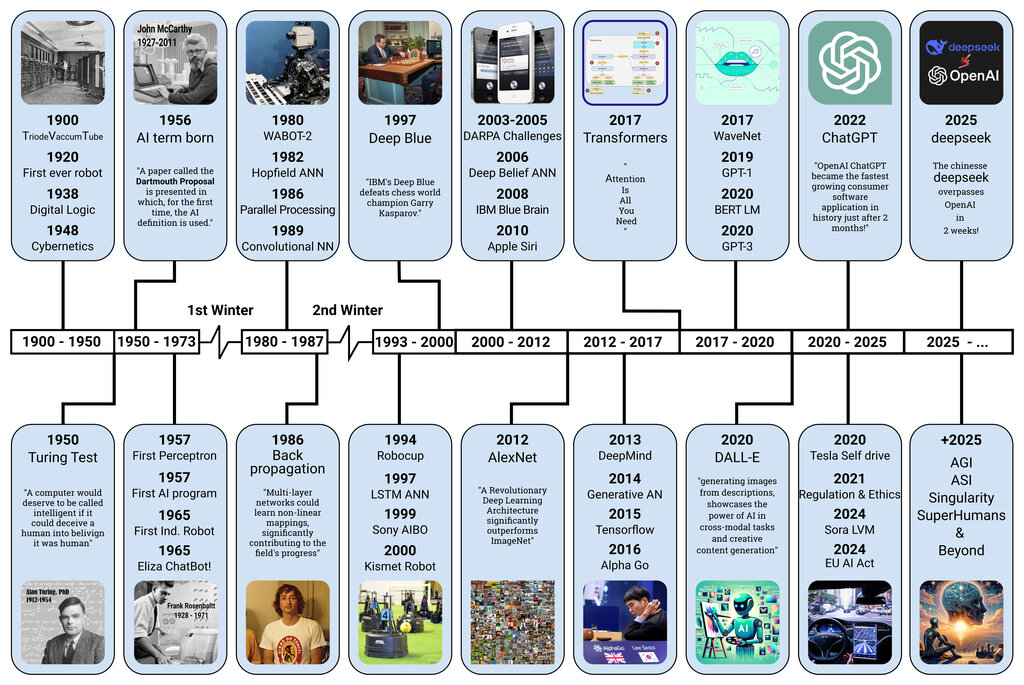
Early AI research focused on symbolic reasoning and logic puzzles. Scientists believed that if they could create a set of rules for how to think, they could build an intelligent machine. This worked for well-defined problems like playing chess, but it failed at messier, real-world tasks like identifying a cat in a photo.
The modern AI boom is powered by two key ingredients that were missing in the early days: massive amounts of data and powerful computers. These have enabled a different approach to AI, one based on learning from examples rather than being programmed with rules.
The AI Family Tree
You'll often hear terms like AI, Machine Learning, and Deep Learning used interchangeably, but they have distinct meanings. It's helpful to think of them as nested concepts, each one a specialized part of the one before it.
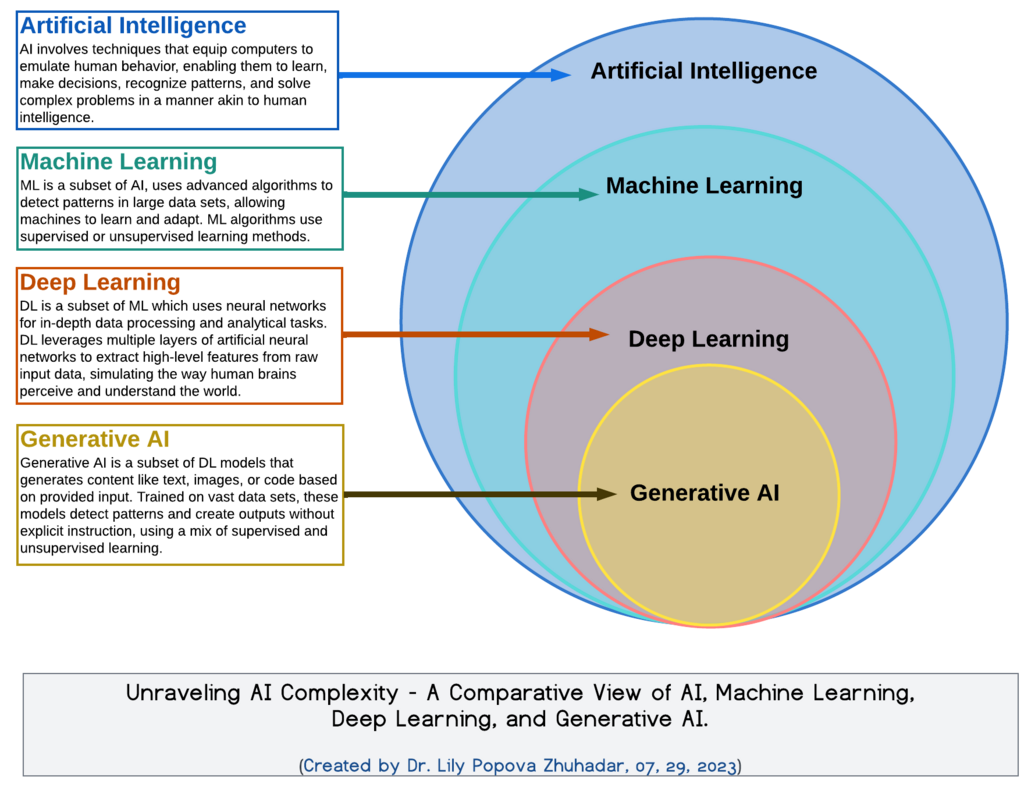
Let's break down these relationships:
- Artificial Intelligence (AI) is the all-encompassing concept of creating intelligent machines.
- Machine Learning (ML) is a subset of AI. It's a specific approach to achieving AI that involves training a system on data to learn patterns, rather than programming it with explicit rules. A spam filter that learns to identify junk mail based on emails you've marked as spam is a classic example of ML.
- Deep Learning (DL) is a subset of Machine Learning. It uses complex, multi-layered neural networks (inspired by the structure of the human brain) to learn from vast amounts of data. Deep learning is the technology behind self-driving cars recognizing pedestrians and voice assistants understanding your commands.
How Machines Learn
Machine learning is the engine driving most modern AI applications. But how does a machine actually "learn"? The process depends on the type of ML algorithm used. There are three main categories.
Algorithm
noun
A process or set of rules to be followed in calculations or other problem-solving operations, especially by a computer.
1. Supervised Learning
This is the most common type of machine learning. In supervised learning, you act as the teacher. You give the algorithm a dataset where the "right answers" are already labeled. The goal is for the algorithm to learn the mapping function between the input data and the output labels.
Example: To train an AI to identify pictures of cats, you would feed it thousands of images, each one labeled as either "cat" or "not a cat." Eventually, the algorithm learns the patterns associated with cats (whiskers, pointy ears, fur) and can identify them in new, unlabeled photos.
2. Unsupervised Learning
Here, there is no teacher and there are no right answers. You give the algorithm a dataset without any labels and ask it to find interesting structures or patterns on its own. It's like giving someone a box of mixed Lego bricks and asking them to sort them into piles of similar pieces.
Example: A company could use unsupervised learning to analyze customer purchase data. The algorithm might discover distinct groups, or clusters, of customers who buy similar products, allowing the company to create targeted marketing campaigns without knowing what to look for beforehand.
3. Reinforcement Learning
This approach is about learning through trial and error. The algorithm, often called an "agent," learns to perform a task by interacting with an environment. It receives rewards for actions that lead to a good outcome and penalties for actions that lead to a bad one. Over time, it learns a strategy, or "policy," to maximize its total reward.
Example: This is how AI is trained to play complex games like Go or chess. The agent plays millions of games against itself. It's rewarded for moves that lead to winning and penalized for moves that lead to losing. Through this process, it discovers strategies far more advanced than any human player could devise.
Understanding these core concepts is the first step in seeing how AI and ML are applied to build products and solve real-world problems. Let's test your knowledge.
What is the primary goal of Artificial Intelligence (AI)?
Which of the following statements best describes the relationship between AI, Machine Learning (ML), and Deep Learning (DL)?
These foundational ideas—from the broad dream of AI to the specific methods of machine learning—are the building blocks for the more advanced technologies that are changing our world.