AI for Research Paper Writing
Introduction to AI Writing Tools
Your New Research Assistants
Writing a research paper involves juggling a lot of moving parts. You have sources to read, notes to organise, arguments to structure, and citations to manage. It's a complex process. AI writing tools are designed to streamline this workflow, acting as powerful assistants that can handle some of the heavy lifting.
These aren't tools for writing the paper for you. Instead, think of them as collaborators. They can help you make sense of your research, draft sections more efficiently, and ensure your formatting is correct. By automating tedious tasks, they free you up to focus on the most important part: the thinking.
NotebookLM for Your Sources
One of the biggest challenges in research is keeping track of all your source material. NotebookLM from Google is designed specifically for this. Its key feature is its ability to be 'grounded' in the documents you provide. You can upload PDFs of research articles, your own notes, interview transcripts, or data sets.
Once your sources are uploaded, NotebookLM becomes an expert on that specific information. You can ask it questions, and it will answer based only on the material you gave it. This is incredibly useful for synthesising information without pulling from the wider internet, which helps ensure the answers are relevant to your project.
For example, you could upload ten key papers for your literature review and ask NotebookLM to 'create a table comparing the methodologies used in these sources'. It will generate the table for you, complete with citations pointing back to the exact documents.
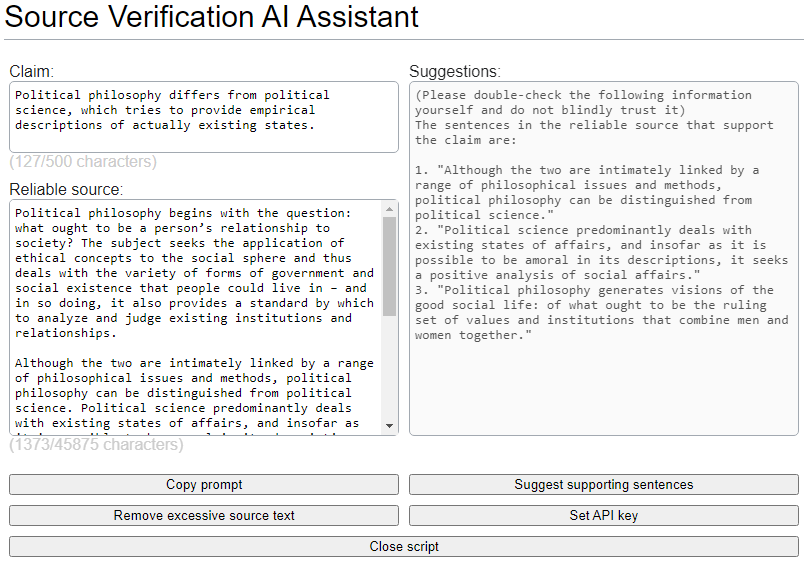
Beyond answering questions, it can also help you generate ideas. Ask it for a summary of a dense article, a list of potential research questions based on your notes, or an outline for a chapter. Every response is linked directly back to your sources, making it easy to check the original context.
STORM for the Big Picture
While NotebookLM focuses on the sources you already have, another tool called STORM helps with the initial, exploratory phase of research. STORM, which stands for Synthesis of Topics, Outlines, and Reports through Multi-agent conversation, is designed to help you conduct a comprehensive literature review on a topic you're just starting to explore.
You give STORM a topic, and it simulates a conversation between multiple AI 'agents'. One agent acts as a researcher, searching for relevant papers online. Another acts as an expert, synthesising the information and identifying different perspectives. The goal is to produce a detailed outline and a full-length report on the topic, complete with cited sources, almost like a first-draft Wikipedia article tailored to your subject.
This tool is best suited for getting a broad overview of a field or generating a starting point for your own literature review. The final output gives you a structured collection of sources and key arguments, saving you hours of initial searching and reading.
Authorea for Collaborative Writing
Once you move from research to writing, tools like Authorea come into play. Authorea is a collaborative online platform built for academic and technical writing. It's like Google Docs, but with features specifically designed for researchers.
One of its main strengths is citation and bibliography management. You can add citations with a single click, and the platform automatically formats them and builds your bibliography in any of the thousands of journal styles available. This alone can save a huge amount of time and prevent frustrating errors.
| Feature | Traditional Word Processor | Authorea |
|---|---|---|
| Collaboration | Track changes, comments | Real-time editing, version control |
| Citations | Manual or plug-in required | Built-in, automatic formatting |
| Data | Static images and tables | Interactive figures, live data |
| Exporting | PDF, .docx | Dozens of journal-specific templates |
Authorea also supports rich media and data. You can embed interactive figures, and the document can be exported directly into the format required by a specific academic journal. Because it's web-based, it simplifies collaboration with co-authors, allowing everyone to work on the same version of the document simultaneously.
What is the primary role of AI writing tools in the research process, as described in the provided text?
Which tool is specifically designed to be 'grounded' in your own source materials, answering questions based only on the documents you provide?
These tools each serve a different part of the research process, from discovery to final formatting. Integrating them into your workflow can make your research more organised and efficient, letting you concentrate on the ideas that matter.