AI for Productivity
Introduction to AI
What Is Artificial Intelligence?
Artificial intelligence, or AI, is the science of making machines that can think like humans. This doesn't mean they have feelings or consciousness. It means they can perform tasks that typically require human intelligence, like learning from experience, understanding language, recognizing objects, and solving problems.
Artificial Intelligence
noun
A field of computer science dedicated to creating systems that can perform tasks that normally require human intelligence.
Think of it this way: when you learn to ride a bike, you don't calculate the physics of balance. You try, you fall, you adjust, and eventually, your brain figures it out. AI systems often work similarly. They process vast amounts of information, identify patterns, and learn from them to make predictions or decisions.
A Brief History
The idea of intelligent machines has been around for centuries, but the formal field of AI research began in the 1950s. Early pioneers believed they were on the cusp of creating machines with human-like intelligence. Progress was slower than expected, leading to periods of reduced funding and interest known as "AI winters."
However, breakthroughs in computing power and the availability of massive datasets fueled a resurgence. The journey has been one of ups and downs, from early symbolic reasoning to the powerful learning models of today.
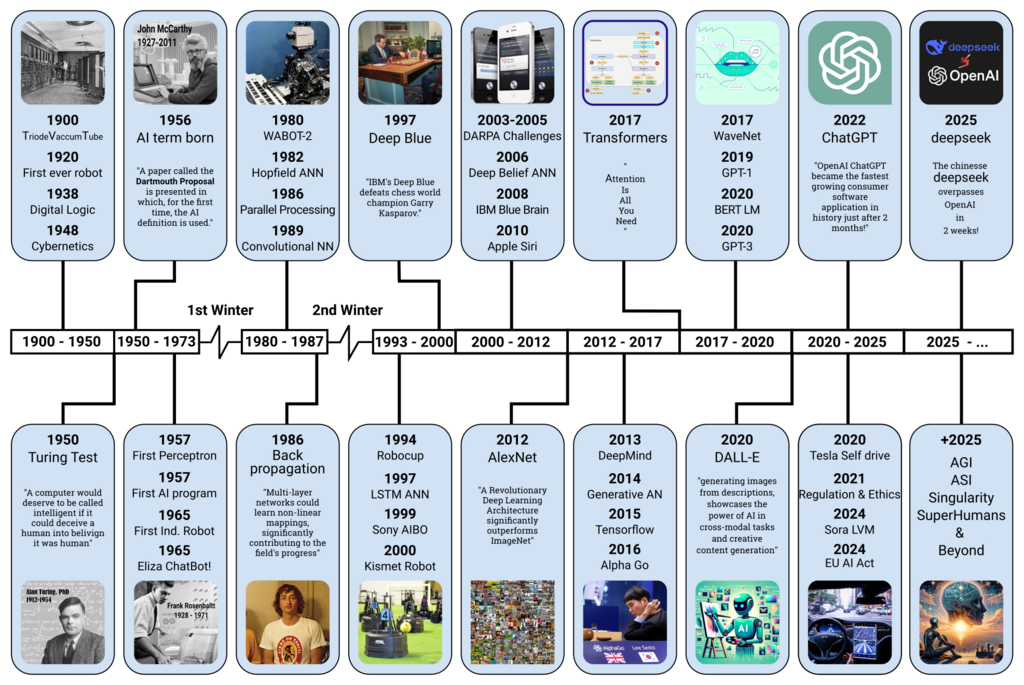
This history is important because it shows that AI is not a single invention but a collection of ideas and technologies that have evolved over decades.
The Building Blocks of AI
AI isn't a single technology; it's an umbrella term for several related fields. Three of the most important components are Machine Learning, Natural Language Processing, and Computer Vision.
Machine Learning (ML) is the engine of most modern AI. It's a way of teaching computers to find patterns in data without being explicitly programmed. Instead of writing step-by-step instructions, developers feed the system a huge amount of data and let it learn the rules for itself. This is how a spam filter learns to identify junk mail or a recommendation engine learns your taste in movies.
Natural Language Processing (NLP) gives machines the ability to understand, interpret, and generate human language. When you talk to a voice assistant, use a translation app, or see a chatbot pop up on a website, you're interacting with NLP. It's the bridge between human communication and computer understanding.
Computer Vision is about teaching computers to see and interpret the visual world. This technology allows machines to recognize faces in photos, identify objects in a video, and even drive a car. It works by analyzing pixels in an image to identify shapes, colors, and patterns, much like our own eyes and brain.
Two Kinds of AI
It's also helpful to distinguish between the AI we have today and the AI often seen in science fiction.
Artificial Narrow Intelligence (ANI), sometimes called Weak AI, is what we have now. These systems are designed to perform a single task or a narrow range of tasks very well. Your GPS, a chess-playing computer, and a language translation tool are all examples of ANI. They are incredibly powerful in their specific domains but cannot operate outside of them.
Artificial General Intelligence (AGI), or Strong AI, is the hypothetical intelligence of a machine that can understand or learn any intellectual task that a human being can. An AGI would be able to reason, plan, and think abstractly across many different fields. This type of AI does not yet exist and is still a long-term goal for researchers.
All current AI systems are forms of Narrow AI. They excel at specific tasks but lack the general, flexible intelligence of a human.
Now let's check your understanding of these fundamental concepts.
What is the primary goal of Artificial Intelligence?
The periods in AI history characterized by reduced funding and interest are known as what?
Understanding these core ideas is the first step. They provide the framework for how AI systems work and what they are capable of achieving.