AI for Product Managers
Introduction to AI
What Is AI?
Artificial Intelligence is the science of making computers do things that normally require human intelligence. Think about recognizing a friend in a photo, understanding a spoken sentence, or making a strategic decision in a game. These are tasks that come naturally to us, but for a machine, they represent complex challenges.
Artificial Intelligence
noun
The theory and development of computer systems able to perform tasks that normally require human intelligence, such as visual perception, speech recognition, decision-making, and translation between languages.
At its core, AI is not about creating conscious robots. It’s about building tools that can analyze information, identify patterns, and make predictions or decisions. The goal is to create systems that can learn and adapt on their own, becoming more effective over time without being explicitly programmed for every single task.
A Quick Trip Through Time
The idea of intelligent machines has been around for centuries, but the formal field of AI research began in the 1950s. The journey has been a rollercoaster, with periods of great excitement and funding followed by "AI winters" when progress stalled and interest waned.
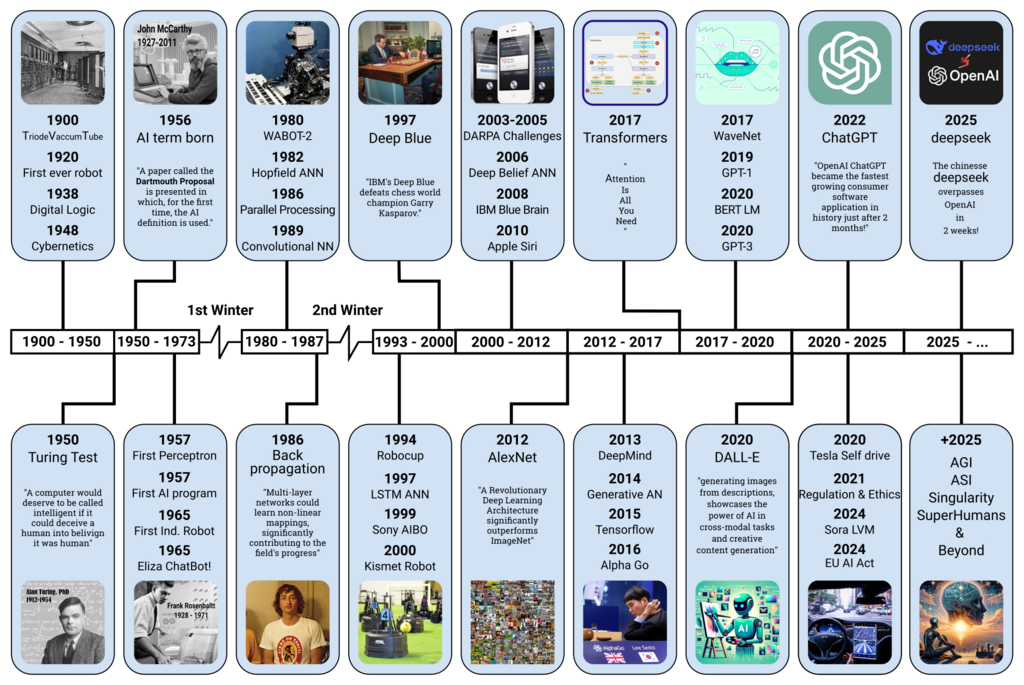
Early AI focused on rule-based systems. A programmer would manually write rules for the machine to follow, like in a game of chess. While effective for specific problems, this approach was brittle. If a situation arose that wasn't covered by a rule, the system would fail.
The modern AI boom is powered by two main forces: the availability of massive amounts of data and the development of powerful computers that can process it all. This has allowed a shift from hand-coded rules to systems that learn the rules themselves.
The Building Blocks of AI
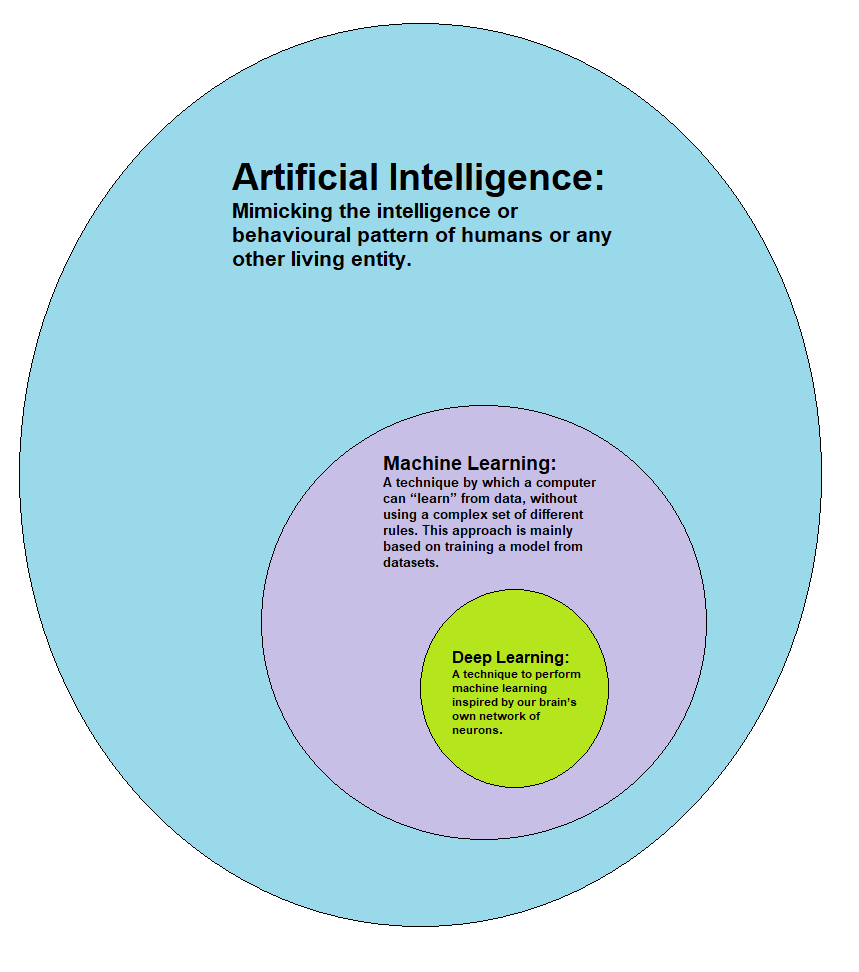
AI is a broad field, like biology or physics. It contains several sub-fields that focus on different aspects of intelligence. For product managers, understanding a few key concepts is crucial for seeing how AI can solve real problems.
Machine Learning
Machine learning (ML) is the most common form of AI today. Instead of being programmed with rules, an ML model is trained on data. It learns to recognize patterns and make predictions from those examples.
Imagine trying to teach a computer to identify spam emails. With a rule-based system, you'd create a long list of rules: "If the email contains 'free money,' mark as spam." But spammers adapt. With machine learning, you simply feed the system thousands of emails that have already been labeled as 'spam' or 'not spam.' The model learns the characteristics of spam on its own, becoming much more flexible and accurate.
Machine learning is about learning from data to make predictions, rather than following explicitly programmed instructions.
Neural Networks
Neural networks are a type of machine learning model loosely inspired by the structure of the human brain. They consist of layers of interconnected nodes, or "neurons." Each neuron receives inputs, processes them, and passes the result to the next layer.
When a neural network has many layers, it's called "deep learning." This depth allows it to learn incredibly complex patterns from data, such as identifying objects in images or understanding the nuances of human speech. Most of the recent breakthroughs in AI, from self-driving cars to advanced chatbots, are powered by deep learning.
Natural Language Processing
Natural Language Processing (NLP) is a branch of AI focused on the interaction between computers and human language. Its goal is to enable computers to read, understand, interpret, and generate human languages in a way that is both meaningful and useful.
Natural Language Processing
noun
A field of artificial intelligence that enables computers to understand, interpret, and manipulate human language.
Every time you use a voice assistant, see a text translated automatically, or get a grammar suggestion in a document, you're using NLP. It combines machine learning and linguistics to turn unstructured text or speech into data a computer can work with.
Now that you've got a handle on the basics, let's test your knowledge.
What is the primary goal of Artificial Intelligence as described in the text?
How did early AI systems, such as those for playing chess, primarily operate?
Understanding these core concepts—AI as the broad goal, machine learning as the method, neural networks as a powerful tool, and NLP as the bridge to human language—is the first step to thinking about how AI can build smarter, more helpful products.