AI for Ops Executives
Introduction to Artificial Intelligence
What Is AI, Really?
Artificial intelligence is the science of making machines that can think and learn like humans. It's not about creating conscious robots from movies. Instead, it’s about building systems that can perform tasks that typically require human intelligence, like recognizing speech, making decisions, or translating languages.
Think of it as giving a computer the ability to solve problems on its own, without being explicitly programmed for every single step.
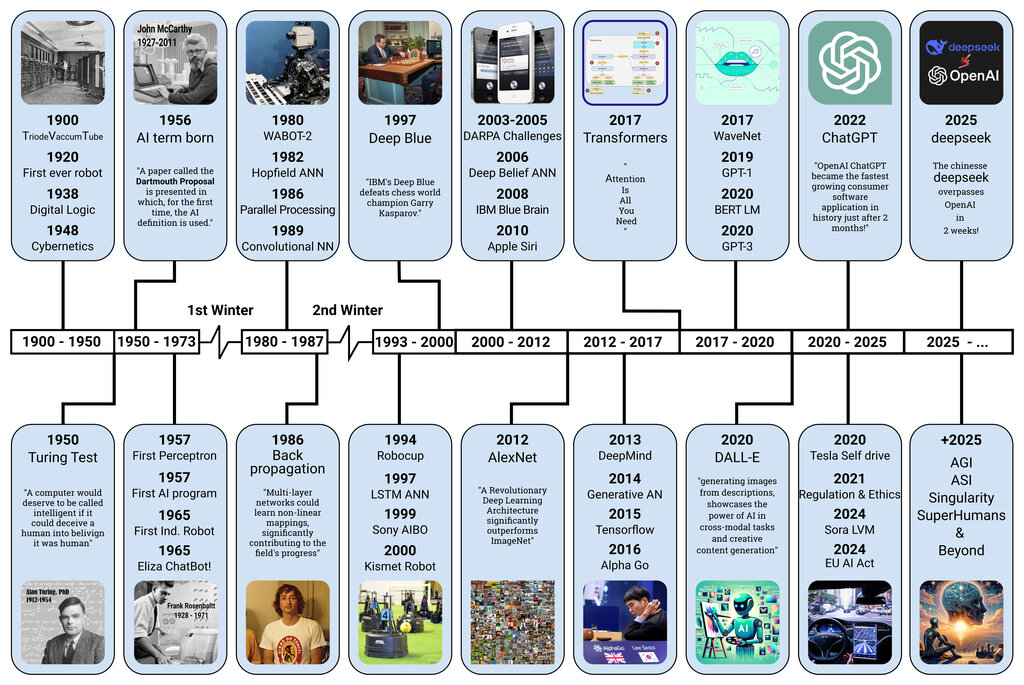
The idea of AI has been around for decades, evolving from simple rule-based systems to the complex models we see today. It's a journey from philosophical concepts to technologies that are now a part of daily life.
The Three Types of AI
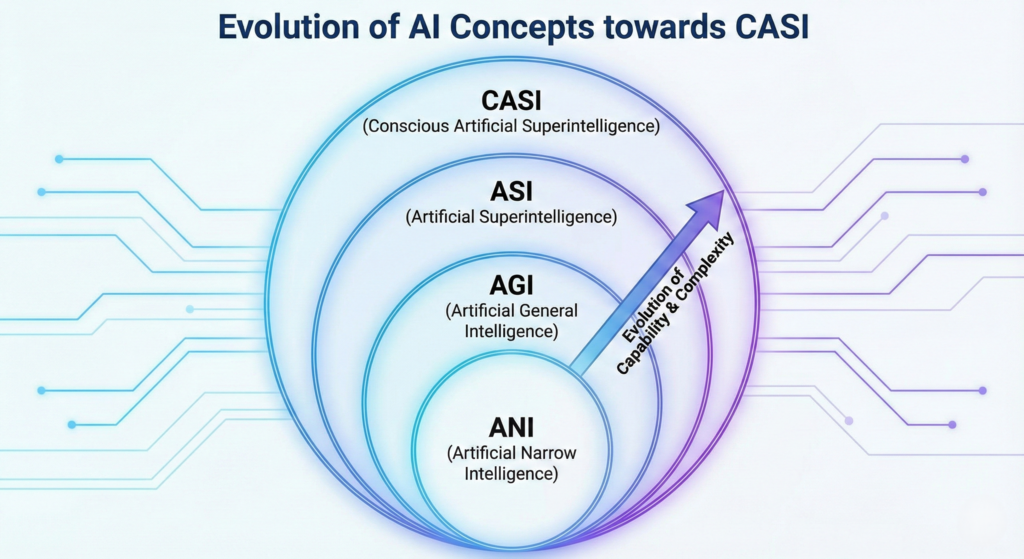
Not all AI is created equal. We can categorize AI into three types based on its capabilities. Most of what we interact with today falls into the first and most basic category.
Artificial Narrow Intelligence
noun
AI that is trained to perform a specific, narrow task. It operates within a pre-defined range and cannot perform tasks beyond its single purpose.
This is also called "Weak AI," and it's everywhere. Your digital voice assistant, the recommendation engine on a streaming service, and even the software that helps fly a commercial airplane are all examples of Narrow AI. They are incredibly good at their one job but can't step outside of it. You can't ask your spam filter to play a song.
Artificial General Intelligence
noun
A theoretical form of AI where a machine has intellectual capabilities equal to a human. It could understand, learn, and apply knowledge across a wide range of tasks.
Often called "Strong AI," this is the type of intelligence that science fiction loves to explore. An AGI would be able to learn to play chess, write a poem, and then figure out your taxes, all without being specifically trained for each task. This level of AI does not yet exist and is considered the holy grail for many researchers in the field.
Artificial Superintelligence
noun
A hypothetical AI with intelligence far surpassing that of the brightest human minds. It would excel in every field, from scientific creativity to general wisdom.
This is the final, theoretical stage. An ASI wouldn't just be smarter than a human; its cognitive abilities would be so advanced that we might not even be able to comprehend them. This idea is still purely speculative.
The Building Blocks of AI
The broad field of AI contains several important subfields. Think of AI as the main subject, and these as the specialized topics within it. Understanding them helps clarify how AI actually works.
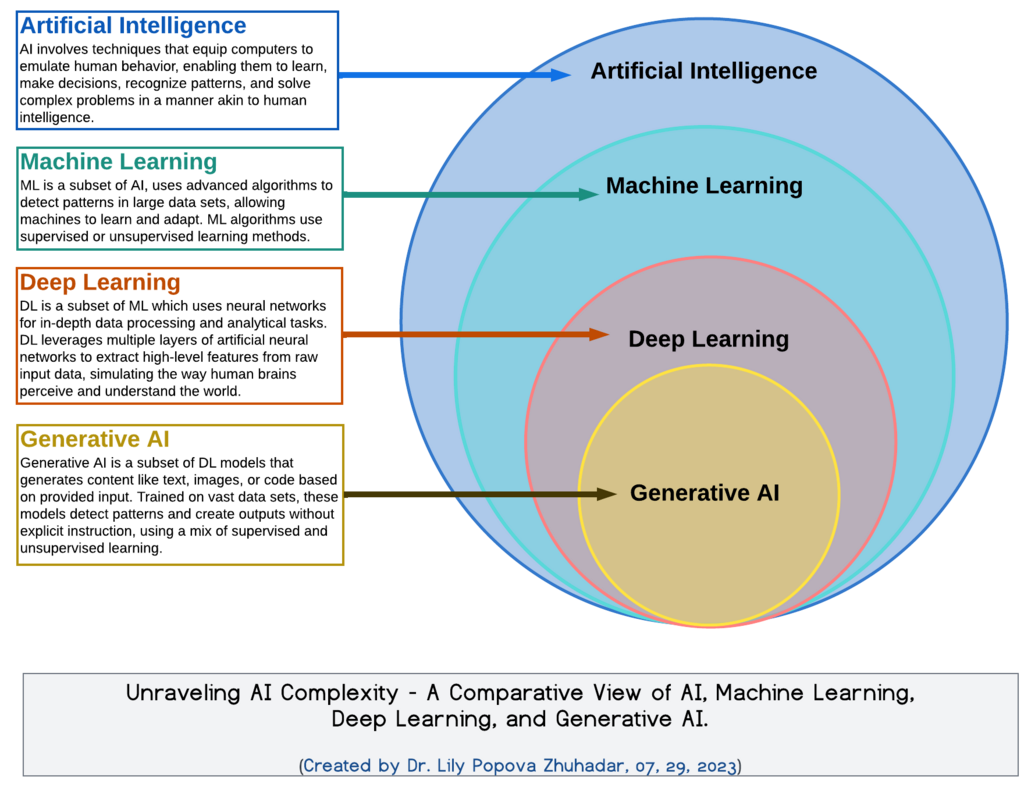
Machine Learning (ML) is a core part of modern AI. Instead of writing explicit rules for a computer, ML allows it to learn from data. You show the machine thousands of examples, and it starts to recognize patterns on its own. Spam filters learn to identify junk mail by analyzing countless emails you've marked as spam.
Deep Learning (DL) is a more advanced type of machine learning. It uses complex structures called neural networks, which are loosely inspired by the human brain. With many layers of these networks, a deep learning model can learn very subtle patterns from massive amounts of data. This is the technology behind facial recognition and self-driving cars, which need to process vast amounts of visual information.
Natural Language Processing (NLP) is the subfield focused on helping computers understand, interpret, and generate human language. Whenever you talk to a chatbot, use a translation app, or see a tool that summarizes a long document, you're seeing NLP at work. It's the bridge between human communication and computer understanding.
These concepts are the foundation of almost every AI application you encounter. They're not just abstract ideas; they are practical tools that power real-world systems and business solutions.
Now, let's test your understanding of these foundational ideas.
Which statement best describes the primary goal of Artificial Intelligence as it is practiced today?
A self-driving car uses complex, multi-layered neural networks to process vast amounts of visual data from cameras and sensors to navigate safely. This is a prime example of which AI subfield?
Grasping these fundamentals—the what, the types, and the key subfields—is the first step to understanding how AI can be a powerful tool in any context.