AI for New Product Innovation
Introduction to AI
What Is Artificial Intelligence?
Artificial Intelligence (AI) is the field of computer science dedicated to creating machines that can perform tasks that typically require human intelligence. This includes things like learning, reasoning, problem-solving, perception, and using language.
Think of it this way: when a person learns to identify a dog, they see many different dogs—big ones, small ones, fluffy ones, short-haired ones. Over time, they form a general concept of "dog." AI works in a similar way, but with data. It sifts through vast amounts of information to find patterns and make decisions, often far faster and more accurately than a human could.
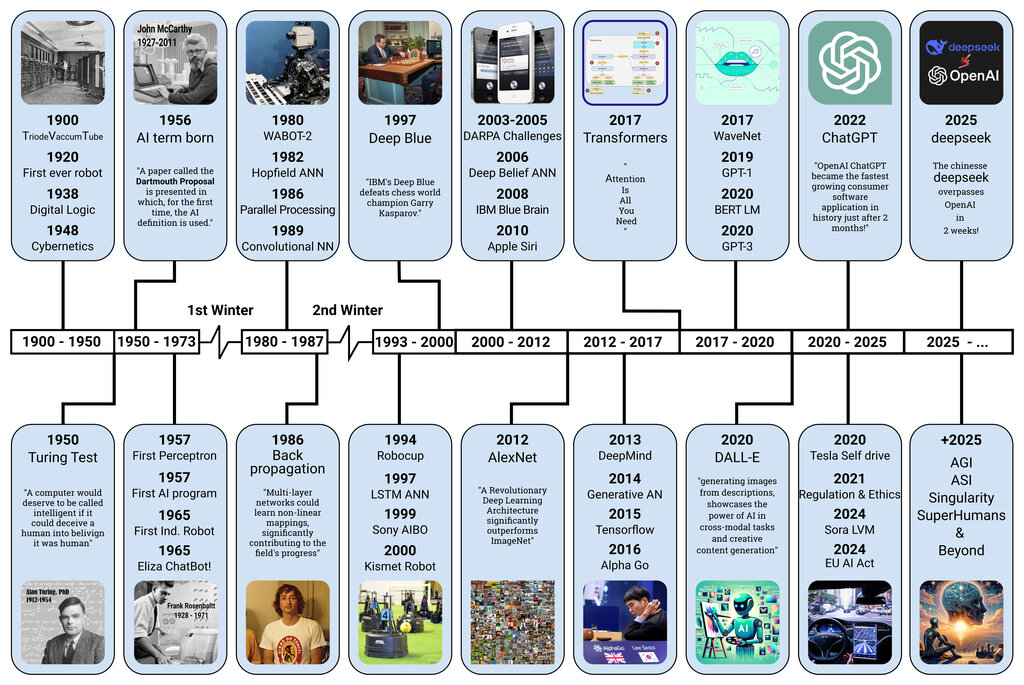
The idea isn't new. Philosophers have long imagined artificial beings. But the modern field of AI officially began in the summer of 1956 at a conference at Dartmouth College. Since then, it has gone through periods of intense excitement and funding, followed by "AI winters" where progress stalled. Today, thanks to powerful computers and massive datasets, we are in a new AI spring.
Types of AI
AI isn't a single, all-knowing entity like you see in movies. The AI we interact with today is highly specialized. We can group AI into two main categories based on its capabilities: Narrow AI and General AI.
Narrow AI
noun
Also known as Weak AI, this type of artificial intelligence is designed and trained for a particular task. It operates within a limited context and is a master of its specific domain.
Virtually all AI in existence today is Narrow AI. Think about the recommendation engine that suggests what to watch next on a streaming service, the voice assistant on your phone, or the software that recognizes your face to unlock your device. Each is an expert at one thing. It can't take its "knowledge" of movies and apply it to understanding a medical diagnosis.
In contrast, there's the long-sought goal of General AI.
General AI
noun
Also known as Strong AI or Artificial General Intelligence (AGI), this is a theoretical form of AI where a machine would have an intelligence equal to humans. It would have a self-aware consciousness and the ability to solve problems, learn, and plan for the future.
We are still a long way from creating AGI. It remains the stuff of science fiction, a fascinating but distant goal for researchers.
How AI Learns
So how do we build AI, especially the Narrow AI we use daily? The power behind modern AI comes from a set of techniques that allow machines to learn from data. The most important of these are Machine Learning and Deep Learning.
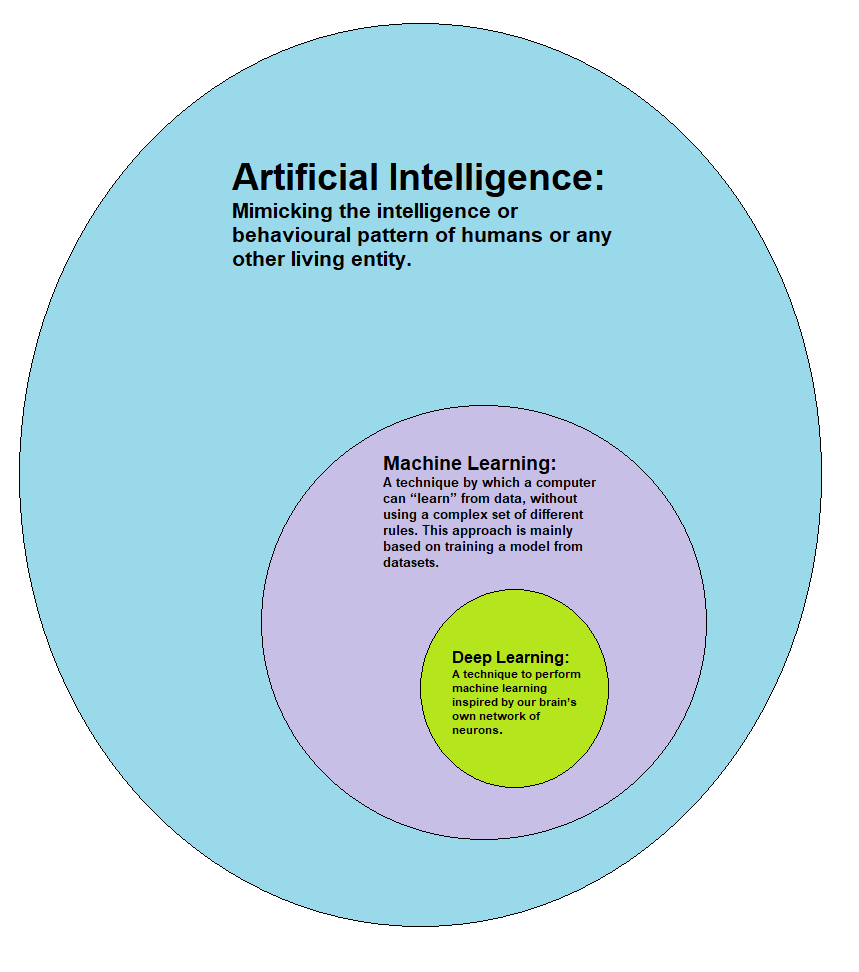
Machine Learning (ML) is a subset of AI. Instead of being explicitly programmed with rules, a machine learning model is trained on a large dataset. It learns to recognize patterns within that data and then uses those patterns to make predictions or decisions about new, unseen data.
For example, to build an ML model that identifies spam emails, you'd feed it thousands of emails already labeled as "spam" or "not spam." The model learns the common features of spam (like certain keywords or sender patterns) on its own. It then applies this learned knowledge to classify incoming emails it's never seen before.
Deep Learning (DL) is a more advanced subset of machine learning. Its structure is inspired by the human brain, using artificial neural networks with many layers. Each layer builds upon the output of the previous one to recognize more complex patterns.
Deep learning is what powers many of the most impressive AI feats today, such as highly accurate image recognition and sophisticated language translation. It requires even larger amounts of data and more powerful computers than traditional machine learning.
Natural Language Processing (NLP) is another key area of AI that focuses on the interaction between computers and human language. It's the technology that allows machines to read, understand, interpret, and generate human language.
Whenever you use a chatbot, a language translation app, or a voice-to-text feature, you're using NLP. It combines machine learning, deep learning, and linguistic rules to bridge the gap between human communication and computer understanding.
What is the primary goal of the field of Artificial Intelligence?
The voice assistant on your phone that can answer questions and set timers, but cannot apply that knowledge to diagnose a medical condition, is an example of what?