AI for Microsoft IT Infrastructure
Introduction to AI in IT
What Is AI, Really?
Artificial intelligence isn't about sentient robots from science fiction. At its core, AI is the science of making machines that can think and learn like humans. It's about creating systems that can perform tasks that normally require human intelligence, like understanding language, recognizing patterns, and making decisions.
The idea has been around for decades. Early computer scientists dreamed of creating thinking machines. In 1950, Alan Turing proposed a test for machine intelligence that we still talk about today. But for a long time, the hardware and data needed to make these dreams a reality just weren't there. Now, with powerful computers and vast amounts of data, AI has moved from theory to a practical tool that's changing the world, especially in Information Technology (IT).
Artificial Intelligence
noun
The theory and development of computer systems able to perform tasks that normally require human intelligence, such as visual perception, speech recognition, decision-making, and translation between languages.
The Language of AI
To understand AI's role in IT, you need to know a few key terms. You'll hear them used often, sometimes interchangeably, but they have distinct meanings.
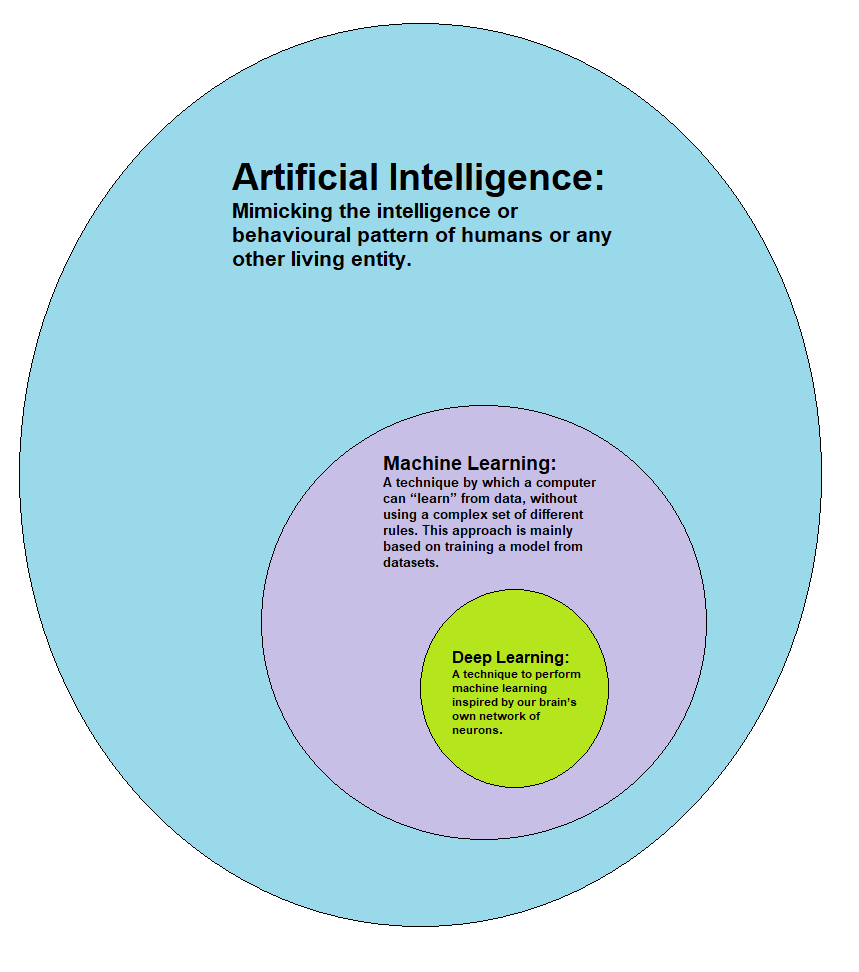
The most important concept to grasp is Machine Learning. It’s a subset of AI and the engine behind most modern AI applications.
Machine Learning
noun
A type of artificial intelligence that provides computers with the ability to learn without being explicitly programmed. It focuses on the development of algorithms that can access data and use it to learn for themselves.
Think of it this way: instead of writing code that says "if you see these specific words, it's spam," you give the machine thousands of examples of spam and non-spam emails. The machine learns the patterns on its own.
Deep Learning takes this a step further. It's a specialized type of machine learning that uses structures called neural networks, which are loosely inspired by the human brain.
Deep Learning
noun
A subfield of machine learning based on artificial neural networks with multiple layers (deep neural networks). It allows computational models to learn representations of data with multiple levels of abstraction.
These deep networks are excellent at finding very complex patterns in large datasets, making them ideal for tasks like image recognition and natural language processing.
AI Meets IT
So, how does this technology apply to IT? The goal of any IT department is to keep systems running smoothly, securely, and efficiently. AI helps achieve this by automating complex processes and providing insights that would be impossible for humans to find on their own.
This application is often called AIOps, which stands for AI for IT Operations.
AIOps is the practice of using AI to solve operational IT problems. It helps teams work smarter and faster by automating tasks, identifying issues before they become critical, and analyzing vast amounts of data in real-time.
AI's impact can be seen across the entire IT infrastructure.
In operations, AI systems can monitor network traffic and server performance, predicting potential failures before they happen. Imagine a system that alerts you that a server's hard drive is likely to fail in the next 24 hours, giving you time to replace it with no downtime. That's predictive maintenance, powered by AI.
For management, AI helps optimize resources. In a cloud computing environment, it can analyze usage patterns and automatically scale resources up or down, ensuring performance while preventing overspending. It can also automate routine tasks like software updates and backups, freeing up IT staff to focus on more strategic projects.
And in security, AI is a game-changer. It can analyze network behavior to detect anomalies that might indicate a cyberattack. Instead of relying on known virus signatures, AI-powered security systems can identify new, unseen threats based on suspicious activity alone. This is crucial for defending against sophisticated modern attacks.
The Payoff
Integrating AI into IT infrastructure isn't just about adopting the latest technology. It delivers tangible benefits that directly impact a business's bottom line. The primary advantages stack up quickly.
| Benefit | How AI Delivers It |
|---|---|
| Increased Efficiency | Automates repetitive, manual tasks, allowing IT teams to focus on high-value work. |
| Improved Reliability | Predicts system failures and performance bottlenecks, reducing downtime and service disruptions. |
| Enhanced Security | Detects and responds to cyber threats faster and more accurately than human teams can alone. |
| Cost Savings | Optimizes resource allocation, particularly in the cloud, and reduces costs associated with downtime and manual labor. |
| Faster Problem Solving | Quickly identifies the root cause of complex issues by analyzing logs and performance data from multiple systems at once. |
Ultimately, AI transforms IT from a reactive department that fixes problems to a proactive one that prevents them. It allows organizations to manage increasingly complex digital environments with greater speed, intelligence, and control.
What is the core concept behind Artificial Intelligence (AI)?
Which statement best describes the relationship between Artificial Intelligence (AI), Machine Learning (ML), and Deep Learning (DL)?
By understanding these core concepts, you have a solid foundation for seeing how AI is not just a buzzword, but a powerful force reshaping the world of information technology.