AI for Finance and FP&A
Introduction to AI
What Is Artificial Intelligence?
At its core, Artificial Intelligence (AI) is about creating machines that can think, learn, and solve problems like a human. It's a broad field of computer science focused on simulating intelligent behavior in computers. This doesn't just mean calculating numbers faster. It means understanding language, recognizing images, making decisions, and even creating art.
Artificial Intelligence
noun
The theory and development of computer systems able to perform tasks that normally require human intelligence, such as visual perception, speech recognition, decision-making, and translation between languages.
Think of AI not as a single technology, but as an umbrella term for a collection of methods that allow a machine to sense its environment, process information, and act to achieve a specific goal. The goal could be anything from recommending a movie to driving a car.
A Brief History of AI
The idea of intelligent machines has been around for centuries, but the formal field of AI research began in the mid-1950s. Early researchers were optimistic, believing that a machine as intelligent as a human could be built within a few decades. The journey, however, proved more complex.

The field has experienced periods of rapid progress followed by "AI winters," when funding and interest dwindled due to unfulfilled promises. The recent explosion in AI is thanks to two main factors: the availability of massive amounts of data and the development of powerful computers that can process it all. This combination has turned many of AI's early ambitions into reality.
The Building Blocks of AI
AI is a vast concept, but its modern power comes from a few key subfields. The most important ones to know are Machine Learning, Neural Networks, and Deep Learning. They are nested concepts, each one a specialized part of the one before it.
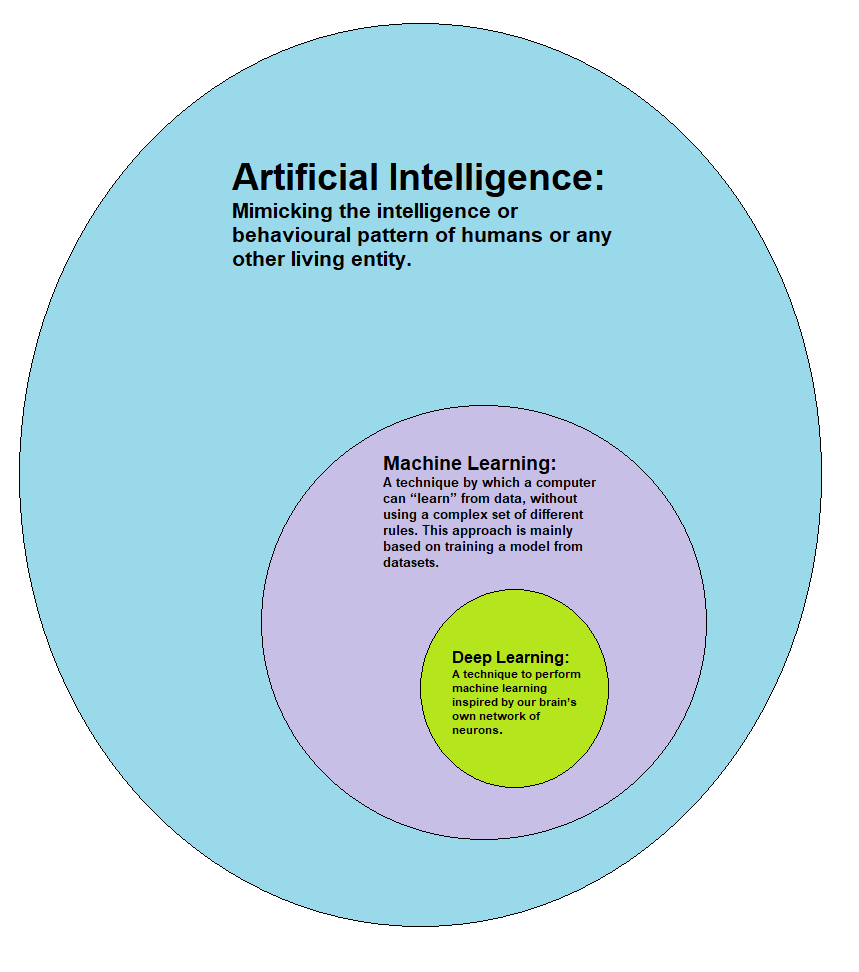
Machine Learning (ML) is the most common approach to AI today. Instead of writing explicit, step-by-step instructions for a task, developers create algorithms that allow computers to learn from data. The machine identifies patterns and makes decisions on its own. For example, an email service learns to spot spam by analyzing millions of emails that users have marked as junk.
Neural Networks are a key part of machine learning, loosely inspired by the structure of the human brain. They consist of layers of interconnected nodes, or "neurons." Each neuron receives input, processes it, and passes an output to the next layer. By adjusting the connections between these neurons, the network can learn to recognize complex patterns, like the features of a face in a photograph.
Deep Learning (DL) is a type of machine learning that uses deep neural networks, meaning networks with many layers. The "deep" structure allows the system to learn from data in a hierarchical way. For instance, to recognize a car, the first layer might learn to identify simple edges and colors. The next layer might combine those to recognize shapes like wheels and windows. Subsequent layers combine those features to identify a complete car. This depth is what enables today's most advanced AI applications, like natural language translation and self-driving cars.
AI Across Industries
While our focus will be on finance, it's important to recognize that AI is transforming nearly every sector. It's not a niche technology; it's a foundational tool with wide-ranging applications.
| Industry | Example Application |
|---|---|
| Healthcare | Analyzing medical images to detect diseases earlier. |
| Retail | Recommending products based on past purchases. |
| Transportation | Optimizing delivery routes and developing self-driving cars. |
| Entertainment | Creating personalized playlists and movie suggestions. |
| Manufacturing | Using robots for assembly and predicting machine failures. |
Understanding these fundamental concepts is the first step. They provide the context needed to appreciate how AI is being applied to more specific and complex challenges in the world of finance and beyond.
Ready to check your understanding? Let's review what you've learned.
What is the fundamental goal of Artificial Intelligence (AI)?
Which of the following best describes the relationship between Artificial Intelligence (AI), Machine Learning (ML), and Deep Learning (DL)?
With this foundation in place, you're ready to explore how these powerful tools are reshaping specific industries.