AI for Everyday Productivity
Introduction to Artificial Intelligence
What Is Artificial Intelligence?
Artificial Intelligence, or AI, is about making computers smart. It’s the science of teaching machines to learn, reason, and make decisions in ways that traditionally require human intelligence. Think of it less as programming a computer with rigid instructions and more like training it to recognize patterns and adapt.
Artificial Intelligence
noun
A field of computer science dedicated to creating systems that can perform tasks that normally require human intelligence, such as visual perception, speech recognition, decision-making, and translation between languages.
A standard computer program, like a calculator, follows a strict set of rules. You input 2 + 2, and its code explicitly tells it to output 4. It can't do anything else. If you ask it for the capital of France, it will produce an error. It doesn't learn; it only executes.
AI is different. It learns from data. Instead of writing a rule for every possible scenario, developers feed an AI model thousands of examples. To build an AI that identifies cats, you don't write rules about whiskers and pointy ears. You show it millions of pictures labeled "cat" and let it figure out the patterns for itself. This ability to learn from experience is the core difference between AI and traditional programming.
A Brief History of AI
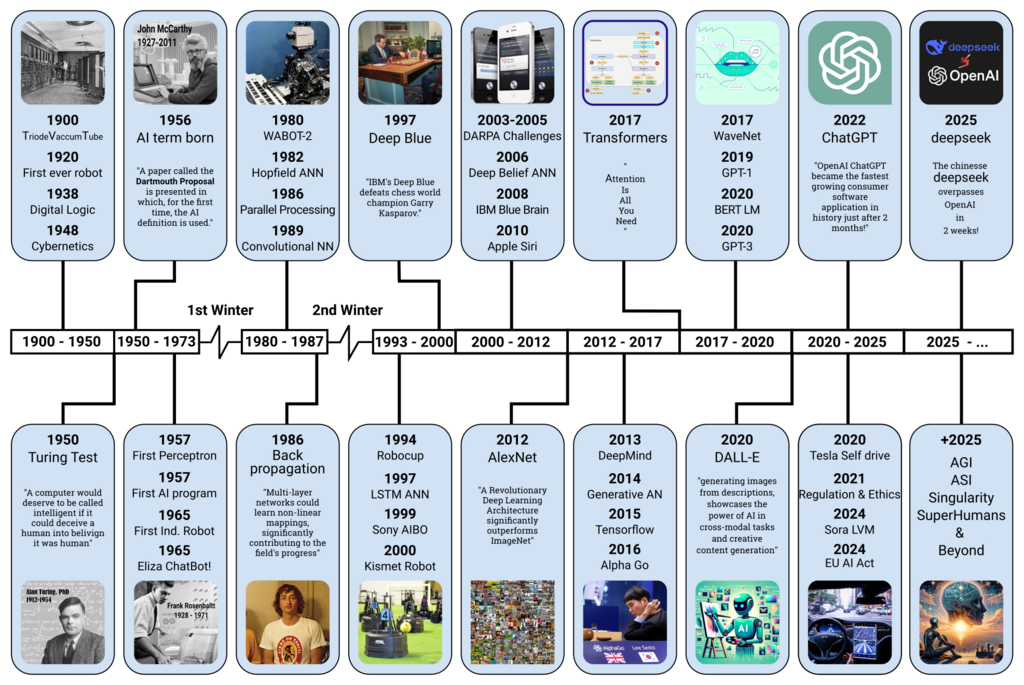
The dream of creating intelligent machines is old, but the scientific field of AI is relatively new. It officially began in the summer of 1956 at a conference at Dartmouth College, where the term "Artificial Intelligence" was first coined. Early researchers were optimistic, believing that a machine with human-like intelligence was just a few decades away.
This optimism led to periods of intense excitement and funding, followed by "AI winters" when progress stalled and interest faded. The early promises were hard to deliver because computers lacked the necessary processing power and, crucially, the vast amounts of data needed for learning.
That all changed in the 21st century. The rise of the internet created a firehose of data—text, images, and videos—that could be used to train AI models. At the same time, specialized computer chips called Graphics Processing Units (GPUs) became powerful enough to handle the massive calculations required. This combination of big data and powerful hardware fueled the AI boom we see today.
The Two Main Flavors of AI
When people talk about AI, they are usually referring to one of two broad categories: Narrow AI and General AI.
Everything we use today—from your phone's digital assistant to complex medical diagnostic tools—is a form of Narrow AI.
Artificial Narrow Intelligence (ANI), also known as Weak AI, is designed and trained for one specific task. An AI that plays chess cannot order you a pizza. A spam filter that protects your inbox has no idea how to drive a car. These systems can be incredibly powerful and even outperform humans at their specific tasks, but they operate within a limited, pre-defined range. Their intelligence is specialized.
Artificial General Intelligence (AGI), or Strong AI, is the kind of AI you often see in science fiction. This is a machine with the ability to understand, learn, and apply its intelligence to solve any problem, much like a human being. It would possess consciousness, self-awareness, and the ability to transfer knowledge from one domain to another. AGI does not currently exist, and it remains a theoretical and long-term goal for many AI researchers.
What is the core difference between an AI system and a traditional computer program, like a calculator?
The term "Artificial Intelligence" was first coined at a conference in 1956 at which institution?
That's a quick look at what AI is, where it came from, and its main types. Understanding these basics is the first step to seeing how it's changing the world.