AI for Emerging Economies
AI Foundations
What is Artificial Intelligence?
Artificial intelligence, or AI, is the science of making computers do things that normally require human intelligence. This could be anything from understanding language to recognizing faces or making complex decisions. The term was first coined in 1956 at a workshop at Dartmouth College, where a small group of scientists dreamed of creating machines that could think.
At its core, AI is about creating algorithms, or sets of rules, that allow computers to learn from data, identify patterns, and make predictions or decisions. It's a broad field with many different approaches, but the ultimate goal is to simulate or even replicate human cognitive abilities in a machine.
Think of AI as a toolbox. It contains various tools and techniques to build intelligent systems, from simple chatbots to sophisticated self-driving cars.
Two Flavors of AI
Today, AI can be split into two main categories: Artificial Narrow Intelligence (ANI) and Artificial General Intelligence (AGI).
Artificial Narrow Intelligence
noun
AI that is designed and trained for a specific task. It operates within a limited context and can't perform tasks outside its designated scope.
Almost all the AI we use today is ANI. This includes virtual assistants like Siri and Alexa, spam filters in your email, and the AI that powers facial recognition on your phone. These systems are incredibly powerful and efficient at their one job, but they can't suddenly decide to learn a new skill or apply their knowledge to a completely different problem.
Artificial General Intelligence, on the other hand, is the stuff of science fiction—for now. AGI refers to a machine with the ability to understand, learn, and apply its intelligence to solve any problem, much like a human being. This type of AI would have consciousness and self-awareness. While it's a major goal for many researchers, true AGI does not yet exist.
The Learning Machines
So how do we get a machine to act intelligently? One of the most important approaches is machine learning, a subset of AI. Instead of programming a computer with explicit, step-by-step instructions for every possible scenario, machine learning allows the computer to learn on its own by analyzing data.
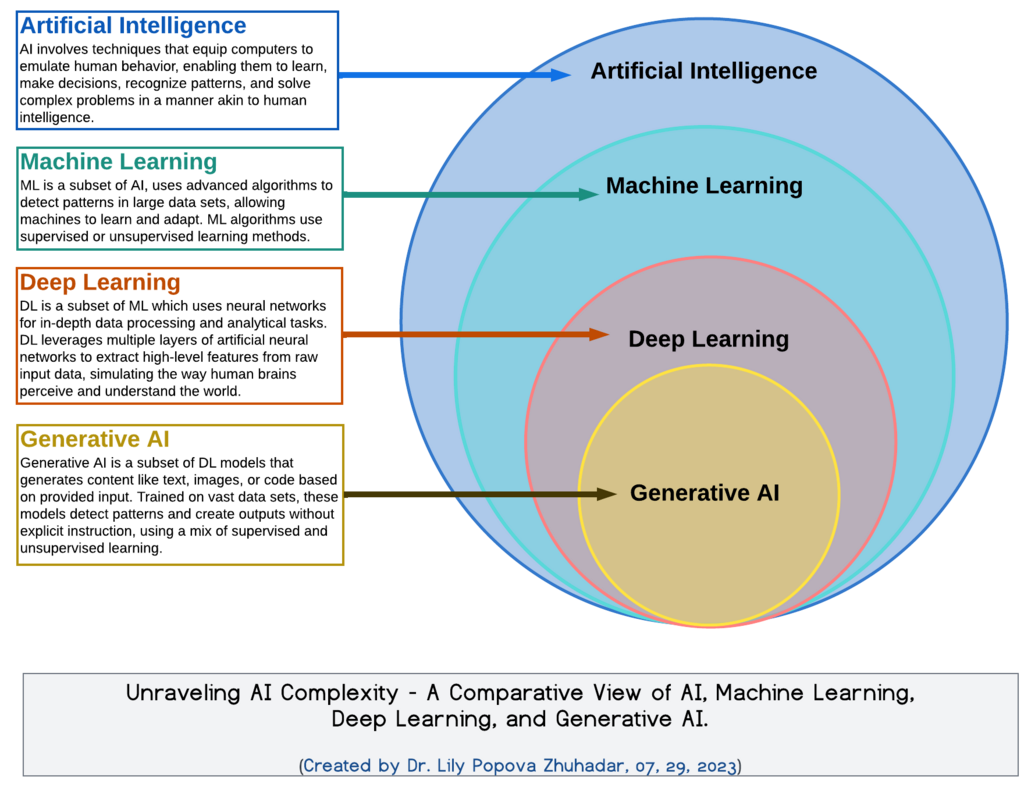
Think about teaching a child to recognize a cat. You don't list out rules like "it must have pointy ears, whiskers, and a tail." Instead, you show them pictures of cats. Over time, the child's brain learns to identify the patterns common to all cats. Machine learning works in a similar way. You feed an algorithm thousands of labeled images—some cats, some not—and it learns to recognize the features of a cat on its own.
Deep learning is a more advanced type of machine learning. It takes the learning process a step further by using complex, multi-layered structures inspired by the human brain. These structures are called neural networks.
The Brain of AI
A neural network is a system of hardware and/or software patterned after the operation of neurons in the human brain. These networks are made up of interconnected nodes, or artificial neurons, organized in layers.
Data enters through the first layer (the input layer). Each node in this layer passes the data to the nodes in the next layer, the "hidden layer." Nodes in the hidden layer perform calculations, weigh the importance of different inputs, and then pass their results to the next layer. This process continues until the final layer (the output layer) produces a result, like a prediction or a classification.
Deep learning models use neural networks with many hidden layers, allowing them to learn very complex patterns from huge amounts of data. This is the technology that powers many of today's most advanced AI applications, from language translation to medical image analysis.
Now, let's test your understanding of these core concepts.
What is the primary goal of Artificial Intelligence (AI)?
The type of AI that can understand, learn, and apply its intelligence to solve any problem, much like a human, is known as ______.
Understanding these building blocks—AI, machine learning, and neural networks—is the first step in harnessing their power to solve real-world problems.