AI for Developers
Introduction to Artificial Intelligence
What Is Artificial Intelligence?
At its core, artificial intelligence is about creating machines that can think and learn like humans. It’s a broad field in computer science focused on building smart systems capable of performing tasks that normally require human intelligence. This includes things like learning from experience, solving problems, understanding language, and recognizing objects.
Artificial Intelligence
noun
The theory and development of computer systems able to perform tasks that normally require human intelligence, such as visual perception, speech recognition, decision-making, and translation between languages.
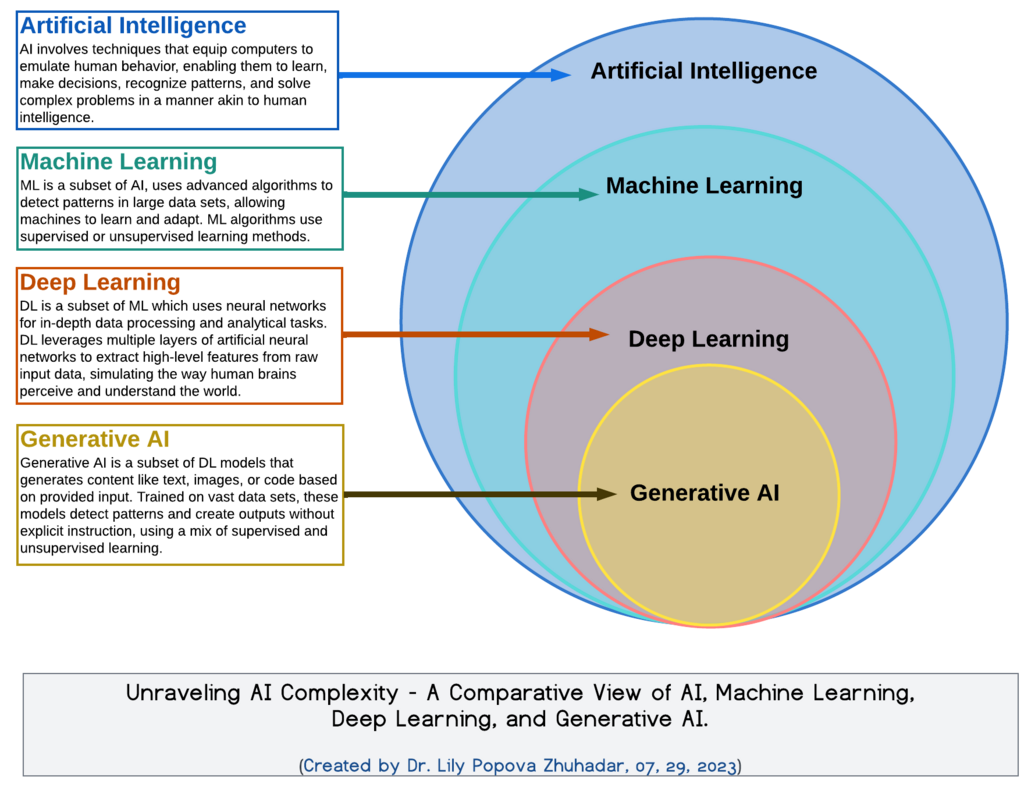
Think of AI not as a single technology, but as an umbrella term that covers many different approaches and subfields. Some of the most important areas within AI are Machine Learning, Deep Learning, and Generative AI, each a subset of the one before it.
A Brief History
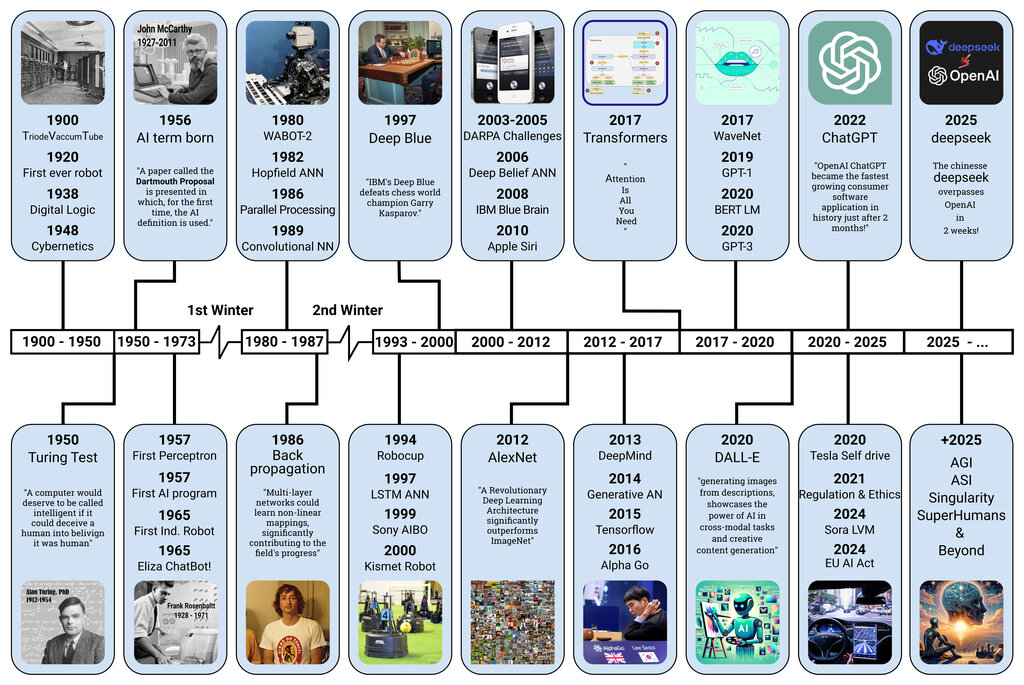
The dream of creating intelligent machines has been around for centuries, but the modern field of AI officially began in the summer of 1956. A group of scientists organized a workshop at Dartmouth College to explore the idea that “every aspect of learning or any other feature of intelligence can in principle be so precisely described that a machine can be made to simulate it.” It was here that the term “artificial intelligence” was coined.
The early decades were dominated by an approach called Symbolic AI. The idea was to program computers with a set of rules and logical statements about the world. The machine would then use these rules to reason about problems and make decisions. For example, to identify a bird, you might give the computer rules like “If it has feathers, and it can fly, and it has a beak, then it is a bird.”
This approach worked well for clearly defined, logical problems like playing chess. However, it struggled with the messiness of the real world. How do you write a rule for every possible exception? What if the bird has feathers but can't fly, like a penguin? The complexity quickly became unmanageable, leading to a period of reduced interest and funding known as an “AI winter.”
The field was revitalized by a new approach, one that focused on learning from data rather than being programmed with rules. This shift, combined with the rise of powerful computers and massive datasets, has powered the AI boom we see today.
The Core Disciplines
Modern AI is divided into several specialized subfields. While they often overlap, each focuses on a different aspect of intelligence. Three of the most prominent are Machine Learning, Natural Language Processing, and Computer Vision.
Machine Learning (ML) is the science of getting computers to act without being explicitly programmed. Instead of writing rules, developers build models and “train” them on large amounts of data. The model learns to recognize patterns in the data and then uses those patterns to make predictions or decisions.
Natural Language Processing (NLP) is all about teaching computers to understand and use human language. This is incredibly complex, as human language is full of ambiguity, slang, and context. NLP enables everything from language translation apps to chatbots and voice assistants that can understand your commands.
Computer Vision aims to give machines the ability to “see.” It involves processing and analyzing digital images and videos to identify and understand what's in them. This is the technology behind facial recognition, self-driving cars navigating roads, and systems that can diagnose diseases from medical scans.
These three fields are the engines driving many of the AI advancements that impact our daily lives.
The Evolution to Deep Learning
Within Machine Learning, a powerful technique called Deep Learning has emerged as a game-changer. Deep Learning is inspired by the structure of the human brain. It uses complex, multi-layered networks called artificial neural networks to learn from vast amounts of data.
Unlike traditional ML, where experts might need to manually select the most important features in the data (like the shape of an ear or the texture of fur for identifying an animal), deep learning models can learn these features on their own. Each layer in the network learns to recognize progressively more complex patterns.
For example, when analyzing an image, the first layer might learn to detect simple edges and colors. The next layer might combine those edges to recognize shapes like eyes and noses. A subsequent layer could combine those shapes to recognize a face. This ability to learn from data at multiple levels of abstraction is what makes deep learning so powerful, especially for complex tasks in computer vision and NLP.
From early symbolic systems to today's data-driven neural networks, the journey of AI has been one of constant evolution. Understanding these foundational concepts is the first step in appreciating the technology that is rapidly shaping our world.
What is the primary goal of artificial intelligence?
Where was the term "artificial intelligence" officially coined?