AI for Course Creators
Introduction to Artificial Intelligence
What Is Artificial Intelligence?
Artificial intelligence, or AI, is the science of making machines that can think or act like humans. The goal is to create systems that can perform tasks that normally require human intelligence, such as learning, reasoning, problem-solving, and understanding language.
Traditional computer programs follow explicit, hard-coded instructions. AI systems, on the other hand, can often learn from data and make decisions or predictions on their own.
Think about the difference between a simple calculator and a spam filter. The calculator follows a fixed set of rules: you input 2 + 2, and it always follows the rule to output 4. A spam filter, powered by AI, doesn't have a rule for every possible spam email. Instead, it learns from thousands of examples what spam looks like and makes an educated guess about new emails it sees.
A Quick History
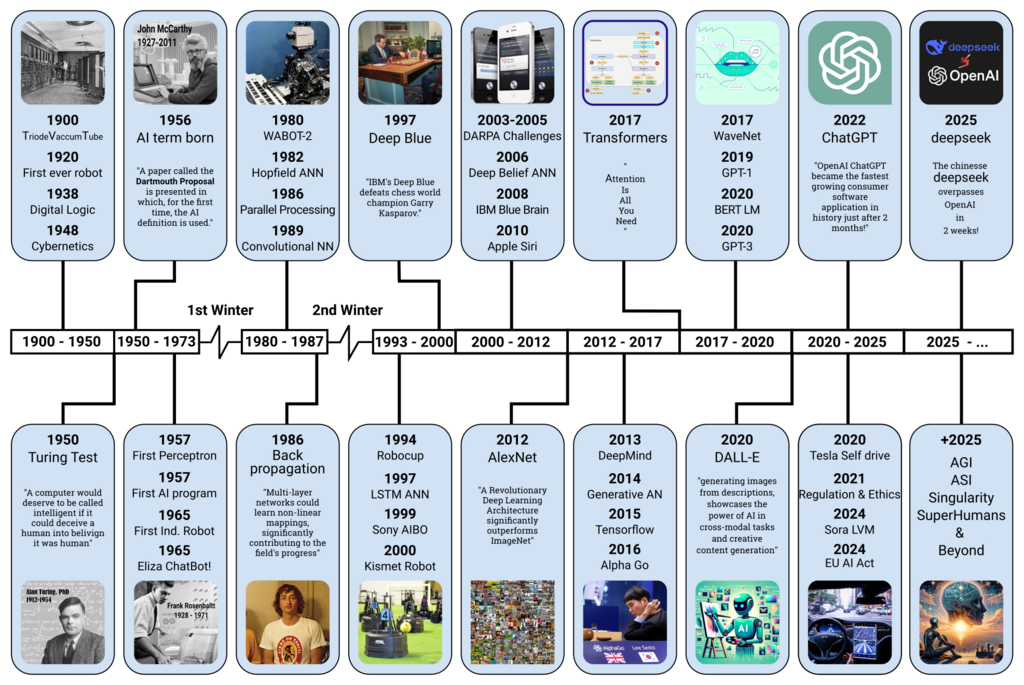
The idea of intelligent machines has been around for centuries, but the modern field of AI began in the mid-20th century. A key moment was the Dartmouth Workshop in 1956, where the term "artificial intelligence" was coined and the field was established as a formal area of research.
Early AI focused on solving puzzles and playing games like chess. Over the decades, progress has come in waves, with periods of rapid advancement followed by "AI winters" where funding and interest dried up. Today, thanks to massive amounts of data and powerful computers, AI is more capable and widespread than ever.
Types of AI
Not all AI is created equal. We can categorize AI based on its capabilities. There are three main types, though only one is common today.
Artificial Narrow Intelligence (ANI)
noun
AI that is designed and trained for one specific task. Also known as Weak AI.
ANI is all around us. It's the AI that recommends movies on Netflix, recognizes your face to unlock your phone, and powers self-driving cars. While these systems can seem incredibly smart, their intelligence is limited to their specific domain. A chess-playing AI can't write a poem, and a spam filter can't diagnose a disease.
| Type | Capability | Example |
|---|---|---|
| Narrow AI (ANI) | Performs a specific task | Face recognition, spam filters |
| General AI (AGI) | Performs any intellectual task a human can | A hypothetical robot with human-like consciousness |
| Superintelligent AI (ASI) | Surpasses human intelligence in every field | A hypothetical AI that is smarter than all of humanity combined |
The other two types, Artificial General Intelligence (AGI) and Artificial Superintelligence (ASI), are still in the realm of science fiction. AGI refers to an AI with human-level intelligence that could understand, learn, and apply its knowledge across a wide range of tasks, just like a person. ASI would be even more advanced, surpassing human intelligence in virtually every field, from scientific creativity to social skills.
The Building Blocks of AI
Several key technologies drive modern AI. You'll often hear terms like Machine Learning, Neural Networks, and Deep Learning used in discussions about AI. They're related but distinct concepts.
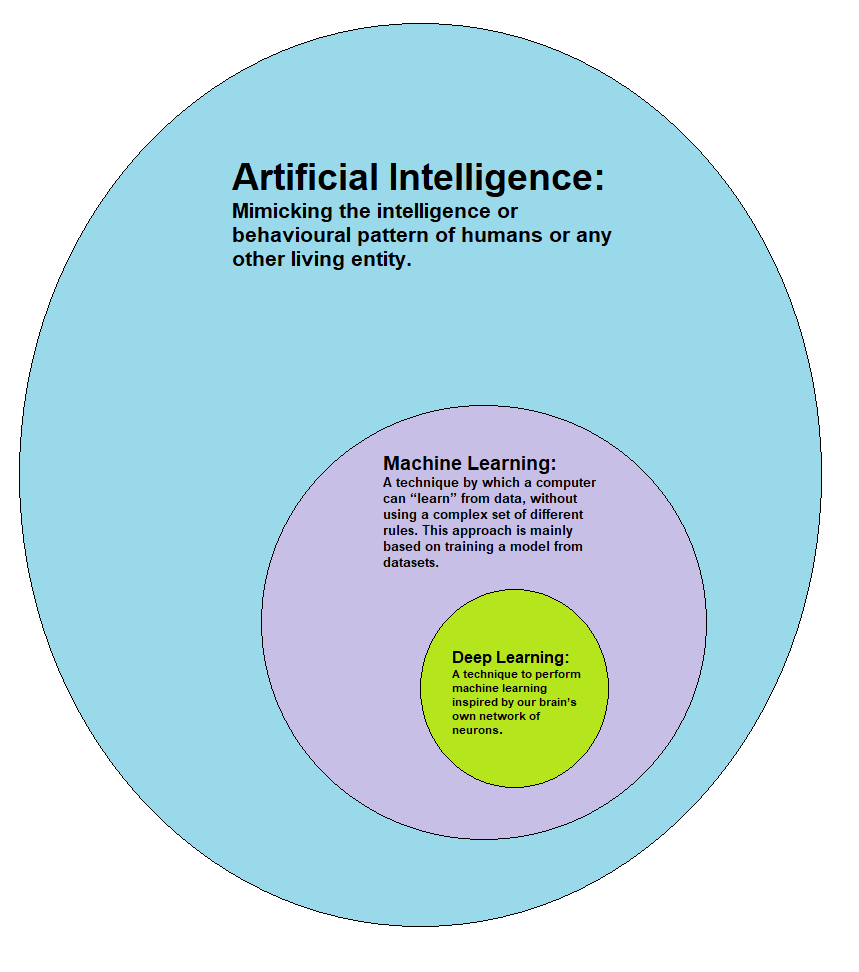
Machine Learning (ML) is a subset of AI. Instead of being explicitly programmed, an ML system is trained on large amounts of data. It learns patterns from this data and uses them to make predictions. For example, by analyzing millions of house sale records, an ML model can learn to predict the price of a house based on its size, location, and number of bedrooms.
Neural Networks are a key part of machine learning, inspired by the structure of the human brain. They are made up of layers of interconnected nodes, or "neurons." Each neuron receives inputs, processes them, and passes the result to the next layer. By adjusting the connections between these neurons during training, the network learns to recognize patterns.
Deep Learning (DL) is a type of machine learning that uses neural networks with many layers—hence the term "deep." These deep networks can learn very complex patterns from vast amounts of data. Deep learning is the technology behind many of today's most impressive AI achievements, like advanced image recognition and natural language processing.
Now that you have a grasp of the basic concepts, let's test your knowledge.
What is the primary goal of Artificial Intelligence?
Which of the following is the best example of Artificial Narrow Intelligence (ANI)?
Understanding these foundational ideas—what AI is, where it came from, and its core technologies—is the first step to seeing how it's changing our world.