AI for Corporate Boards
Introduction to AI
What Is Artificial Intelligence?
Artificial Intelligence, or AI, is the simulation of human intelligence in machines. At its core, it's about creating systems that can perform tasks that typically require human intellect, such as learning, reasoning, problem-solving, and understanding language.
The concept isn't new. The term "Artificial Intelligence" was coined in 1956 at a Dartmouth College workshop, which is widely considered the birth of the field. Early AI research focused on rule-based systems, where programmers explicitly wrote instructions for every possible scenario. This approach worked for well-defined problems, like playing chess, but it was brittle and couldn't handle the complexities of the real world.
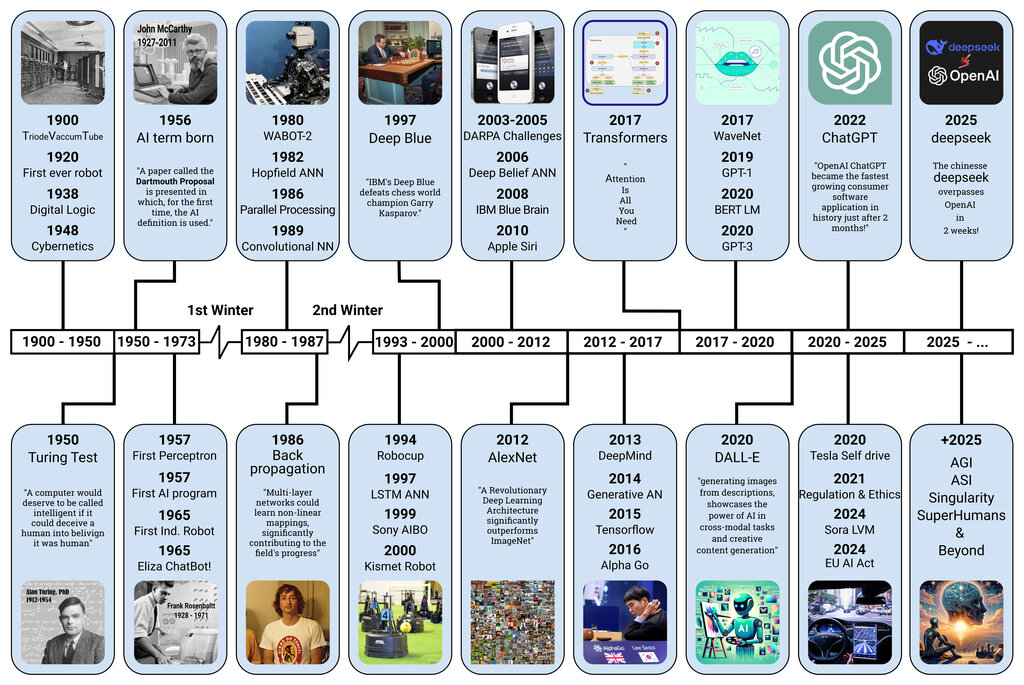
The major shift came with the rise of machine learning, fueled by massive increases in data and computing power. Instead of being explicitly programmed, modern AI systems learn patterns and make decisions from data.
Two Kinds of AI
When discussing AI, it's critical to distinguish between two main types: Narrow AI and General AI. Understanding this distinction is key to cutting through the hype and focusing on what's relevant for business today.
Artificial Narrow Intelligence (ANI)
noun
Also known as Weak AI, this is the only type of AI we have achieved so far. ANI is designed and trained to perform a specific task without being explicitly programmed how to do so. It operates within a limited context and can't perform tasks beyond its designated field.
Think of ANI as a highly specialized tool. A calculator is brilliant at arithmetic but can't write an email. Similarly, an AI that excels at detecting fraud in financial transactions has no ability to diagnose a medical condition. All current business applications of AI fall under this category.
Artificial General Intelligence (AGI)
noun
Also known as Strong AI, this is the type of AI often seen in science fiction. AGI refers to a machine with the ability to understand, learn, and apply its intelligence to solve any problem that a human being can. It possesses consciousness, self-awareness, and a broad, adaptable intellect.
AGI remains a theoretical concept and a long-term research goal. For strategic planning at the board level, the focus should be on the capabilities and implications of Narrow AI.
The Engine of Modern AI
To understand how today's AI works, we need to look at the concepts that power it. These terms are often used interchangeably, but they represent distinct, nested ideas.
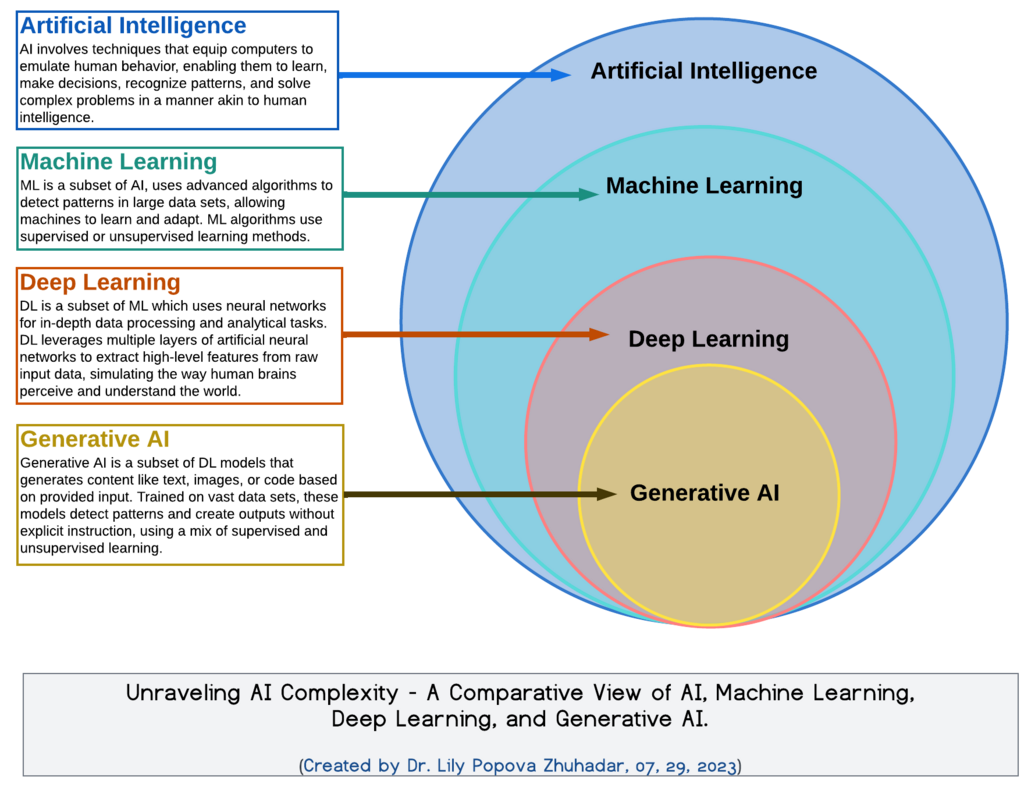
At the broadest level is Artificial Intelligence. Within AI, a major subfield is Machine Learning (ML). This is an approach to AI where systems learn directly from data. Instead of being programmed with rules, an ML model is trained on a large dataset to recognize patterns. The more data it sees, the better it gets at its task.
Within Machine Learning, there's a specialized technique called Deep Learning. Deep learning uses structures called neural networks, which are inspired by the human brain. These networks consist of layers of interconnected nodes, or "neurons." Each layer learns to detect increasingly complex features in the data. A simple layer might detect edges in an image, while deeper layers might recognize shapes, objects, and eventually entire scenes.
This layered approach allows deep learning models to tackle very complex problems, like image recognition and natural language processing, with remarkable accuracy.
Think of it this way: AI is the overall goal. Machine Learning is a way to achieve that goal by learning from data. Deep Learning is a powerful technique within Machine Learning that uses complex neural networks to find patterns.
Now that we have a shared vocabulary, let's test your understanding.
What is the primary goal of Artificial Intelligence?
Which statement accurately describes the relationship between AI, Machine Learning (ML), and Deep Learning (DL)?
This foundational knowledge of what AI is, its history, and its core components is the first step for any leader navigating this technology.