AI for Business
Introduction to Artificial Intelligence
What Is AI?
Artificial intelligence is about making machines smart. The goal is to create systems that can perform tasks that normally require human intelligence. This could mean recognizing a face in a photo, understanding spoken language, or even driving a car.
Think of it as teaching a computer to learn, reason, and solve problems on its own, much like a person does.
Artificial Intelligence
noun
A field of computer science dedicated to creating systems capable of performing tasks that typically require human intelligence, such as visual perception, speech recognition, decision-making, and translation between languages.
At its core, AI is not a single technology but a broad field of study. It includes many different theories, methods, and tools. The central idea is to build machines that can sense their environment, think about what they sense, and then act on it.
A Quick History
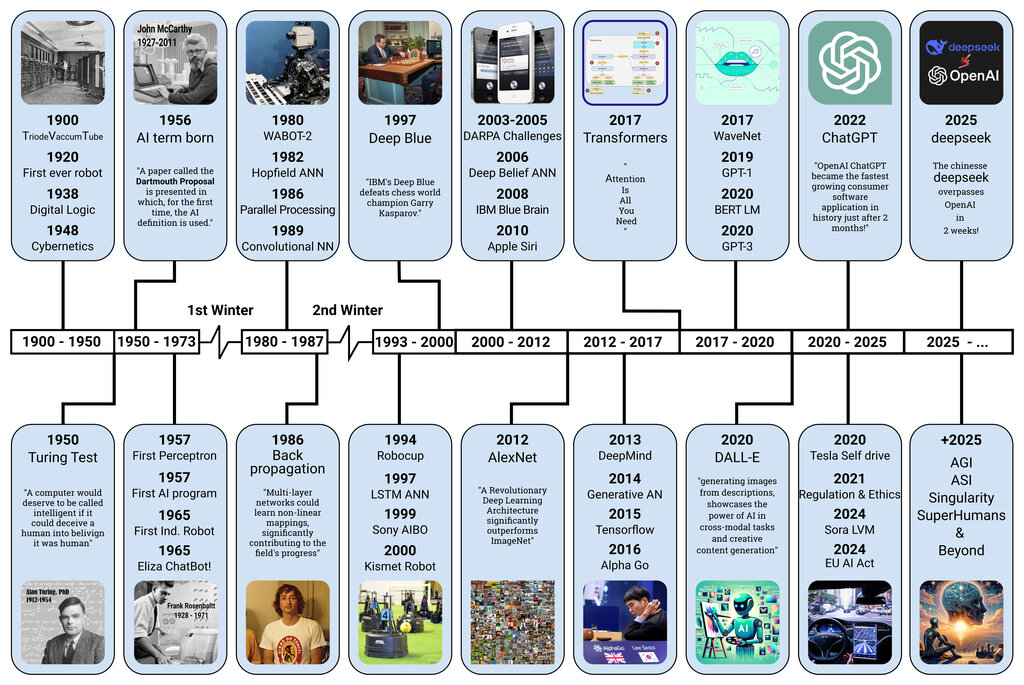
The idea of intelligent machines has been around for centuries, but the modern field of AI officially began in the summer of 1956. A group of researchers gathered at Dartmouth College for a workshop where they coined the term "artificial intelligence" and laid out the field's ambitious goals.
The early years were filled with excitement and bold predictions. However, progress was slower than expected. Limited computing power and a lack of data led to periods known as "AI winters," when funding and interest dried up. But the field always rebounded.
In recent decades, two key factors have fueled an explosion in AI development: the availability of massive amounts of data and the development of powerful, fast computers. This combination has allowed AI to move from academic theory to a practical tool that shapes our daily lives.
The Main Ingredients
Modern AI systems are built on three main pillars: data, algorithms, and computing power.
Data is the lifeblood of AI. It's the information that an AI system learns from. This could be anything from millions of images of cats to years of stock market figures. The more data an AI has, the better it can learn to identify patterns and make accurate predictions.
Algorithms are the sets of rules and instructions that computers use to process that data. They are the 'brain' of the AI, guiding it on how to learn from the information it's given. An algorithm might tell an AI how to distinguish between a cat and a dog by analyzing features like ear shape and snout length.
Computing Power is the engine that drives it all. Training an AI model requires performing billions of calculations. Today's advanced computer processors, especially Graphics Processing Units (GPUs), are perfectly suited for these intensive tasks, making it possible to build complex AI systems that would have been unimaginable just a few years ago.
Two Kinds of AI
When people talk about AI, they are usually referring to one of two broad categories: Artificial Narrow Intelligence (ANI) or Artificial General Intelligence (AGI).
The key difference lies in their scope. One is a specialist, and the other is a generalist.
Artificial Narrow Intelligence (ANI), sometimes called Weak AI, is designed to perform a single, specific task. All the AI we use today falls into this category. Your spam filter, a chess-playing computer, a self-driving car, and the voice assistant on your phone are all examples of ANI. They can be incredibly good at what they do, often surpassing human ability, but they can't operate outside their pre-defined purpose.
Artificial General Intelligence (AGI), or Strong AI, is the type of AI you often see in science fiction. This is a hypothetical machine with the ability to understand, learn, and apply knowledge across a wide range of tasks at a human level. An AGI could, in theory, do anything a human can do: write a novel, compose music, conduct scientific research, or even have a meaningful conversation. We are still a long way from creating AGI.
| Feature | Artificial Narrow Intelligence (ANI) | Artificial General Intelligence (AGI) |
|---|---|---|
| Scope | Specializes in one task | Can perform any intellectual task a human can |
| Current Status | All current AI is ANI | Theoretical; does not exist yet |
| Example | Facial recognition software | A robot that can learn and reason like a human |
Essential Terms to Know
As you explore AI, you'll encounter some specific terms that describe how these systems work. The most important ones are Machine Learning, Neural Networks, and Deep Learning. They are all related, but they aren't interchangeable.
This visual shows how the concepts fit together. AI is the overall field. Within AI, there's a specific approach called Machine Learning.
Machine Learning
noun
A subset of artificial intelligence that provides systems the ability to automatically learn and improve from experience without being explicitly programmed. It focuses on the development of computer programs that can access data and use it to learn for themselves.
Instead of writing step-by-step instructions, developers use machine learning algorithms to train a model by feeding it vast amounts of data. The model then learns to make predictions or decisions based on the patterns it finds.
One popular technique within machine learning is the use of neural networks.
Neural Network
noun
A computing system inspired by the biological neural networks that constitute animal brains. The system learns to perform tasks by considering examples, generally without being programmed with any task-specific rules.
When these neural networks have many layers, they're called "deep" neural networks. This leads to the final key term.
Deep Learning
noun
A subfield of machine learning based on artificial neural networks with multiple layers (deep neural networks). It allows computational models to learn representations of data with multiple levels of abstraction.
Deep learning has been the driving force behind many of the recent breakthroughs in AI, from understanding natural language to creating realistic images from text descriptions.
Ready to check your understanding?
What is the central idea behind Artificial Intelligence?
What two key factors have fueled the recent explosion in AI development?
Understanding these foundational ideas is the first step in seeing how AI works and what it can do. You now have the basic vocabulary and context to explore its many applications.