AI for Beginners
Introduction to Artificial Intelligence
What Is AI?
Artificial intelligence is the ability of a computer or machine to perform tasks that normally require human intelligence. This includes things like learning from experience, recognizing patterns, understanding language, and making decisions.
Artificial Intelligence
noun
A field of computer science dedicated to creating systems that can perform tasks requiring human intelligence.
Think of it this way: We don't consider a simple calculator to be intelligent. It follows rigid instructions to add or subtract numbers. But a system that can look at thousands of animal photos and learn to tell the difference between a cat and a dog on its own? That’s stepping into the realm of AI.
A Brief History
The dream of creating intelligent machines has been around for centuries, but the modern field of AI officially began in the summer of 1956. A group of scientists gathered at Dartmouth College for a workshop to explore the idea that "every aspect of learning or any other feature of intelligence can in principle be so precisely described that a machine can be made to simulate it."
It was here that the term "artificial intelligence" was coined. The early years were filled with excitement and bold predictions. Researchers believed that machines with human-level intelligence were just a few decades away.
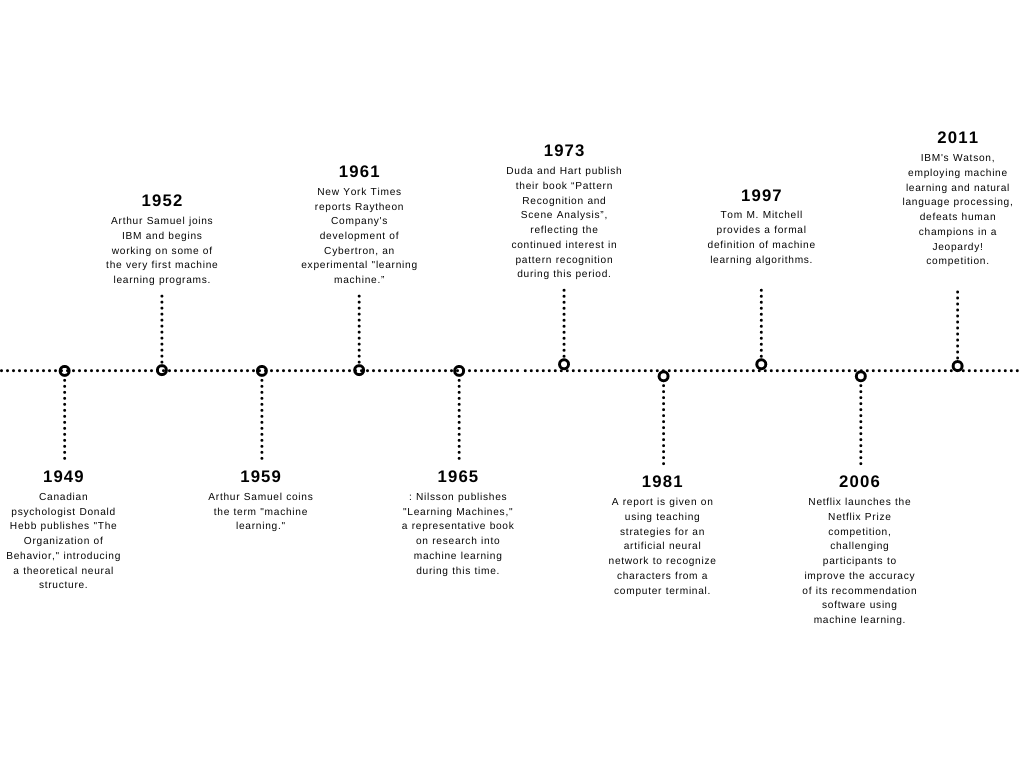
Two Paths to Intelligence
Early AI research followed an approach called Symbolic AI, sometimes nicknamed "Good Old-Fashioned AI" (GOFAI). The idea was to program a machine with all the rules and logic it would need to reason about a topic. A Symbolic AI system for playing chess, for example, would be explicitly told the rules of the game and strategies for winning, encoded by human experts.
Symbolic AI is like giving someone a massive, detailed rulebook for every possible situation. The intelligence comes from following the rules perfectly.
But this approach had its limits. It’s impossible to write rules for every single task, especially complex ones like identifying objects in an image. The world is just too messy and unpredictable.
This led to a new dominant approach: Machine Learning. Instead of feeding a computer rules, developers feed it vast amounts of data and let it learn the patterns and rules for itself. A machine learning model learns to identify cats by analyzing millions of cat photos, not by being given a list of rules like "has pointy ears" and "has whiskers."
| Approach | How it Works | Analogy |
|---|---|---|
| Symbolic AI | Programmers hand-code rules and logic. | A chef following a precise recipe. |
| Machine Learning | The system learns patterns from data. | A chef tasting ingredients to figure out a recipe. |
Narrow vs General AI
Today, all the AI we interact with is considered Artificial Narrow Intelligence (ANI), or "weak AI." These systems are designed to perform a single task very well. Your GPS is great at navigation, a spam filter is excellent at flagging junk email, and a recommendation engine can suggest movies you might like. But you can't ask your GPS for a movie recommendation, and your spam filter can't give you driving directions.
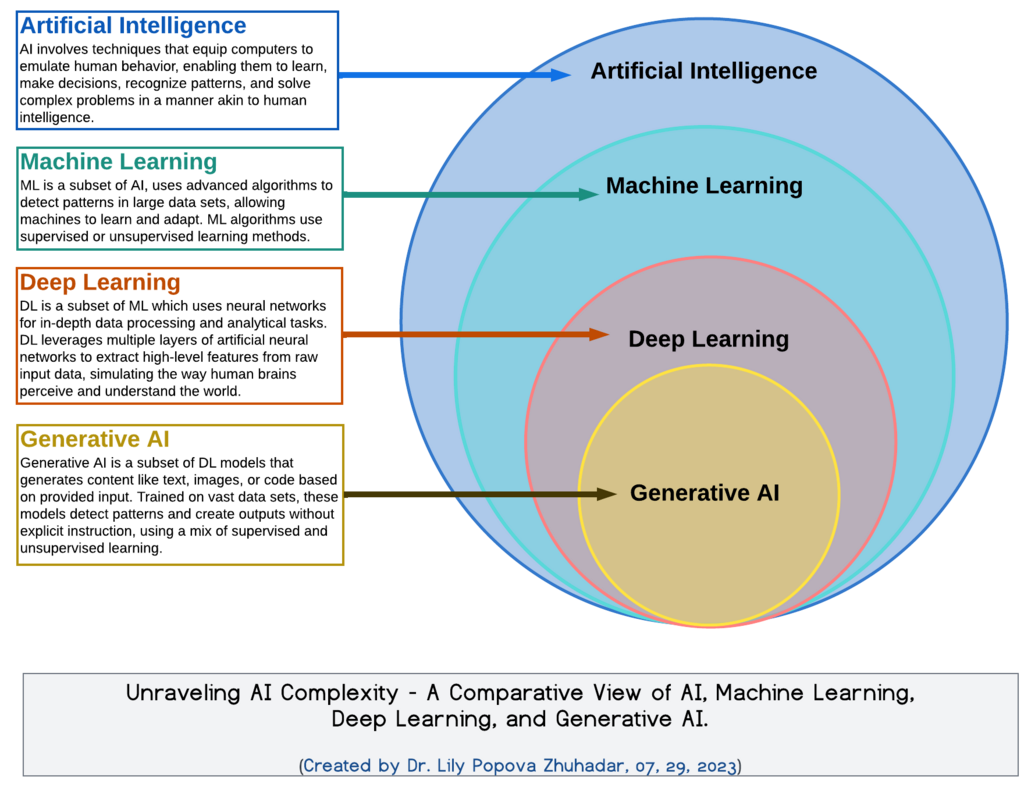
The other category is Artificial General Intelligence (AGI), or "strong AI." This is the type of AI often seen in science fiction—a machine with the ability to understand, learn, and apply knowledge across a wide range of tasks at a human level. AGI would be able to learn a new language, solve a complex scientific problem, or compose music, all with the same underlying system. AGI is still a theoretical concept; we haven't built one yet.
The Core Ingredients
Modern AI systems, especially those based on machine learning, rely on three key components working together.
-
Data: This is the fuel for AI. Machine learning models need large datasets to learn from. For an AI that identifies images, the data is millions of labeled pictures. For a language model, it's a massive library of text and books.
-
Algorithms: An algorithm is a set of rules or instructions that a computer follows to solve a problem. In AI, these are the recipes that process the data, find patterns, and make predictions or decisions. Different algorithms are suited for different tasks.
-
Computing Power: Processing huge datasets with complex algorithms requires a lot of computational muscle. Advances in specialized computer chips, like GPUs (Graphics Processing Units), have provided the power needed to train and run today's sophisticated AI models.
Without data, the algorithm has nothing to learn from. Without the algorithm, the data is just a pile of information. Without computing power, the process would be too slow to be useful.
Now, let's test your understanding of these core concepts.
What is the primary characteristic that distinguishes an AI system, like one that identifies animals in photos, from a simple calculator?
The term "artificial intelligence" was first coined at which key event?
Understanding these foundational ideas—what AI is, where it came from, and how it works at a high level—is the first step to grasping its impact on the world.