AI for Algorithmic Trading
Introduction to AI in Trading
From Trading Pits to Algorithms
Not long ago, financial trading was a physical, chaotic scene. Traders in colorful jackets crowded onto exchange floors, shouting orders and using complex hand signals to buy and sell stocks. Fortunes were made and lost in a frenzy of noise and paper slips. It was a world that ran on human intuition, speed, and stamina.
Then, computers arrived. The trading pits began to empty out as screens lit up. This shift gave rise to algorithmic trading, where computers were programmed to execute trades based on a fixed set of rules. For example, a simple algorithm might be: "If stock X drops by 5%, buy 100 shares. If it rises by 5%, sell."
This was a massive leap. Algorithms could execute orders faster and more consistently than any human, removing emotion from the equation. But they were still just following instructions. The next evolution would involve systems that could think and learn for themselves. This is where Artificial Intelligence (AI) enters the picture.
AI's Role in the Market
AI takes trading a step beyond rigid, pre-programmed rules. Instead of just following a checklist, AI systems learn from vast amounts of data to make smarter, more adaptive decisions. Think of it this way: traditional algorithmic trading is like following a recipe exactly as written. AI is like an experienced chef who can taste the ingredients, adapt to what's available, and create something new based on past successes and failures.
The core of this capability comes from Machine Learning (ML), a subset of AI where systems learn to identify patterns in data without being explicitly programmed. A trading algorithm using ML might analyze years of stock prices, trading volumes, and economic reports to learn what market conditions typically precede a price increase.
A more advanced form of this is Deep Learning (DL), which uses complex structures called neural networks, loosely inspired by the human brain. Deep learning models can uncover subtle, complex patterns that other methods might miss. For instance, a DL system could analyze the sentiment of thousands of news articles and social media posts per second to predict how the market might react to breaking news.
At its heart, AI in trading is about finding predictive patterns in market data that are too fast, too complex, or too subtle for humans to see.
Benefits and Challenges
The advantages of using AI in trading are significant. The most obvious is speed. AI systems can analyze data and execute trades in microseconds, capitalizing on opportunities that disappear in the blink of an eye. They can also process far more information than a human ever could, running countless scenarios simultaneously to find the best strategy.
However, AI-driven trading is not without its risks. AI models are only as good as the data they are trained on. If the market behaves in a way it has never behaved before, such as during a sudden global crisis, the model may fail spectacularly. This is often called "model decay," where a once-profitable strategy stops working because market conditions have changed.
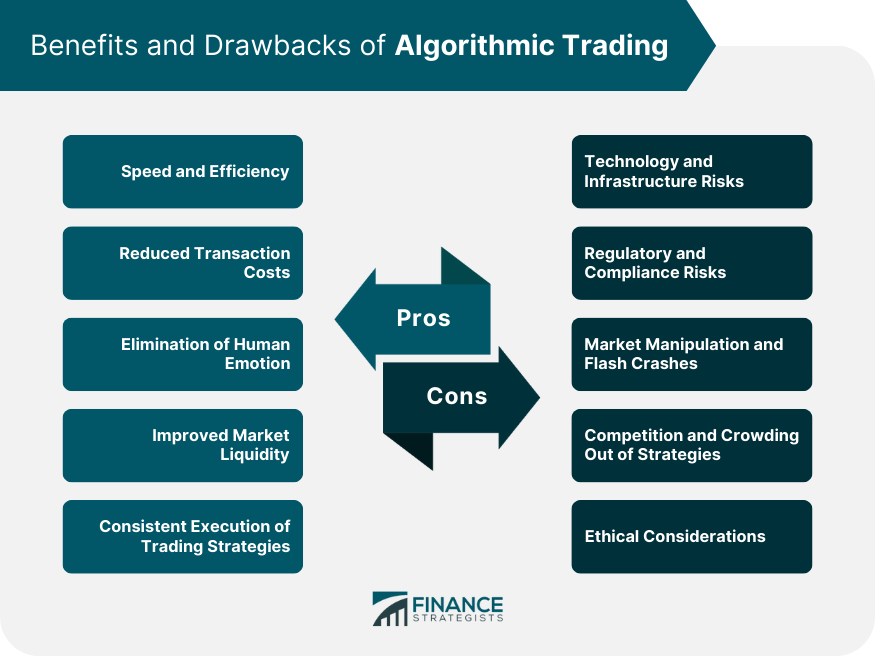
There's also the risk of market manipulation or unintended consequences. If many AI systems are using similar strategies, they could amplify a market movement, leading to a "flash crash" where prices plummet and recover in minutes. The complexity of these systems can also create a "black box" problem, where even their creators don't fully understand why an AI made a particular decision.
Because of these risks, the world of AI trading is facing growing scrutiny. Regulators are tasked with a difficult balancing act: how to foster innovation while protecting the financial system's stability. This involves developing rules around model testing, transparency, and risk management to ensure that automated systems don't run amok. The goal is to create guardrails that prevent a single faulty algorithm from causing widespread damage.
Let's review the key concepts of AI in trading.
What is the primary difference between traditional algorithmic trading and AI-driven trading?
Which of the following best describes the 'black box' problem in AI trading?