AI for Academic Excellence
Introduction to AI in Academia
What Is AI Anyway?
Artificial intelligence, or AI, is about creating computer systems that can perform tasks that usually require human intelligence. This includes things like learning from experience, understanding language, recognizing patterns, and solving problems.
Think of it this way: AI doesn't just follow a strict set of pre-programmed instructions. It can adapt and make decisions based on new data.
This field is broad and includes several key areas. You might hear terms like machine learning, where systems learn from data to improve their performance, and natural language processing (NLP), which helps computers understand and respond to human language. Together, these technologies allow AI to do some pretty amazing things, from powering recommendation engines to driving cars.
A Quick Trip Through Time
The idea of artificial minds has been around for centuries, but the scientific field of AI officially kicked off in the 1950s. Early researchers were incredibly optimistic, believing that a machine as intelligent as a human was just a few decades away. They developed programs that could solve algebra problems and prove logical theorems.
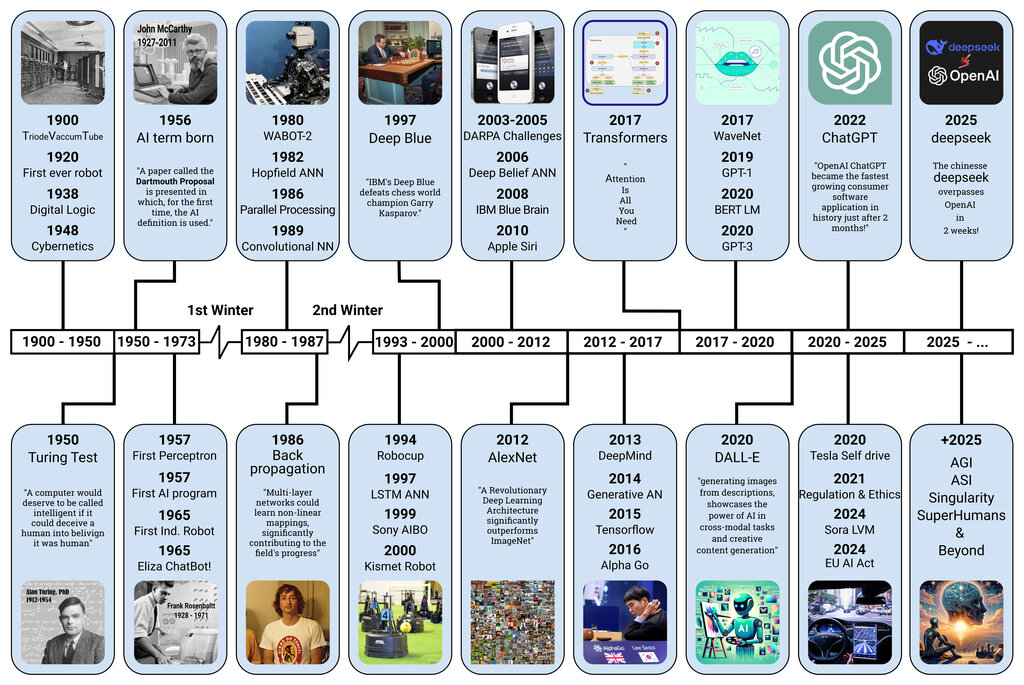
However, progress wasn't always a straight line. The field went through a couple of "AI winters," periods where funding dried up because the technology couldn't live up to the hype. But in recent decades, two things changed the game: the explosion of available data and a massive increase in computing power. This combination fueled the deep learning revolution, leading to the powerful AI we interact with today.
AI in Your School Life
So, how does all this affect you as a student? AI is quickly becoming a common part of the academic landscape, changing how we learn and conduct research. It's not just about futuristic robots; it's about practical tools that can make your work easier and more effective.
For instance, AI can create personalized learning paths. Imagine a tutoring system that adapts to your unique strengths and weaknesses, giving you extra practice where you need it most. It can also act as a powerful research assistant, helping you sift through mountains of academic papers to find the most relevant sources for your next essay. AI tools can also help you brainstorm ideas, structure your arguments, and even check your grammar.
When used thoughtfully, AI can free you up from tedious tasks, allowing you to focus on the most important part of learning: critical thinking and understanding complex ideas.
A Powerful Tool, Not a Magic Wand
While AI offers many benefits, it's crucial to understand its limitations. These tools are incredibly powerful, but they aren't perfect. They don't "think" or "understand" in the same way humans do. They are pattern-matching machines that work with the data they were trained on.
This means AI can sometimes make mistakes, generate incorrect information (often called "hallucinations"), or reflect biases present in its training data. It's a fantastic starting point for research or a great tool for polishing a draft, but it can't replace your own judgment and critical thinking. Always double-check the information it gives you and make sure you truly understand the material yourself.
| Benefits | Limitations |
|---|---|
| Efficiency: Speeds up research and writing. | Inaccuracy: Can generate false information. |
| Personalization: Adapts to individual learning needs. | Lack of Understanding: Doesn't grasp concepts like a human. |
| Accessibility: Helps summarize complex topics quickly. | Potential for Bias: Can reflect biases from its training data. |
| Productivity: Assists with brainstorming and organization. | No Critical Thinking: Cannot analyze or evaluate information critically. |
Let's test what you've learned about the fundamentals of AI in academia.
What is the primary goal of Artificial Intelligence?
What two factors were primarily responsible for the recent rapid advancements in AI, leading to the 'deep learning revolution'?
Understanding these basics is the first step. By seeing AI as a capable but flawed assistant, you can use it to enhance your learning without letting it get in the way of your education.