AI Evolution and Infrastructure Needs
Introduction to AI
What Is Artificial Intelligence?
At its core, artificial intelligence is about creating machines that can think, learn, and solve problems like humans do. The goal isn't just to make a machine follow instructions, but to give it the ability to reason, adapt, and act on its own.
Early AI systems were a lot like very obedient, but not very clever, assistants. They operated on a set of strict rules programmed by humans. Think of an old-school video game enemy that only moves left if you're on its left, and right if you're on its right. This is a rule-based system. It works perfectly as long as the situation matches one of its pre-written rules. But if something unexpected happens, it's completely lost.
A rule-based system follows a simple "if-then" logic. For example: IF a user's email contains the phrase "free money," THEN mark it as spam. This approach is powerful but rigid; it can't learn or handle new situations it wasn't programmed for.
Engineers quickly realized that to build truly intelligent systems, they couldn't possibly write a rule for every single scenario. The world is too complex. The solution was to create systems that could learn on their own, much like we do. This shift in thinking led to the development of machine learning, which powers almost all the AI we use today.
Learning from Examples
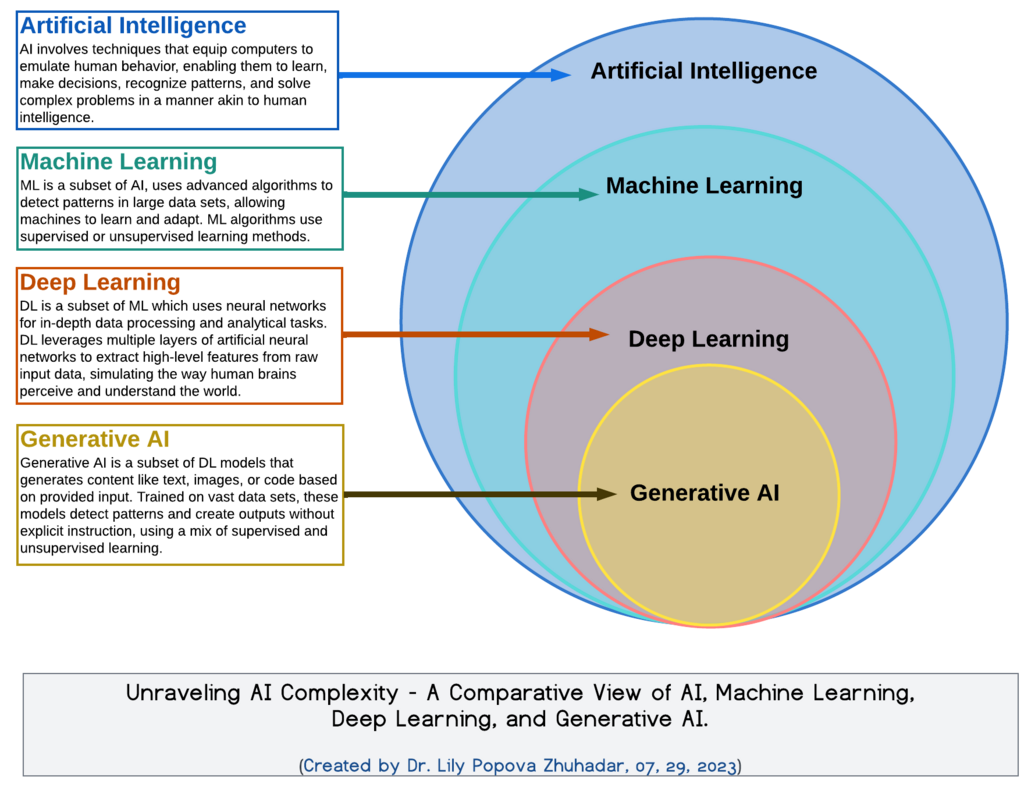
Machine learning is a type of AI where a computer learns to recognize patterns by analyzing data. Instead of being programmed with rules, it's trained on examples. There are two main ways it learns: with a guide, or on its own.
Supervised Learning
noun
A machine learning approach where the model is trained on a dataset that is labeled, meaning each piece of data is tagged with the correct output or answer.
Supervised learning is like studying for a test with an answer key. The AI is given a huge dataset where all the answers are already provided. For example, to teach an AI to identify cats, you'd show it thousands of pictures, each one labeled "cat" or "not cat." By studying these examples, the AI learns the features that make up a cat—pointy ears, whiskers, fur patterns—so it can identify cats in new, unlabeled pictures.
But what if you don't have an answer key? That's where unsupervised learning comes in.
Unsupervised Learning
noun
A machine learning approach where the model is trained on a dataset that is not labeled. The system tries to find patterns and relationships in the data on its own.
With unsupervised learning, the AI is given a jumble of data and asked to find its own patterns and structures. It's like being handed a box of mixed Lego bricks and sorting them by color and shape without being told what the categories are. This method is great for discovering hidden groupings in data, like finding different types of shoppers on an e-commerce site or organizing large document libraries by topic.
The Brain of the AI
So how does a machine actually "learn" these patterns? One of the most powerful techniques is inspired by the human brain. It's called a neural network.
A neural network is a system of interconnected nodes, or "neurons," that process information. It's organized in layers. The first layer takes in raw data, like the pixels of an image. Each neuron in this layer passes its information on to the next layer, which processes it further. This continues through several layers until the final layer produces an output, like the label "cat."
During training, the connections between these neurons are adjusted. If the network makes a wrong guess (for instance, calling a dog a "cat"), the connections that led to that mistake are weakened, and the ones that might lead to the right answer are strengthened. This process is repeated millions of times with all the training data.

This brings us to the most critical ingredient for modern AI: data. A neural network is useless without vast amounts of data to learn from. The more high-quality, relevant data an AI is trained on, the more accurate and capable it becomes. The explosion of data generated by the internet is a key reason why AI has made such incredible progress in recent years.
From simple rules to complex learning systems, AI has evolved dramatically. Understanding these foundational ideas—supervised and unsupervised learning, neural networks, and the vital role of data—is the first step to seeing how AI is changing our world.
Let's check your understanding of these core concepts.