AI Essentials Understanding and Applications
Introduction to Artificial Intelligence
What is Artificial Intelligence?
At its core, artificial intelligence is the science and engineering of making intelligent machines. Think of it as the effort to build computer systems that can perform tasks that normally require human intelligence. This includes things like learning from experience, understanding language, recognizing objects, and solving problems.
Artificial Intelligence
noun
A field of computer science dedicated to creating systems that can perform tasks requiring human intelligence, such as learning, reasoning, problem-solving, perception, and language understanding.
This doesn't mean creating a machine that is a human. Instead, it's about simulating intelligent behavior. An AI system perceives its environment, processes that information, and takes actions to achieve a specific goal. The
A Quick Trip Through Time
The idea of intelligent machines has been around for centuries, long before computers existed. But the modern field of AI officially began in the summer of 1956 at a workshop at Dartmouth College. There, a group of scientists coined the term "artificial intelligence" and laid out the field's ambitious goals.
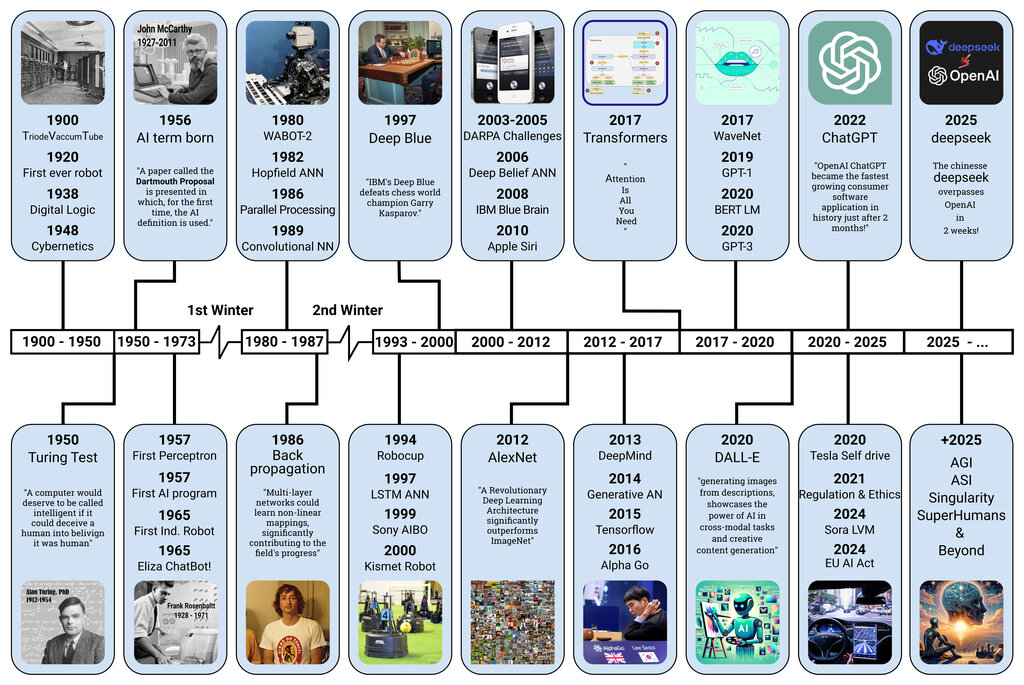
The journey wasn't a straight line. The early years were full of optimism, but progress was slow. Limited computing power and data led to several "AI winters," periods when funding and interest dwindled. However, breakthroughs in the late 20th and early 21st centuries, fueled by faster computers and the explosion of digital data, led to a massive resurgence. This revival brought AI out of the lab and into our daily lives.
Two Kinds of AI
When people talk about AI, they are usually referring to one of two broad categories. The distinction between them is crucial for understanding what AI can and can't do today.
| Feature | Narrow AI (ANI) | General AI (AGI) |
|---|---|---|
| Scope | Performs a single, specific task. | Can understand and learn any intellectual task a human can. |
| Examples | Spam filters, voice assistants, chess-playing programs. | None exist yet. Think of science fiction robots like C-3PO. |
| Status | It's all around us today. | Purely theoretical and a subject of ongoing research. |
All the AI systems we use right now, from the one that recommends movies to the one that helps doctors diagnose diseases, are forms of Artificial Narrow Intelligence (ANI). They can be incredibly powerful and outperform humans at their specific tasks, but they operate within a pre-defined, limited context. They can't take their
The Building Blocks
So how does an AI system work? While the specifics can get very complex, most systems are built on three fundamental components: data, algorithms, and models.
Data is the raw material. It's the information, facts, and examples that an AI system learns from. For an AI that identifies cats in photos, the data would be thousands of labeled pictures of cats.
Algorithms are the instructions. They are the step-by-step procedures or rules that the system uses to analyze the data, find patterns, and make predictions or decisions. It's the recipe that tells the system how to learn from the data.
A model is the output of this process. After an algorithm has processed the data, it produces a model. This model is a representation of what the system has learned. It's the trained
What is the core objective of artificial intelligence?
The modern field of AI, and the term itself, originated from a 1956 workshop at which institution?
With these foundational concepts, you're ready to explore the more advanced topics in the world of AI.