AI Essentials Made Simple
Introduction to AI
What Is Artificial Intelligence?
At its core, Artificial Intelligence (AI) is about teaching computers to perform tasks that normally require human intelligence. Think of it like teaching a child. You don't write a rule for every single possible situation. Instead, you give them examples and let them learn the patterns for themselves. AI does something similar, but on a massive scale with data.
AI systems are built on a few key principles. They learn from data, recognize patterns within it, and then make decisions or predictions. Let's break down these core ideas:
- Data-Driven Learning: AI systems aren't explicitly programmed for every task. Instead, they are trained on vast amounts of data—images, text, numbers—and learn to identify underlying relationships.
- Pattern Recognition: This is the AI's ability to spot recurring features or trends in the data. It's how an AI can learn to tell the difference between a cat and a dog after seeing thousands of pictures of each.
- Optimization: AI constantly works to improve its performance. It makes a prediction, checks how accurate it was, and adjusts its internal logic to do better next time. This process of refining its approach is called optimization.
- Generalization: The real magic happens when an AI can apply what it learned from one set of data to new, unseen data. This ability to generalize is what makes AI useful in the real world, allowing it to handle situations it wasn't specifically trained on.
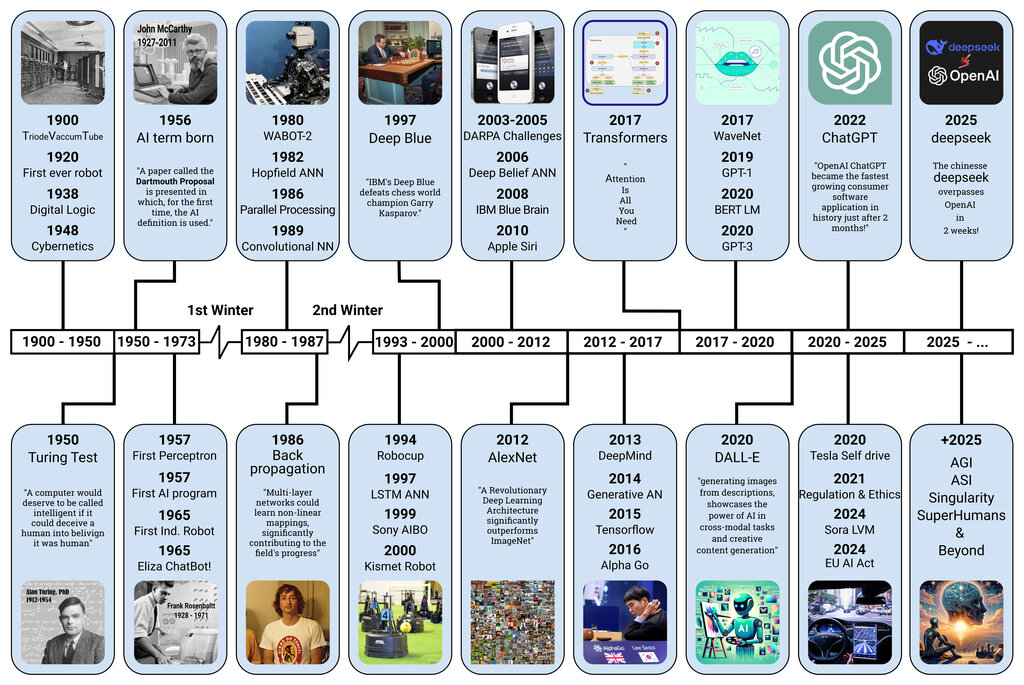
A Quick Trip Through Time
The idea of creating intelligent machines has been around for centuries, but the formal field of AI research began in the 1950s. Early efforts focused on rule-based systems, where programmers tried to write down all the rules for intelligent behavior. This worked for simple games like checkers but failed at more complex, real-world problems.
The major breakthrough came with the rise of machine learning and deep learning, which shifted the focus from writing rules to letting computers learn from data. Combined with the explosion of available data and powerful computing hardware, this led to the rapid advances we see today.
The Branches of AI
AI isn't one single thing; it's a broad field with many specialized branches. Think of it as a large tree with several major limbs. While there are many subfields, three are particularly important to understand.
Machine Learning
noun
A subfield of AI where algorithms are trained on data to find patterns and make predictions without being explicitly programmed for the task.
Machine Learning (ML) is the engine driving most modern AI. It's the process of feeding a computer vast amounts of data and letting it build its own models to make predictions. This is the foundation for everything from spam filters to stock market predictions.
Natural Language Processing (NLP) focuses on the interaction between computers and human language. NLP allows machines to read, understand, interpret, and generate human language. It's what powers voice assistants, translation apps, and chatbots.
Computer Vision gives machines the ability to "see" and interpret the visual world. By analyzing images and videos, computer vision systems can identify objects, faces, and even emotions. This technology is behind facial recognition on your phone and self-driving cars.
These fields often overlap. For example, an AI that analyzes customer reviews (NLP) might use machine learning to determine if the review is positive or negative.
AI's Role in Modern Society
AI is rapidly becoming a foundational technology, much like electricity or the internet. It operates behind the scenes in countless tools we use every day, from navigation apps that find the fastest route to streaming services that recommend your next favorite show.
The goal of AI is to create technology that can operate intelligently and independently, augmenting human capabilities and automating tasks to solve complex problems.
Its influence extends across nearly every industry, including healthcare, finance, transportation, and entertainment. By automating complex processes and providing powerful insights from data, AI is changing how we work, live, and interact with the world around us. Understanding its basic principles is the first step toward navigating this new landscape.
What is the fundamental principle behind how most modern AI systems learn?
An AI model is trained to identify cats in photos. It is then able to correctly identify a cat in a new photo it has never seen before. This ability is known as: