AI Essentials for Students
Introduction to AI
What Is AI?
Artificial intelligence is about creating machines that can think, reason, and learn. Instead of just following a strict set of pre-programmed instructions, an AI system can analyze new information and adapt its behavior to achieve a specific goal. It's the science of making computers smart.
Think of it this way: a simple calculator follows rules. An AI can learn the rules on its own by looking at examples.
Artificial Intelligence
noun
A field of computer science dedicated to creating systems that can perform tasks that typically require human intelligence, such as learning, reasoning, problem-solving, and understanding language.
The Journey of AI
The dream of intelligent machines isn't new, but the official starting point for AI as a field of study was a summer workshop at Dartmouth College in 1956. A small group of researchers gathered to explore the idea that "every aspect of learning or any other feature of intelligence can in principle be so precisely described that a machine can be made to simulate it."
Early enthusiasm was high. Researchers built programs that could solve algebra problems and prove theorems. But the complexity of creating true intelligence was far greater than anyone imagined. The limited computing power and data available at the time created major roadblocks.
The middle period of AI development saw one of the most important moments of all: the coining of the term "artificial intelligence."
This led to periods known as "AI winters." From the mid-1970s into the early 1990s, progress slowed, and funding for research became scarce. The initial promises of AI seemed impossible to deliver, and the field fell out of the spotlight.
Then, things started to change. The rise of the internet generated massive amounts of data, and computer processors became exponentially more powerful. These two ingredients, big data and powerful computers, were exactly what AI needed to finally flourish.
Key Milestones
Several key breakthroughs mark AI's path from a niche academic idea to a world-changing technology. These moments showed what was possible and inspired new waves of research.
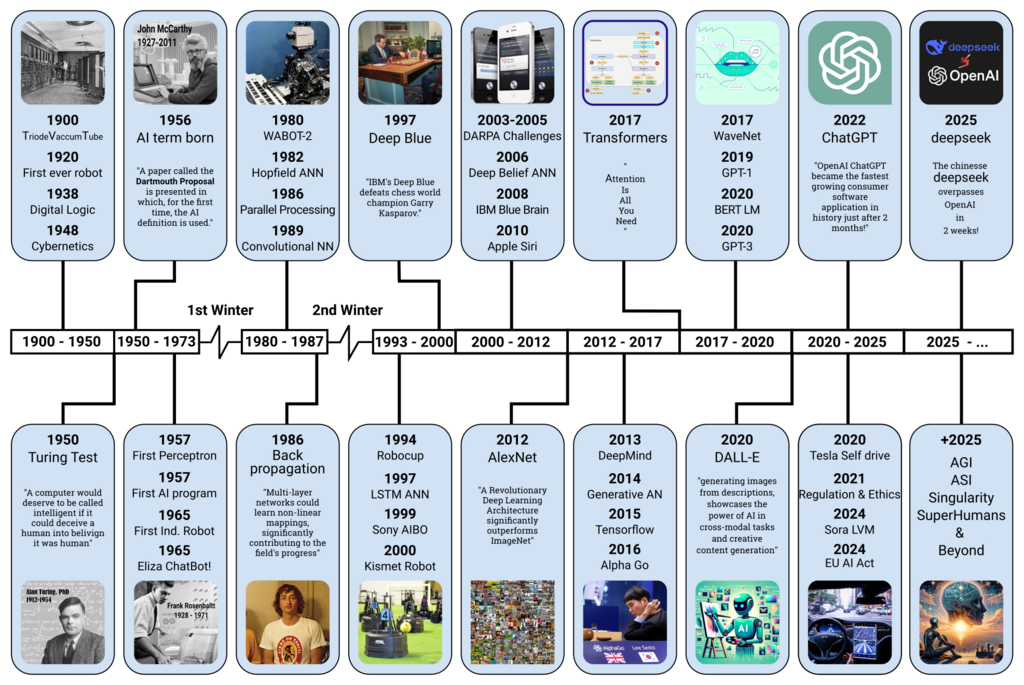
One of the most famous milestones was in 1997, when IBM's Deep Blue supercomputer defeated the world chess champion, Garry Kasparov. This was a huge moment because chess requires strategy, foresight, and intuition, qualities once thought to be uniquely human.
Another leap forward came in 2011 when another IBM system, Watson, won the game show Jeopardy!. Watson had to understand nuanced, subtle, and sometimes tricky language to beat the best human players. This demonstrated a huge advance in a field called Natural Language Processing.
More recently, a 2016 victory by Google DeepMind's AlphaGo over the world's top Go player, Lee Sedol, was a landmark achievement. The ancient game of Go is vastly more complex than chess, with more possible moves than atoms in the universe. AlphaGo didn't just calculate moves; it learned strategy and developed novel approaches that stunned human experts.
These events weren't just about playing games. They were public demonstrations of AI's growing ability to tackle complex problems that require a form of intelligence.
Let's review what you've learned about the foundations of AI.
What is the core concept of artificial intelligence?
The official starting point for AI as a field of study was a 1956 summer workshop at which institution?
This journey from abstract theory to powerful reality is what makes the history of AI so compelling.