AI Essentials for Service Technicians
Introduction to Artificial Intelligence
What Is Artificial Intelligence?
Artificial Intelligence, or AI, is the science of making machines that can think and learn like humans. Think of it like training an apprentice. At first, you show the apprentice exactly what to do. Over time, they learn from experience, start to recognize patterns, and eventually make decisions on their own without step-by-step instructions.
AI works similarly. It's about creating systems that can analyze information, learn from it, and then perform tasks that would normally require human intelligence. This could be anything from understanding spoken language to identifying a worn-out part in a machine just by the sound it makes.
In simple terms, AI is about teaching computers to learn and solve problems.
Two Main Types of AI
AI isn't one single thing. It exists on a spectrum, and today, we primarily deal with two types: Narrow AI and General AI.
Narrow AI
noun
Also known as Weak AI, this type of artificial intelligence is designed and trained for a particular task. It operates within a limited, pre-defined range of functions.
All the AI we use today is Narrow AI. It's fantastic at the one job it's built for. For example, a voice assistant like Siri can answer questions and set timers, but it can't diagnose a complex equipment failure. A system that predicts part failures is another example of Narrow AI. It analyzes sensor data to spot warning signs, but it can't help you with customer invoicing.
General AI, on the other hand, is the stuff of science fiction, for now. This type of AI, also called Strong AI, would have the ability to understand, learn, and apply its intelligence to solve any problem, much like a human being. It could switch from translating languages to composing music to developing a new maintenance strategy, all with the same level of competence as a person. We are still a long way from developing General AI.
How AI Learns
So how does an AI system learn? It's usually through a process called Machine Learning.
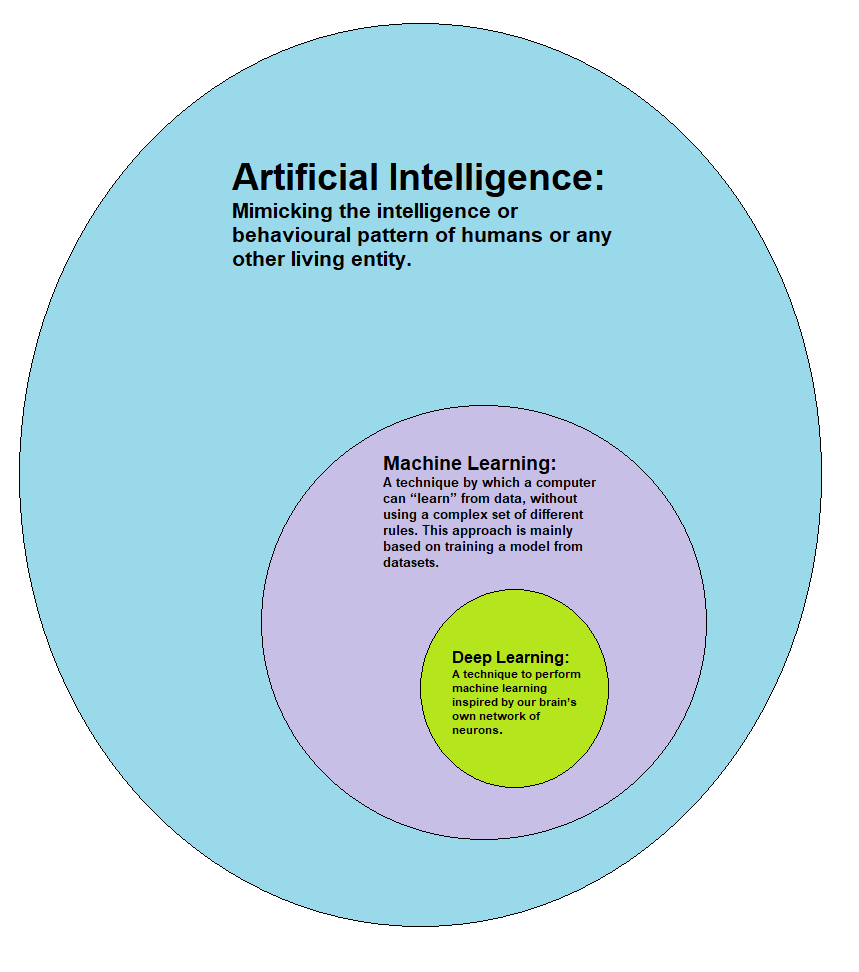
Machine Learning (ML) is a subset of AI that gives computers the ability to learn without being explicitly programmed. Instead of writing code for every possible scenario, developers create algorithms that allow the system to learn from data.
Imagine you want to build an AI that can predict when a specific motor is about to fail. Using machine learning, you would feed it thousands of data points from both healthy and failing motors—data like vibration levels, temperature, and operating hours. The ML algorithm sifts through this data, identifies patterns associated with failure, and builds a model. From then on, it can use that model to predict failures in other motors it hasn't seen before.
Deep Learning is a more advanced type of machine learning. It's inspired by the structure of the human brain, using layers of artificial neural networks to learn from vast amounts of data. This allows it to recognize very complex patterns. Deep learning is the technology behind things like image recognition that can spot a tiny crack in a pipe from a photo, or natural language processing that allows you to talk to a chatbot.
Algorithm
noun
A set of rules or instructions given to a computer to help it solve a problem or perform a task.
Understanding these basic terms is the first step. Knowing the difference between AI, machine learning, and deep learning helps you understand what these tools can—and can't—do. Now, let's test your knowledge.
What is the primary goal of Artificial Intelligence?
A system that analyzes sensor data from a wind turbine to predict when a blade needs maintenance is an example of what?
With this foundation, you're ready to see how these concepts are applied in the real world to make service tasks smarter and more efficient.