AI Engineering Mastery for Data Science Leaders
AI Engineering Fundamentals
The AI Development Lifecycle
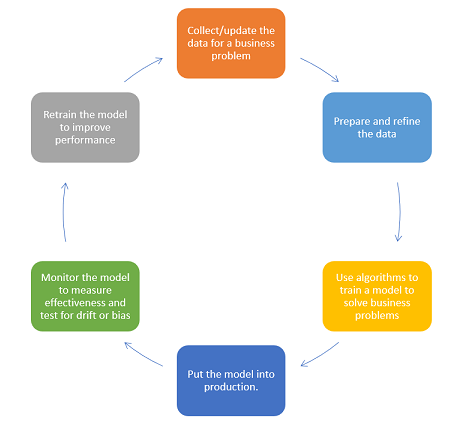
Building an AI system isn't a single event; it's a cycle. This process ensures that what you build is useful, reliable, and continues to improve over time. It all starts not with data or code, but with a question.
First, you define the problem. What do you want the AI to do? Predict customer churn? Identify faulty products on an assembly line? A clear goal is crucial. Next comes data collection and preparation. AI learns from data, so you need to gather relevant information and clean it up. This step is often the most time-consuming.
Then, it's time for model training. This is where data scientists experiment with different algorithms to create a predictive model. Once a promising model is built, it's rigorously evaluated to see how well it performs on new, unseen data. Finally, the model is deployed, meaning it's integrated into a live application or workflow. But the job isn't done. The model is continuously monitored to ensure it's still accurate and retrained with new data as needed.
What an AI Engineer Does
If a data scientist is the architect who designs the blueprint for a model, the AI engineer is the construction manager and civil engineer who builds the skyscraper. An AI engineer is responsible for taking the model that a data scientist has developed and turning it into a robust, scalable, and reliable product.
Their world is one of infrastructure, pipelines, and performance. They build the systems that automatically collect data, train models, and serve predictions to users, ensuring everything runs smoothly and efficiently.
This involves a heavy dose of software engineering. AI engineers write production-level code, manage cloud infrastructure, and set up automated testing and deployment pipelines. They worry about things like latency (how fast does the model give an answer?), throughput (how many requests can it handle?), and cost. Their goal is to make the AI system work seamlessly in the real world, not just on a data scientist's laptop.
Building Bridges
The most effective AI teams see a deep collaboration between data scientists and AI engineers. The data scientist brings expertise in statistics, algorithms, and experimental design. The AI engineer brings expertise in software development, system architecture, and operations.
Without the engineer, a brilliant model might remain a research project. Without the data scientist, the engineer might build a flawless system that delivers flawed or meaningless results. They need each other.
This partnership starts early. AI engineers provide input on what's feasible to build at scale, while data scientists explain the nuances of the model. This back-and-forth ensures the final product is both statistically sound and technically robust.
Encourage collaboration between data scientists, software engineers, and domain experts to:
Align Goals: Ensure AI solutions address real-world problems. Enhance Communication: Use tools and practices that promote transparency and teamwork. Leverage Expertise: Incorporate insights from diverse fields to build more comprehensive solutions.
For someone moving from data science management to AI engineering, the focus shifts from strategy to execution. A manager might oversee the entire lifecycle, but their main role is to define the problem, manage stakeholders, and clear roadblocks for the team. An AI engineer, on the other hand, is deep in the technical details of implementation.
This transition means getting hands-on with the tools of production: cloud platforms, containerization tools like Docker, and automation scripts. It’s about moving from asking “What should we build?” to “How do we build this so it can serve a million users without breaking a sweat?”
What is the foundational first step in any AI system's development lifecycle?
Which of the following is a primary concern for an AI Engineer?
Understanding the lifecycle and the distinct roles within an AI team is the first step in building effective and scalable AI solutions.