AI Engineering Fundamentals
Introduction to AI Engineering
What is AI Engineering?
Artificial intelligence often brings to mind futuristic robots or brilliant algorithms. But how do these concepts actually make their way into the apps on your phone or the systems that power businesses? That's the work of AI engineering.
Think of it this way: a physicist might discover the principles of aerodynamics, but it takes an aerospace engineer to design and build a functional airplane. AI engineering is similar. It's the discipline of taking the theoretical power of AI and building reliable, scalable, and useful systems that solve real problems.
AI engineering serves to create, build, and launch artificial intelligence solutions that resolve practical issues.
This isn't just about writing clever code. It's a structured approach that combines insights from different fields to create robust AI solutions. An AI engineer is a builder, taking raw data and complex algorithms and turning them into something tangible and dependable.
A Brief History
The dream of intelligent machines is old, but the field of AI officially began in the 1950s. Early researchers were optimistic, believing that human-level intelligence was just a few decades away. Progress was made, but the enormous complexity of the task led to periods of reduced funding and interest, often called "AI winters."
For decades, the core ideas of AI were more powerful than the computers available. But in the 21st century, two things changed: the explosion of digital data and the development of powerful computing hardware. Suddenly, long-held theories could be put into practice, transforming AI from a niche academic pursuit into a major technological force.
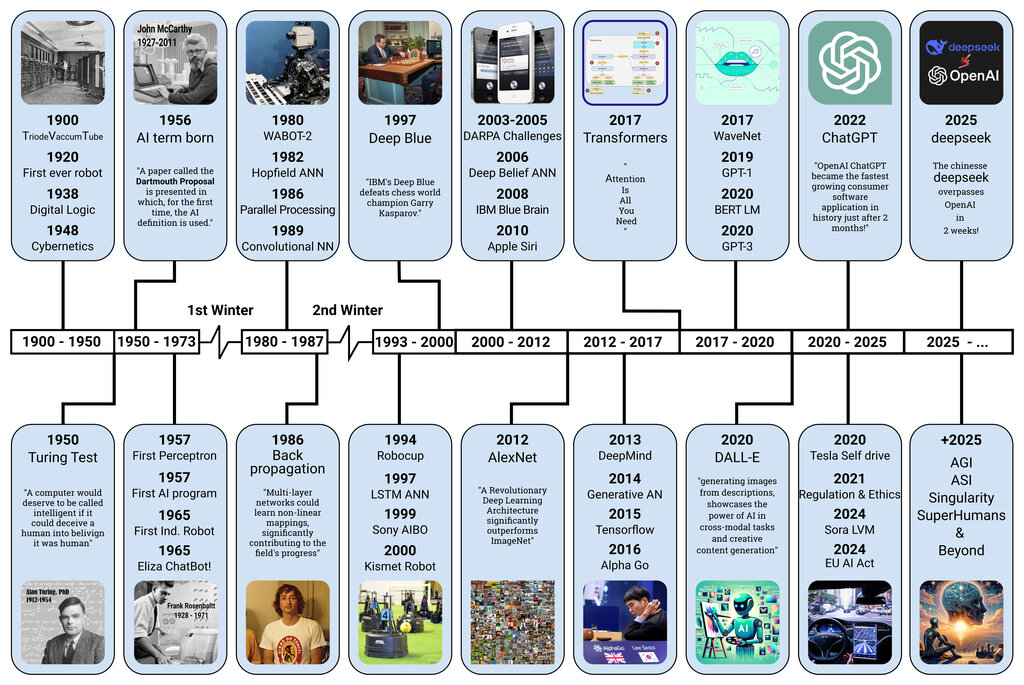
This shift brought engineering to the forefront. The challenge was no longer just about creating an algorithm that could learn, but about building systems that could handle massive datasets, operate continuously, and integrate seamlessly into our lives.
The Language of AI
As with any specialized field, AI has its own vocabulary. Understanding these core terms is the first step in understanding the engineering process.
Algorithm
noun
A set of rules or instructions a computer follows to solve a problem or perform a task.
Model
noun
The output of a machine learning algorithm that has been trained on a set of data. It's a mathematical representation of a real-world process.
Training
noun
The process of feeding data to a machine learning algorithm to create a model. During training, the algorithm learns to find patterns or make predictions.
These terms are interconnected. An algorithm learns from data during a training process to create a model. The AI engineer's job is to manage this entire process and build the system around it.
A Team Sport
Building a successful AI system is rarely a solo endeavor. It requires a blend of different skills, making AI engineering a highly interdisciplinary field.
| Field | Contribution to AI Engineering |
|---|---|
| Computer Science | Provides the foundation for algorithms, data structures, and software architecture. |
| Data Science | Focuses on cleaning, exploring, and preparing data to train effective models. |
| Domain Knowledge | Expertise in a specific area (like medicine or finance) ensures the AI solves the right problem. |
| DevOps | Manages the infrastructure for deploying, monitoring, and maintaining AI systems at scale. |
An AI engineer sits at the intersection of these domains. They need to speak the language of data scientists, understand the principles of software development, and appreciate the nuances of the specific problem they're trying to solve. This collaborative nature is key to moving an AI project from a concept to a fully operational product.
The AI Lifecycle
Developing an AI system is a cyclical process, not a one-time task. AI engineers guide projects through a series of stages known as the AI lifecycle. While the specifics can vary, the core journey remains consistent.
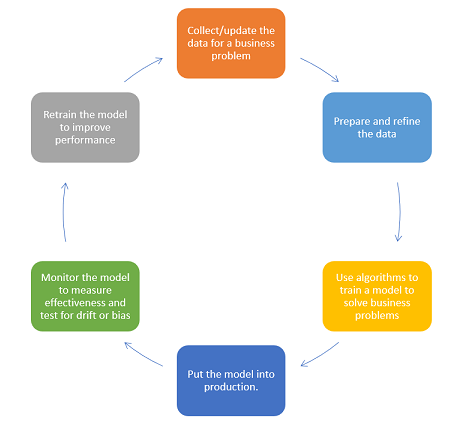
Here's a simplified look at the stages:
-
Problem Definition: It starts with a clear question. What business problem are we trying to solve? What does success look like?
-
Data Collection & Preparation: Data is the fuel for AI. This stage involves gathering the right data, cleaning it, and formatting it for training.
-
Model Training: This is where the learning happens. An algorithm is chosen and trained on the prepared data to create a predictive model.
-
Evaluation: Before a model can be used, it must be tested. How accurate is it? Does it perform well on new, unseen data?
-
Deployment: The model is integrated into a real-world application or business process. This involves building the surrounding software and infrastructure.
-
Monitoring & Maintenance: The job isn't done after deployment. The model's performance must be tracked over time. As the world changes, the model may need to be retrained with new data to remain accurate.
This cycle highlights the engineering mindset: it’s about building a system, testing it rigorously, and ensuring it performs reliably over the long term. It's this structured process that makes modern AI possible and powerful.
What is the primary role of an AI engineer?
What two major factors in the 21st century transformed AI from a niche academic field into a major technological force?
This introduction covers the what, why, and how of AI engineering. It's a field built on a long history of research, blending multiple disciplines to create a structured process for building intelligent systems that work in the real world.