AI Engineering Fundamentals
Introduction to AI
What Is Artificial Intelligence?
Artificial Intelligence, or AI, is the science of making machines that can think and learn like humans. Think of it like teaching a computer to solve problems, understand language, or even recognize a friend's face in a photo. Instead of being explicitly programmed for every single task, an AI system learns from experience, adapting its responses based on new information.
The core goal of AI is to create systems that can perform tasks that typically require human intelligence, such as visual perception, speech recognition, decision-making, and translation between languages.
At its heart, AI is about pattern recognition and prediction. Whether it's predicting the weather, suggesting a movie you might like, or identifying a stop sign for a self-driving car, the system is analyzing data to make an informed guess about the world.
A Brief History
The term "Artificial Intelligence" was first coined in 1956 at a workshop at Dartmouth College. Early AI research was full of optimism, focusing on creating systems that could solve logic puzzles and play games like chess. These early systems were mostly "rule-based," meaning programmers had to manually write explicit rules for every possible situation. For example, a chess program would have rules like, "If the opponent's king is in this position, move the rook here."
This approach worked for well-defined problems, but it was brittle. If the system encountered a situation its programmers hadn't anticipated, it would fail. Progress slowed in the 1970s and 80s, leading to a period known as the "AI winter" when funding and interest dried up.

The game changed with the rise of machine learning and the availability of massive amounts of data and powerful computers. Instead of relying on hand-coded rules, modern AI systems learn directly from examples. To teach a system to recognize cats, developers don't write rules about fur, whiskers, and pointy ears. Instead, they show it millions of pictures of cats, and the system learns the identifying patterns on its own.
The Flavors of AI
AI isn't a single technology; it's a broad field with many specialized subfields. You can think of it as an umbrella term that covers various approaches to creating intelligent systems.
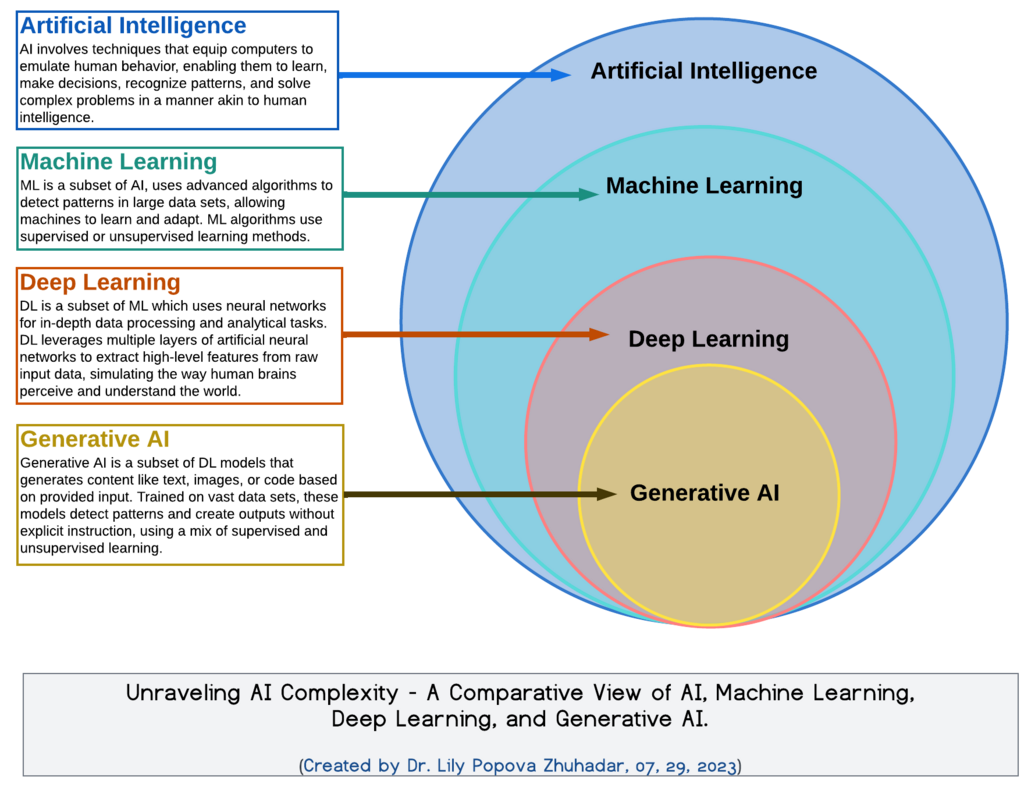
Some of the most important subfields include:
- Machine Learning (ML): This is the most common type of AI today. It's the science of getting computers to learn and act without being explicitly programmed. ML algorithms use data to build a model and then use that model to make predictions or decisions.
- Deep Learning: A subfield of machine learning based on artificial neural networks with many layers. It's the powerhouse behind many recent AI breakthroughs, like advanced image recognition and natural language understanding.
- Natural Language Processing (NLP): This area focuses on the interaction between computers and human language. NLP makes it possible for machines to read, understand, and generate human text and speech. Think of chatbots and translation apps.
- Computer Vision: This field enables machines to "see" and interpret visual information from the world, like images and videos. It’s used in everything from facial recognition on your phone to medical imaging analysis.
More Than Just Code
Creating artificial intelligence requires more than just computer science. It's a truly interdisciplinary field that borrows ideas from many other areas of study.
For example, insights from psychology help researchers understand how humans learn and solve problems, providing models for AI systems. Neuroscience inspires the architecture of artificial neural networks, which are loosely based on the structure of the human brain. And of course, mathematics and statistics provide the fundamental tools for building and analyzing the algorithms that make AI work.
The Ethical Maze
As AI becomes more powerful and integrated into our daily lives, it's crucial to consider its ethical and societal impacts. These aren't just abstract questions for philosophers; they have real-world consequences.
Key ethical considerations include fairness, privacy, and accountability. We must ensure AI systems are designed and used responsibly to benefit humanity.
One major concern is bias. If an AI system is trained on biased data, it will produce biased results. For example, a hiring algorithm trained on historical data from a company that predominantly hired men might learn to unfairly favor male candidates.
Privacy is another huge issue. AI systems often require vast amounts of personal data to function, raising questions about how that data is collected, stored, and used. Finally, there's the question of accountability. When an AI system makes a mistake, who is responsible? The programmer, the user, or the company that deployed it?
Navigating these challenges is one of the most important tasks as we continue to develop and deploy AI technologies.
What is the primary goal of Artificial Intelligence?
The period in the 1970s and 80s when AI research funding and interest significantly decreased is known as the...
This introduction has laid the groundwork for understanding what AI is, where it came from, and why it's such a transformative and complex field. As we move forward, we'll build on these core concepts to explore how AI works in more detail.