AI Engineering for Financial Fraud Forensics
AI in Financial Fraud Detection
Catching Thieves with Code
Financial fraud is a constant battle. As soon as one scheme is shut down, another pops up. Traditional, rule-based systems struggle to keep pace. They might flag a transaction over $10,000, but they can't easily spot a series of smaller, coordinated fraudulent purchases. This is where artificial intelligence comes in.
AI systems sift through millions of transactions, learning the subtle patterns of normal behavior. They can then identify activities that deviate from the norm, flagging potential fraud with a speed and accuracy that's impossible for humans to match. Let's look at the different ways AI learns to protect financial systems.
Training a Digital Detective
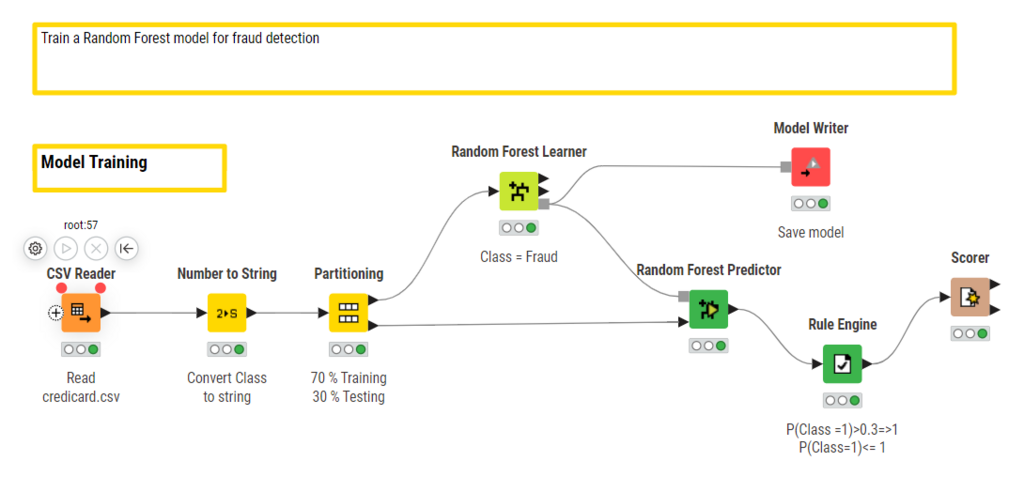
One of the most common methods is supervised learning. Think of it like training a new detective with a stack of old case files. You show the AI thousands of past transactions, each one clearly labeled as either 'fraudulent' or 'legitimate'.
The AI analyzes this labeled data, learning the characteristics associated with each label. It might discover that fraudulent transactions often occur at unusual hours, originate from new locations, or involve atypical purchase amounts. Over time, the model builds an understanding of what fraud looks like based on historical examples. Once trained, it can apply this knowledge to new, incoming transactions and predict whether they are likely to be fraudulent.
AI and machine learning are revolutionizing risk assessment in finance by analyzing large datasets to identify potential risks and forecast future challenges.
Finding the Odd One Out
But what happens when fraudsters invent a completely new type of scam? A supervised model trained on old data might miss it entirely. This is where unsupervised learning becomes crucial. Instead of relying on labeled data, this approach looks for anomalies.
An unsupervised model analyzes a dataset to learn the structure of 'normal' activity. It groups similar transactions together into clusters. Any transaction that doesn't fit neatly into these clusters is flagged as a potential outlier. It's like spotting a single penguin in the middle of the Sahara desert. You might not know exactly what a penguin is, but you know it doesn't belong there. This method is powerful for detecting novel and emerging fraud tactics that have never been seen before.
Learning from Experience
Reinforcement learning takes a different approach, one that mimics how humans learn from trial and error. In this setup, an AI 'agent' actively participates in the fraud detection process. For each transaction, the agent decides whether to approve, block, or flag it for review.
After its decision, it receives feedback. If it correctly blocks a fraudulent transaction, it gets a 'reward'. If it incorrectly blocks a legitimate one, it receives a 'penalty'. The agent's goal is to maximize its total reward over time. This continuous feedback loop allows the system to adapt its strategy in real-time, learning from its mistakes and becoming more effective as it encounters new fraud patterns.
| AI Technique | How It Works | Best For |
|---|---|---|
| Supervised Learning | Learns from data labeled as 'fraud' or 'not fraud'. | Detecting known types of fraud with high accuracy. |
| Unsupervised Learning | Identifies unusual data points that don't fit normal patterns. | Finding new, never-before-seen fraud tactics. |
| Reinforcement Learning | An agent learns by taking actions and receiving rewards or penalties. | Adapting to evolving fraud strategies in real-time. |
By combining these techniques, financial institutions can build robust, multi-layered defense systems. An unsupervised model might first flag a strange new transaction, which is then analyzed by a supervised model trained on similar past anomalies. This adaptability is what makes AI such a powerful ally in the ongoing fight against financial crime.
Why are traditional, rule-based fraud detection systems often less effective than AI-powered systems?
Which type of AI model requires a large dataset of historical transactions that have been explicitly labeled as either 'fraudulent' or 'legitimate' to learn?