AI Driven Product Design for Senior UI UX Specialists
Strategy and Outcomes
From Pixels to Product Strategy
With years of design experience, you've mastered the 'how' of creating intuitive user interfaces. The next step in your career is to master the 'why'. This means shifting your focus from design execution to product strategy. It's not about abandoning your design skills, but augmenting them with a new way of thinking: Product Thinking.
Design Thinking is user-centric. It revolves around empathy, ideation, and prototyping to solve user problems. Product Thinking is business-centric. It asks how solving that user problem creates a sustainable, successful business. A senior designer operates where these two mindsets intersect, ensuring that beautiful, usable designs also drive meaningful business results.
Product Thinking doesn't replace Design Thinking. It provides the strategic context that makes your design work more impactful.
Speaking the Language of Business
To align your work with business goals, you need to understand the metrics that define success. Instead of focusing solely on usability scores or completion rates, strategic designers track how their work influences the bottom line. Four key metrics are crucial:
| Metric | What It Measures | How Design Influences It |
|---|---|---|
| LTV (Lifetime Value) | The total revenue a business can expect from a single customer account. | A seamless, valuable user experience encourages customers to stay longer and spend more. |
| CAC (Customer Acquisition Cost) | The cost of winning a new customer. | An intuitive onboarding flow reduces the need for costly marketing and support to get users started. |
| NPS (Net Promoter Score) | Customer loyalty and satisfaction. | A delightful and reliable product experience turns users into advocates who recommend your product to others. |
| Retention | The percentage of customers who continue using your product over time. | Features that solve real problems and are easy to use give customers a reason to come back. |
Understanding these numbers helps you frame your design decisions in terms of business impact. You're not just 'improving the dashboard'; you're 'designing an experience to increase user retention by making core data more accessible'.
The Evolved Design Process
The Double Diamond framework is a classic model for the design process: Discover, Define, Develop, and Deliver. But today, this process is being supercharged by AI, creating what we can call 'Double Diamond 2.0'.
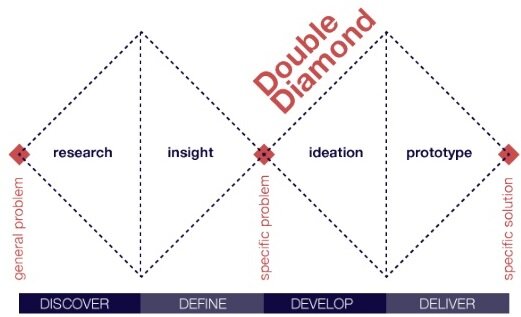
In this updated model, AI acts as a strategic partner, especially in the first diamond. You can use tools like ChatGPT or Claude to accelerate discovery and definition. Instead of spending weeks on initial market research, you can generate comprehensive summaries in minutes. You can simulate user personas, brainstorm feature ideas based on competitor analysis, and draft user journey maps to quickly explore the problem space.
This doesn't replace deep user research; it augments it. AI helps you form stronger hypotheses faster, so when you do engage in user interviews or testing, your questions are more targeted and insightful. You're using AI to handle the broad initial exploration, freeing you up to focus on the nuanced human insights that lead to breakthrough designs.
Connecting Design to the Business Model
The most effective product strategy starts with the business itself, not with a blank wireframe. The Business Model Canvas is a tool that outlines the foundational blocks of a business, such as customer segments, value propositions, and revenue streams. As a designer, understanding this canvas is key to ensuring your work is strategically aligned.
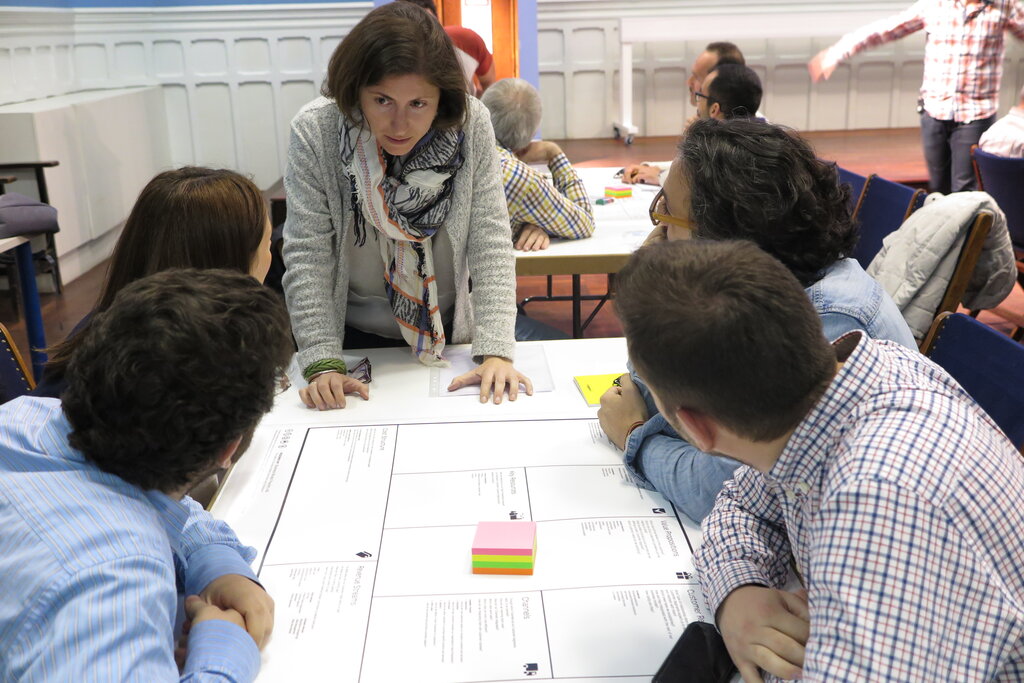
Instead of waiting for a feature request, you can proactively identify opportunities. By looking at the Business Model Canvas, you might ask: 'How can our design better serve this underserved customer segment?' or 'Can we simplify the user journey to lower our operational costs?'
This leads to a new starting point: the 'Product-Market Fit' hypothesis. Before you design anything, you state a clear, testable assumption about your users, the value you provide, and the business outcome. You can use AI to help draft and refine these hypotheses, simulating market scenarios and potential user objections.
# Prompt for Claude to draft a hypothesis

"Act as a senior product strategist. Our company offers a project management tool for small creative agencies (our Customer Segment). Our current value proposition is 'all-in-one collaboration.' The Business Model Canvas shows a weakness in our Revenue Streams, as we have high churn after the first year.

Draft three distinct product-market fit hypotheses that propose a new design-led feature to improve long-term retention. For each hypothesis, define the user problem, the proposed solution, and the key metric we would use to measure success."
Using this approach, every design project begins with a clear strategic purpose. The focus shifts from the output (a wireframe) to the outcome (a measurable impact on a business goal). Now, let's test your understanding of these strategic concepts.
What is the primary distinction between Design Thinking and Product Thinking?
A design team is tasked with increasing the average monthly spending of users within their app. Which key business metric are they directly trying to influence?
By integrating Product Thinking, business metrics, and strategic frameworks into your process, you elevate your role from a designer to a product leader who shapes not just interfaces, but outcomes.