AI Development Machine Learning and Computer Vision
Introduction to AI
What Is Artificial Intelligence?
Artificial intelligence is the science of making machines that can think and act like humans. The goal is to create systems that can perform tasks that typically require human intelligence, such as understanding language, recognizing patterns, and solving problems.
Think of it this way: a simple calculator can perform complex math, but it only follows pre-programmed rules. An AI, on the other hand, can learn and adapt. It might learn to identify cats in photos not because a programmer wrote specific rules for what a cat looks like, but because it has analyzed thousands of cat photos and identified the patterns itself.
A Brief History
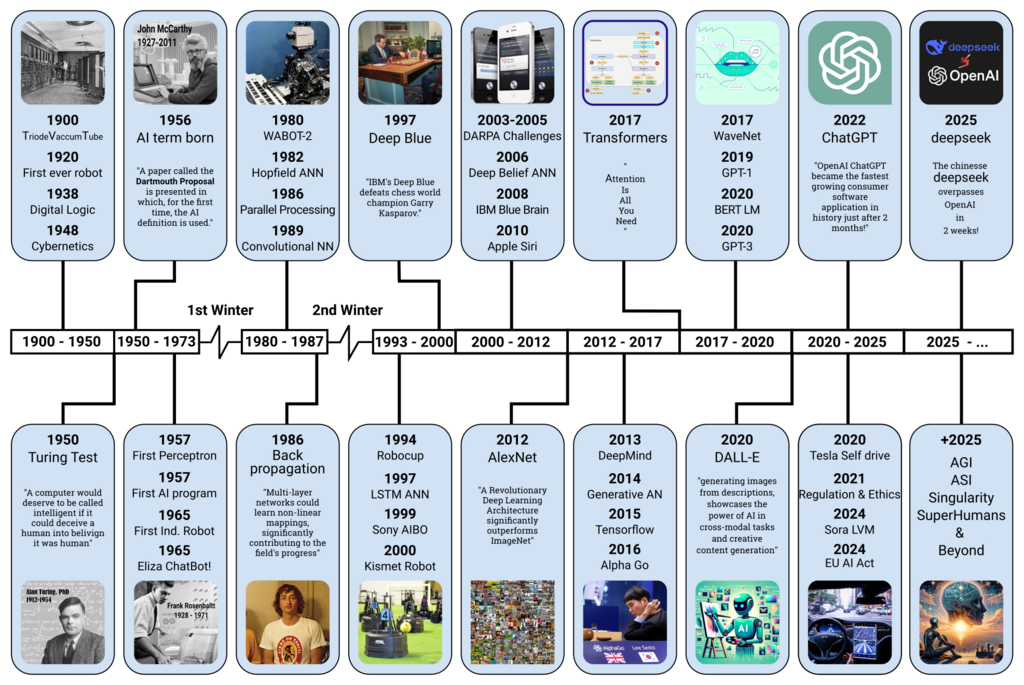
The term "Artificial Intelligence" was first coined in 1956 at a workshop at Dartmouth College. Early researchers were incredibly optimistic, believing that a machine as intelligent as a human being was just a few decades away. This initial excitement was followed by periods known as "AI winters," when progress stalled and funding dried up.
The last couple of decades have seen a massive resurgence. Why? Two main reasons: the availability of huge amounts of data (thanks to the internet) and the development of powerful, fast computers. These two ingredients are the fuel that powers modern AI.
AI's Family Tree
AI isn't just one thing; it's a broad field with many specialized areas. Think of it like biology, which has subfields like genetics, botany, and zoology. Some of the major branches of AI include:
| Subfield | Focus |
|---|---|
| Machine Learning | Systems that learn from data to make predictions or decisions. |
| Natural Language Processing (NLP) | Enabling computers to understand and process human language. |
| Computer Vision | Allowing machines to "see" and interpret visual information. |
| Robotics | Building physical agents that can move and perform tasks in the real world. |
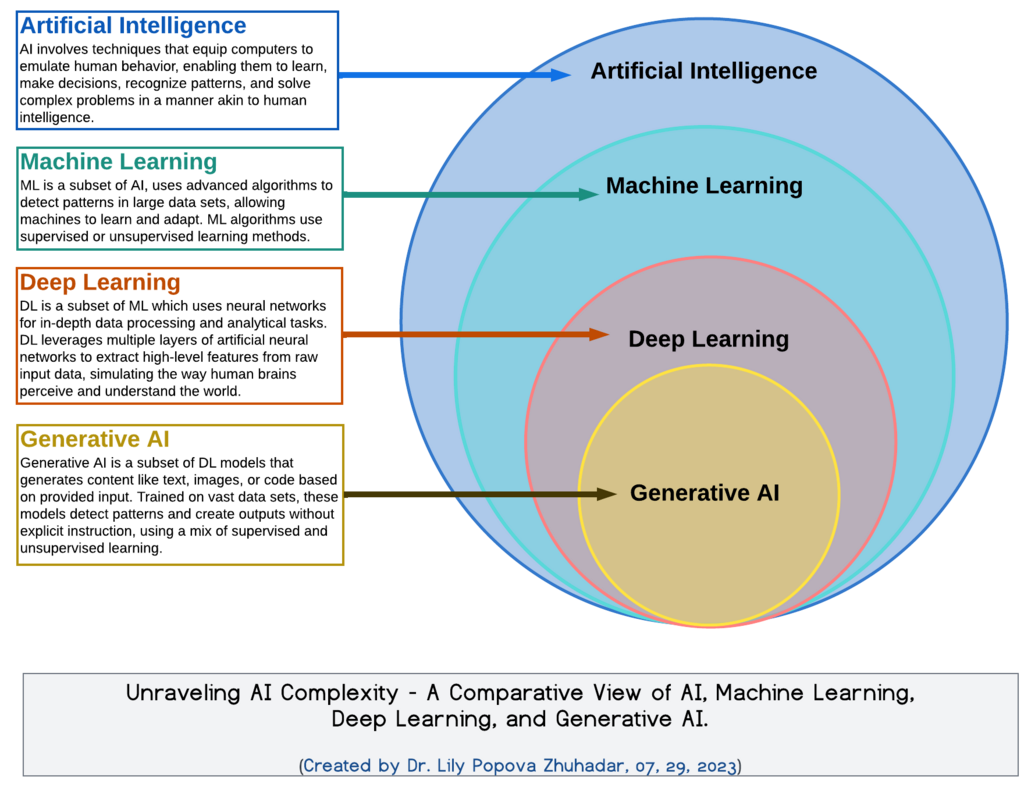
You'll often hear the terms AI, Machine Learning, and Deep Learning used interchangeably, but they have distinct meanings. It's best to think of them as nested concepts, with each one being a subset of the one before it.
Artificial Intelligence
noun
The overarching field focused on creating machines capable of intelligent behavior.
Machine Learning (ML) is a subset of AI. It's the most common approach to AI today. Instead of programming a computer with explicit rules for a task, machine learning involves training a model on a large dataset. The model learns the patterns in the data and can then make predictions about new, unseen data.
Machine Learning
noun
A subset of AI where algorithms are trained on data to find patterns and make predictions.
Deep Learning is a subset of machine learning. It uses complex, multi-layered structures called artificial neural networks, which are loosely inspired by the human brain. Deep learning has been the driving force behind recent breakthroughs in areas like image recognition and natural language processing. It's particularly good at finding very complex patterns in massive datasets.
So, all deep learning is machine learning, and all machine learning is AI. But not all AI uses machine learning, and not all machine learning uses deep learning.
Now, let's test what you've learned.
What is the primary goal of Artificial Intelligence?
Which of the following best describes the relationship between Artificial Intelligence (AI), Machine Learning (ML), and Deep Learning (DL)?