AI Creation Fundamentals
Introduction to Artificial Intelligence
What Is Artificial Intelligence?
At its heart, artificial intelligence is the science of making machines smart. It's a field of computer science dedicated to creating systems that can perform tasks that typically require human intelligence. This includes things like learning from experience, understanding language, recognizing objects, solving problems, and making decisions.
Artificial Intelligence
noun
A field of computer science focused on creating systems capable of performing tasks that normally require human intelligence, such as visual perception, speech recognition, decision-making, and translation between languages.
Think about how you recognize a friend's face in a crowd, or how you learn the rules of a new board game. AI aims to replicate these abilities in machines. It's not about creating a mechanical human, but about building tools that can perceive, reason, and adapt.
A Brief History
The dream of intelligent machines is ancient, but the formal field of AI research began in the mid-20th century. The term "artificial intelligence" was officially coined in 1956 at a conference at Dartmouth College. Early researchers were incredibly optimistic, believing that a machine as intelligent as a human being was only a generation away.
Progress came in waves. The early years saw breakthroughs in problem-solving and game playing. Then came the "AI winter" in the 1970s and 80s, when funding dried up due to slow progress and unmet expectations. But the field re-emerged, fueled by more powerful computers and new approaches. In 1997, IBM's Deep Blue chess computer defeated the world champion, a major milestone that captured public attention. The 21st century has seen an explosion in AI, driven by the availability of massive datasets and advancements in machine learning.

The Three Types of AI
When we talk about AI, we're not talking about one single thing. AI can be categorized into three main types based on its capabilities. Understanding these distinctions is key to understanding what AI can do today and what it might do tomorrow.
Artificial Narrow Intelligence (ANI): This is the AI we have today. ANI is designed to perform a specific, narrow task. Your smartphone's voice assistant, the recommendation engine on a streaming service, and a self-driving car are all examples of Narrow AI. They can be incredibly good at their one job, sometimes even better than humans, but they can't operate outside of that specific domain.
ANI is powerful and has thousands of applications, from medical diagnosis to financial trading. It's the engine behind most of the AI technology you interact with daily.
Artificial General Intelligence (AGI): This is the next frontier. AGI refers to a machine with the ability to understand, learn, and apply knowledge in a way that is indistinguishable from a human being. An AGI could switch between tasks as different as cooking a meal, writing a novel, and solving a complex scientific problem without being reprogrammed. We are not there yet; AGI remains the stuff of science fiction and a long-term goal for many researchers.
The challenge of creating AGI is immense, as it requires not just raw computing power but also a deep understanding of consciousness and general reasoning.
Artificial Superintelligence (ASI): This is a hypothetical future stage where AI surpasses human intelligence across virtually every field, from scientific creativity and general wisdom to social skills. The concept of ASI raises profound questions about the future of humanity and our relationship with technology. It's a topic of both excitement and serious debate among scientists and ethicists.
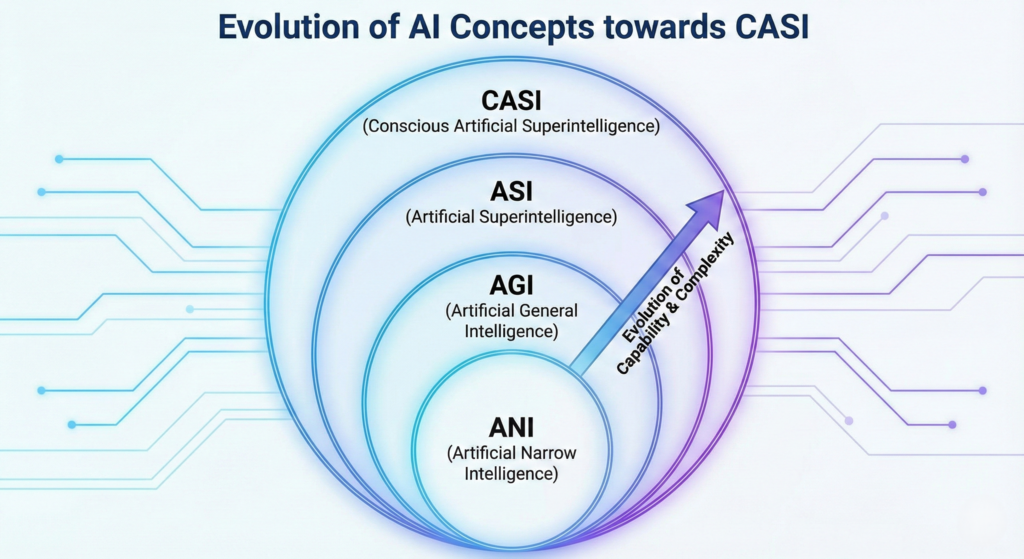
As we move forward, the line between these categories may blur, but for now, they provide a useful map of the AI landscape.
Ready to check your understanding?
What is the primary goal of the field of artificial intelligence?
The term "artificial intelligence" was officially coined at a conference held at which institution?
From its early days of theory to its current practical applications, AI is a field that is constantly evolving, shaping our world in countless ways.