AI Contextual Understanding
Introduction to AI Context
What is Context?
If you tell a friend, "I'm running late," they understand what you mean. They know where you're supposed to be, what time it is, and who you're meeting. That surrounding information is context. Without it, your statement is just a fact with no real meaning.
Artificial intelligence needs context, too. For an AI, context is any data that helps it understand a user's request and the world around it. This could be the previous messages in a chat, your location, the time of day, or your past preferences. It's the difference between a generic answer and a genuinely helpful one.
Context turns a simple query into a specific task. It provides the who, what, where, when, and why for an AI.
Think of a smart home assistant. If you say "turn on the lights," it needs context to be useful. Is it morning or evening? Which room are you in? A context-aware assistant knows you're in the kitchen and it's 7 PM, so it turns on the kitchen lights, not the bedroom lights.
Why Context Matters
Context is what separates a simple calculator from an intelligent partner. A basic program can answer a direct question, but it can't handle a conversation. It treats every new input as a brand new problem.
AI models use context to build on previous interactions, making them more efficient and accurate. Imagine trying to book a trip with a travel bot that has no memory. You'd have to repeat your destination, dates, and budget with every single message. Context allows the AI to remember those details, leading to a smooth, natural conversation.
Clear, specific, contextually-rich prompts ensure that AI can provide accurate and relevant responses, making interactions more efficient and effective.
Without context, AI is just a pattern-matching machine. It can find information that looks like what you asked for. With context, it can begin to understand your intent and become a true problem-solver.
The Challenge of Forgetting
Maintaining context isn't easy for an AI. Many models have a limited
context window
noun
The amount of recent information an AI model can remember and consider when generating a response.
Think of it like a person's short-term memory. It can hold onto the last few pieces of a conversation, but in a very long discussion, it might forget details from the beginning. This is why an AI might ask a question you've already answered or lose track of the original goal.
When a model's context window is full, older information is pushed out to make room for new data. This can lead to conversations that drift off-topic or give answers that contradict earlier statements. Managing this memory limitation is one of the biggest challenges in AI development.
Context in Action
When AI systems use context effectively, they can feel almost magical. Here are a few examples of context-aware systems at work:
-
Personalized Recommendations: Streaming services like Netflix and Spotify don't just recommend what's popular. They use the context of your viewing and listening history to suggest things you'll personally enjoy.
-
Smarter GPS: A navigation app uses your current location, traffic conditions, and time of day (the context) to find the fastest route. It understands that the best way to get across town at 5 PM is different from the best way at 3 AM.
-
Helpful Chatbots: A customer service bot for an online store can use the context of your browsing history and past purchases to provide relevant help. It knows you were just looking at running shoes, so it's ready to answer questions about sizing or shipping for that specific product.
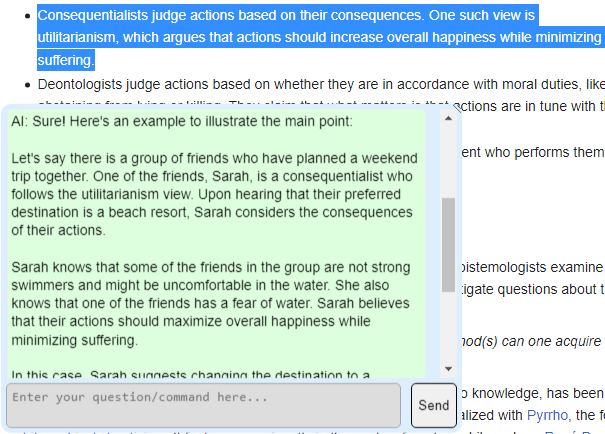
In each case, the AI isn't just responding to a command. It's using a rich set of contextual information to anticipate needs and provide a more relevant, personalized experience.
Ready to check your understanding?
In the realm of Artificial Intelligence, what is the best definition of "context"?
An AI model's limited "context window" is most similar to which human cognitive function?
Understanding context is the first step in learning how to communicate effectively with AI. By providing clear, relevant information, you help the model move beyond simple answers to deliver truly intelligent results.