AI Concepts Demystified
Introduction to Artificial Intelligence
What Is AI Anyway?
Artificial intelligence is about making machines smart. Think about how you learn. You recognize faces, understand language, and solve problems. AI is the science of teaching computers to do those same things, and more. It's a broad field in computer science that aims to create systems that can perform tasks that normally require human intelligence.
Artificial intelligence (AI) is a branch of computer science and engineering that focuses on building machines that are capable of learning, solving problems, making decisions, and all other functions that are performed traditionally by the human intellect.
Instead of being explicitly programmed for every single task, an AI system learns from data. It identifies patterns and makes decisions, improving its performance over time. This ability to learn is what makes AI so powerful and versatile.
The Three Levels of AI
Not all AI is created equal. Scientists and researchers generally categorize AI into three types based on its capabilities. Understanding these distinctions is key to understanding where AI is today and where it might be headed.
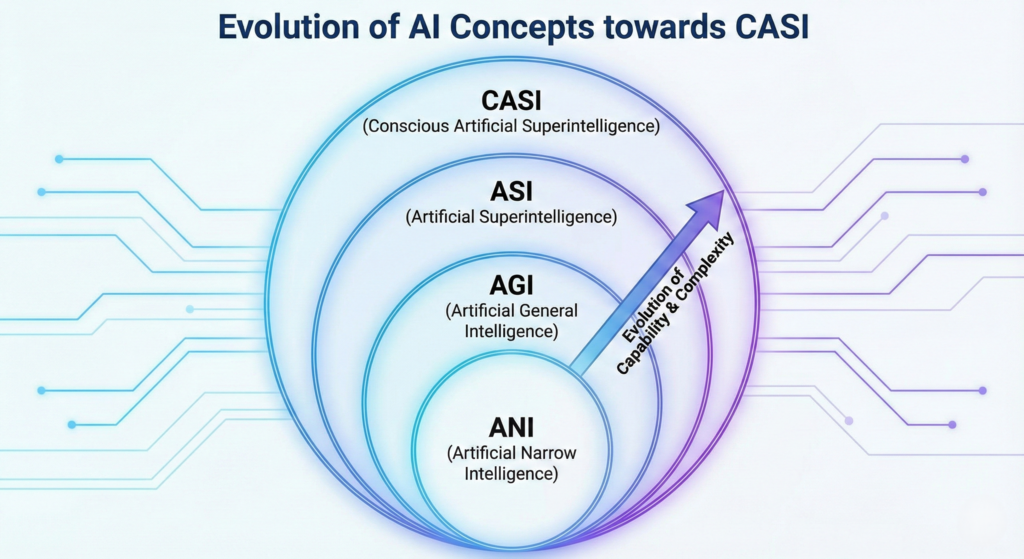
The first level is Artificial Narrow Intelligence (ANI), sometimes called Weak AI. This is the only type of AI we have successfully created so far. ANI is designed to perform a single, specific task. It can be incredibly good at that one thing, often better than humans, but it can't operate outside its designated function.
Think about the AI you interact with daily. The recommendation engine that suggests what to watch next, the virtual assistant on your phone, or the software that filters spam from your email are all examples of ANI. They are specialists, not generalists.
ANI is a master of one trade. It can beat the world champion at chess but can't tell you how to boil an egg.
The next level is Artificial General Intelligence (AGI), or Strong AI. This is the kind of AI you often see in movies. AGI would possess the ability to understand, learn, and apply its intelligence to solve any problem, much like a human being. It would have consciousness, self-awareness, and the ability to think abstractly and creatively.
Building an AGI is the ultimate goal for many AI researchers, but it remains a massive challenge. We are not there yet. An AGI could switch from writing a novel to composing a symphony to designing a bridge, all with the same level of competence as a human expert in each field.
Finally, there's Artificial Superintelligence (ASI). This is a hypothetical form of AI that would surpass human intelligence in every conceivable way. An ASI wouldn't just be smarter than the smartest human; its cognitive abilities would be so far beyond ours that we might not even be able to comprehend them.
This type of intelligence could solve humanity's biggest problems, from disease to climate change. However, it also raises profound questions about control and safety that are actively debated by philosophers and scientists.
Why AI Matters
Even in its current "narrow" form, AI is already transforming our world. Its significance comes from its ability to process vast amounts of data and automate complex tasks, leading to breakthroughs and efficiencies across many industries.
In healthcare, AI helps doctors diagnose diseases earlier and more accurately by analyzing medical images like X-rays and MRIs. It also powers the discovery of new drugs by sifting through massive biological datasets.
In finance, AI algorithms detect fraudulent transactions in real-time and help manage investment portfolios by predicting market trends. They make our financial systems faster and more secure.
In transportation, AI is the brain behind self-driving cars, which have the potential to make roads safer and travel more efficient. It also optimizes logistics, ensuring that packages are delivered as quickly as possible.
Entertainment is personalized by AI, with streaming services learning your preferences to recommend movies and music you'll love. It’s also used in creating visual effects for movies and developing more realistic video game characters.
These examples are just the beginning. As AI technology continues to develop, its role in our daily lives and in solving global challenges will only grow.
Ready to check your understanding? Let's see what you've learned about the fundamentals of AI.
What is the fundamental difference between an AI system and a traditional computer program?
The recommendation engine on a streaming service suggests movies based on your viewing history. What type of AI is this an example of?
AI is a foundational technology that's reshaping how we live and work. By understanding what it is, its different forms, and its current applications, you're better equipped to navigate the future.