AI Capabilities Explained
Introduction to Large Language Models
What Are Large Language Models?
A large language model, or LLM, is a type of artificial intelligence trained on a massive amount of text data. Think of it like a student who has read a colossal library—every book, article, and website. By analyzing all this information, the LLM learns the patterns, rules, and nuances of human language. Its primary purpose is to understand and generate text in a way that feels natural and coherent.
This ability allows them to perform a wide range of tasks, from answering questions and summarizing articles to writing code and translating between languages. They don't "understand" in the human sense, but they are incredibly skilled at predicting the next most likely word in a sequence, which is the foundation of their capabilities.
At their core, LLMs are prediction engines for language.
A Brief History
The journey to today's powerful LLMs was a long one. Early language models were statistical. They looked at short sequences of words, called n-grams, to predict the next word. For example, after seeing "a rolling stone," an n-gram model might predict "gathers," because that sequence is common. These models were useful but had a very short memory. They couldn't grasp the context of a long paragraph.
Later, recurrent neural networks (RNNs) improved on this by creating a kind of memory loop, allowing information to persist. This was a step forward, but they still struggled to remember context over long sentences. It was like trying to remember the beginning of a long story by the time you reached the end.
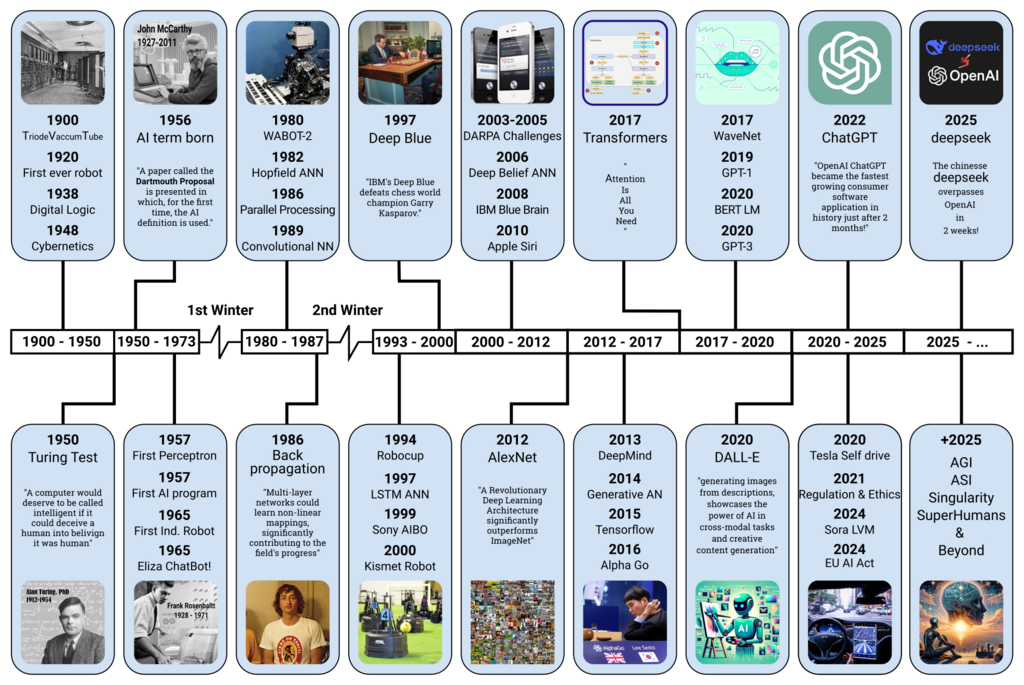
The real game-changer arrived in 2017 with a new architecture that would become the foundation for nearly all modern LLMs.
The Transformer Breakthrough
The 2017 paper "Attention Is All You Need" introduced the transformer architecture. Its key innovation was the attention mechanism. Instead of processing words one by one in a strict sequence, the attention mechanism allows the model to weigh the importance of all other words in the input when processing a single word.
Imagine reading the sentence: "The robot picked up the heavy metal screw with its metal claw." To understand the second "metal," you need to pay attention to "claw," not the first "metal" which describes the screw. The attention mechanism does exactly that. It learns which words are most relevant to one another, regardless of their distance in the text.
The Transformer architecture has revolutionized the Natural Language Processing field and is the backbone of Large Language Models (LLMs).
This parallel processing capability made transformers incredibly efficient. They could be trained on much larger datasets than previous models, leading directly to the creation of truly "large" language models.
Why LLMs Matter
The rise of LLMs marks a significant turning point in natural language processing (NLP), the field of AI focused on enabling computers to understand and process human language. Before LLMs, NLP tasks like translation, summarization, and sentiment analysis each required a separate, specially trained model.
LLMs changed this. Because of their vast training, a single LLM can perform many different tasks with little to no task-specific training. This versatility has unlocked a wave of new applications and made advanced language AI accessible to a much wider audience, fundamentally changing how we interact with information and technology.
At its core, what is the primary mechanism an LLM uses to generate human-like text?
What was the key innovation of the transformer architecture, introduced in the 2017 paper "Attention Is All You Need"?
This foundational knowledge sets the stage for understanding how specific models like GPT-4 work and what makes them so capable.