AI Automation Explained
Introduction to AI and Automation
Starting with the Basics
Let's start with a simple idea. Artificial Intelligence, or AI, is the science of making machines that can think or act like humans. This doesn't mean creating robots that look like us. It's about giving computers the ability to learn, reason, solve problems, and understand language.
Intelligence
noun
The ability to acquire and apply knowledge and skills.
Now, what about automation? It’s a related but different concept. Automation is about making a system or process operate automatically, without human input. Think of a factory assembly line where robots perform the same task over and over. That's classic automation. It follows a pre-set list of instructions perfectly every time.
Automation is about following rules. AI is about creating rules and making judgments.
The key difference lies in flexibility. Traditional automation is rigid. If something unexpected happens, the system stops or makes an error. AI, on the other hand, can adapt. It can analyze a new situation and decide on the best course of action, much like a person would.
A Brief History of Thinking Machines
The dream of AI isn't new. For centuries, people have imagined creating artificial beings with intelligence. But the real journey began in the mid-20th century with the invention of the computer. The term "Artificial Intelligence" was first coined at a workshop at Dartmouth College in 1956. Early researchers were incredibly optimistic, believing that a machine with human-like intelligence was just a few decades away.
This early work, often called "Symbolic AI," was based on the idea that human thought could be broken down into logical rules. Researchers tried to program computers with all the rules needed to understand the world. It was a good start, but the real world is messy and has too many exceptions for a simple set of rules.
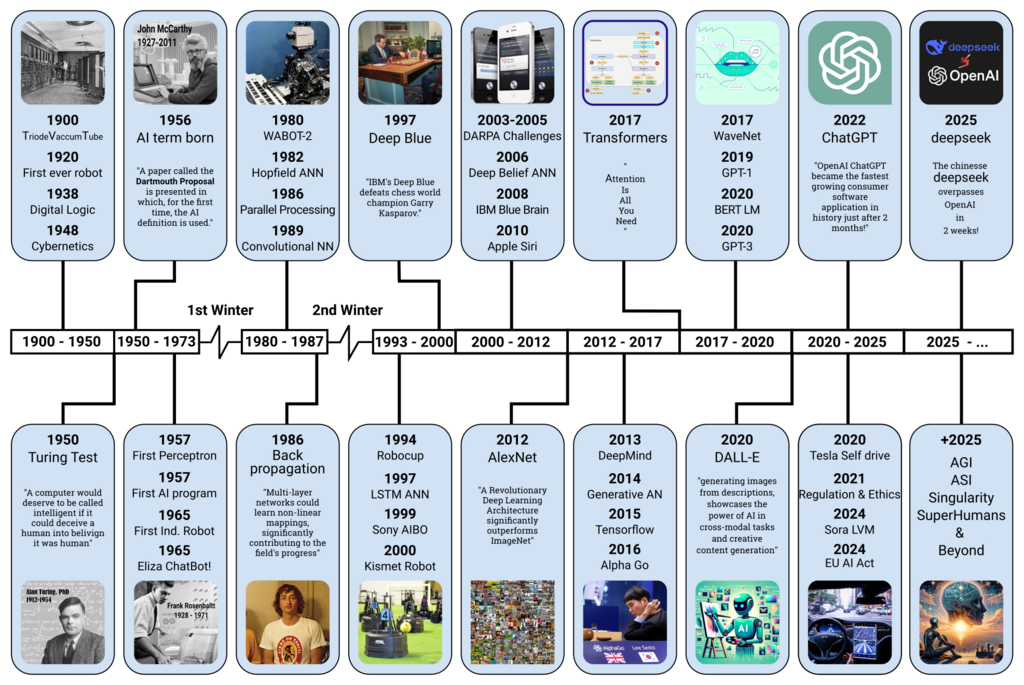
Progress slowed in the 1970s and 80s, a period sometimes called the "AI winter." But things picked up again with the rise of a new approach: machine learning. Instead of trying to teach computers every rule, developers started creating systems that could learn the rules themselves by analyzing huge amounts of data. This shift, powered by faster computers and the internet's explosion of data, is what led to the AI we see today.
How AI Works
So, how does an AI learn? At its heart, modern AI is about pattern recognition. The core principle is to feed a system vast quantities of examples. If you want an AI to recognize pictures of cats, you show it thousands of cat photos. The system, known as a model, adjusts itself to identify the common features in all those pictures.
This introduction to this special issue discusses artificial intelligence (AI), commonly defined as “a system’s ability to interpret external data correctly, to learn from such data, and to use those learnings to achieve specific goals and tasks through flexible adaptation.”
This learning process can take a few different forms:
- Supervised Learning: The AI is given labeled data. For our cat example, each picture would be tagged "cat." This is like learning with a teacher who provides the right answers.
- Unsupervised Learning: The AI is given unlabeled data and must find patterns on its own. It might group photos into different clusters without knowing one cluster is "cats" and another is "dogs."
- Reinforcement Learning: The AI learns by trial and error. It's rewarded for correct actions and penalized for incorrect ones, like teaching a dog a new trick with treats.
These principles allow AI to perform tasks that were once thought to be exclusively human, from translating languages to composing music.
AI and Automation Working Together
This brings us back to automation. When you combine AI with automation, you get something much more powerful than either one alone. Instead of a robotic arm that only welds in one specific spot, you can have an arm that uses computer vision (a type of AI) to see where the weld is needed and adapt to slight changes in each part.
This combination creates systems that are both efficient and intelligent. They can handle not just repetitive work, but also complex and unpredictable situations. This is the true power of AI in the modern world: making automation smarter, more flexible, and more capable.
What is the primary difference between Artificial Intelligence and traditional automation?
The term 'Artificial Intelligence' was first coined at a workshop in 1956 held at which institution?